
Caring for Loved Ones, Getting Paid: Exploring Family Caregiver Grant Opportunities

What Are Family Caregiver Grants and How Can They Help You?
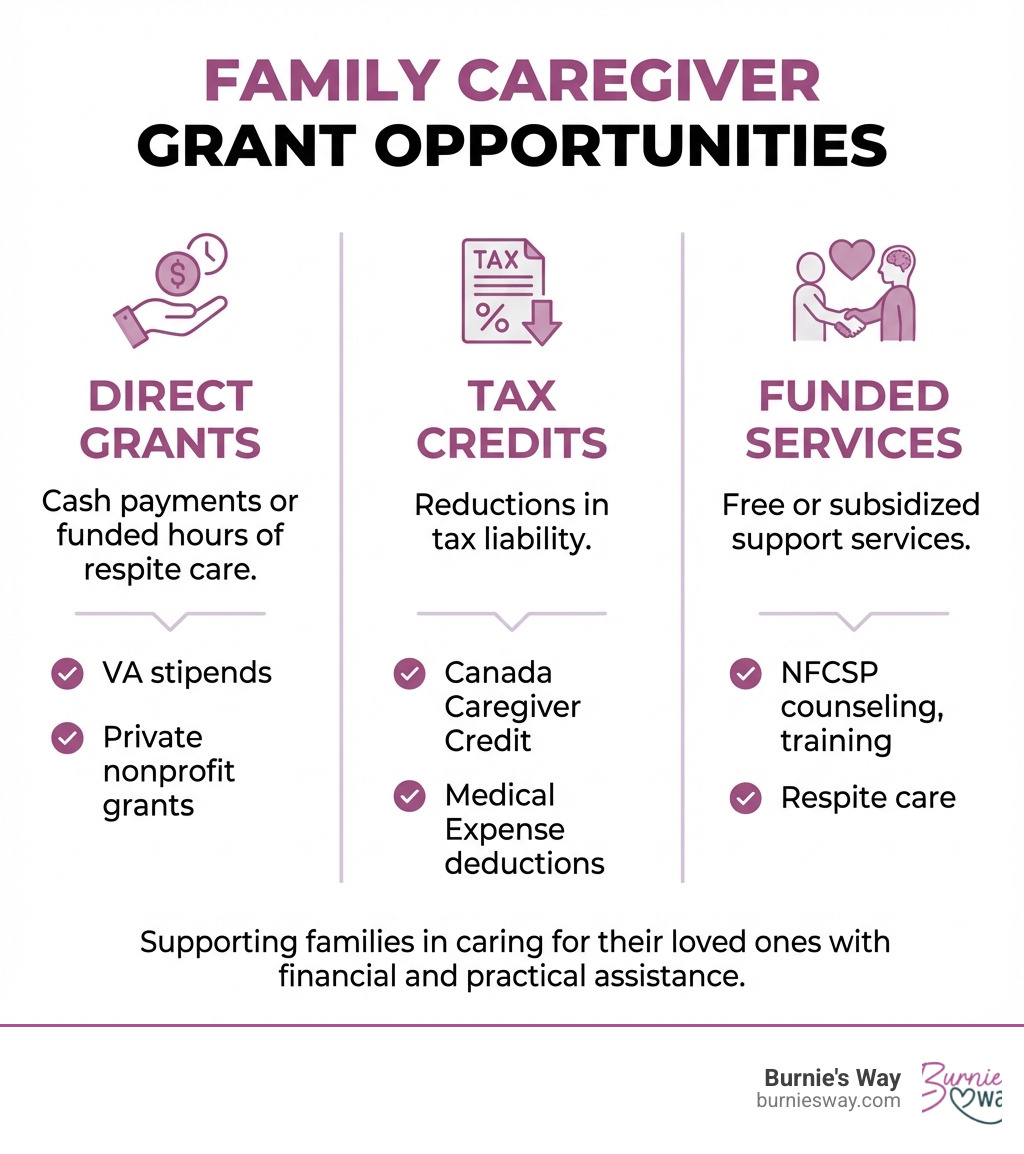
Family caregiver grants are financial assistance programs that help families offset the costs and burdens of caring for aging or disabled loved ones at home. These grants come from federal, state, and private sources, and they can provide direct payments, tax relief, or funded services like respite care and counseling.
Quick Answer: Types of Family Caregiver Grants Available
- Federal Programs - National Family Caregiver Support Program (NFCSP) provides respite care, counseling, and supplemental services worth $300-$600 annually
- Veteran Programs - Program of Comprehensive Assistance for Family Caregivers (PCAFC) offers monthly stipends, health insurance, and training
- State Programs - Medicaid self-directed care and state-specific assistance (varies by location)
- Private Grants - Disease-specific organizations and nonprofits offer respite care grants (50 hours to 6 months)
- Tax Credits - Canada Caregiver Credit and other deductions reduce tax burden
If you're among the more than 770,000 people in Maryland alone providing unpaid care to aging family members, you already know the toll it takes. Most caregivers work full-time jobs while managing medications, appointments, and daily support. The financial strain is real, and the emotional weight can be crushing.
As former First Lady Rosalynn Carter once said: "There are only four kinds of people in this world: Those who have been caregivers; those who currently are caregivers; those who will be caregivers; and those who will need caregivers."
The good news? You don't have to shoulder this burden alone or unpaid. Various grant programs exist specifically to support family caregivers like you. These programs recognize that in FY 2014, over 700,000 caregivers received services through federal programs alone, with 74% reporting these services enabled them to provide care longer than would have been possible otherwise.
This guide will walk you through the types of grants available, who qualifies, and exactly how to apply. Whether you're caring for a parent with dementia, a veteran spouse, or an aging relative, there's likely financial support waiting for you.
Understanding the Main Types of Caregiver Funding
Navigating the landscape of family caregiver grants can feel like a maze, but we're here to help you find the right path. Generally, funding opportunities for family caregivers in the United States fall into three main categories: federally-funded programs, veteran-directed programs, and private or non-profit grants. Each offers unique benefits and has specific eligibility requirements. Understanding these distinctions is your first step toward securing the support you need.

Federally-Funded Programs
The most prominent federally-funded initiative for family caregivers is the National Family Caregiver Support Program (NFCSP). This program, authorized by the Older Americans Act, provides grants to states and territories based on their share of the population aged 70 and over. These states then use the funds to offer crucial services to family and informal caregivers, helping them keep older adults in their homes for as long as possible.
The NFCSP recognizes the vital role family caregivers play in our long-term services and support system. In fact, studies show that NFCSP services can significantly reduce caregiver depression, anxiety, and stress, enabling them to provide care longer and potentially delaying the need for institutionalization. In FY 2014 alone, over 700,000 caregivers received services through the NFCSP.
What services are covered?
NFCSP-funded programs typically provide five core services:
- Information: Helping caregivers learn about available services.
- Access Assistance: Guiding caregivers to connect with services.
- Counseling, Support Groups, and Training: Offering emotional support, peer connection, and practical skills. In FY 2014, over 100,000 caregivers received these services.
- Respite Care: Providing temporary relief from caregiving duties. More than 604,000 caregivers received nearly 6 million hours of respite care in FY 2014.
- Supplemental Services: These are provided on a limited basis and can include non-emergency financial assistance for things like housing improvements, chores, or medical supplies. This assistance is often limited to $300-$600 per person annually.
Who is eligible?
Eligibility for NFCSP services is quite broad and includes:
- Adult family members or other informal caregivers providing care to individuals 60 years of age and older.
- Adult family members or other informal caregivers providing care to individuals of any age with Alzheimer’s disease and related disorders.
- Older relatives (not parents) aged 55 and older providing care to children under 18.
- Older relatives, including parents, aged 55 and older providing care to adults aged 18-59 with disabilities.
It’s worth noting that 74% of caregivers reported that NFCSP services enabled them to provide care longer than would have been possible otherwise, and 88% said the services helped them to be a better caregiver. Almost 62% indicated that without these services, their loved one would be in a nursing home.
To find out more about this essential program, we encourage you to visit The National Family Caregiver Support Program website. You can also contact your local Area Agency on Aging (AAA) or use the Eldercare Locator to find services in your community.
Veteran-Directed Programs
For those caring for a United States military veteran, the Department of Veterans Affairs (VA) offers specific and robust support, most notably through the Program of Comprehensive Assistance for Family Caregivers (PCAFC). This program provides comprehensive assistance to eligible family caregivers of veterans with serious injuries or illnesses.
What benefits are covered?
The PCAFC can offer significant support, including:
- A monthly stipend: This financial payment is based on the level of care needed by the veteran.
- Health insurance: Eligible caregivers may receive health insurance through the Civilian Health and Medical Program of the Department of Veterans Affairs (CHAMPVA).
- Caregiver training: Essential education and resources to help caregivers effectively manage their loved one's needs.
- Mental health services and counseling: Support for the caregiver's own well-being.
- Travel benefits: When traveling with the veteran to appointments.
Who is eligible?
Eligibility for PCAFC requires that the veteran has a serious injury or illness incurred or aggravated in the line of duty on or after September 11, 2001, OR on or before May 7, 1975. The program covers both a primary family caregiver and up to two secondary family caregivers, allowing for shared responsibility and support.
The application process for PCAFC is unique in that it requires both the veteran and the family caregiver to apply together. We’ll dig into the specifics of this process later in this guide. For more detailed information, please refer to The Program of Comprehensive Assistance for Family Caregivers website.
Private and Non-Profit Grants
Beyond government programs, a variety of private organizations and non-profits offer family caregiver grants, often focusing on specific conditions or needs. These grants frequently aim to provide respite care, recognizing the critical importance of breaks for caregivers' physical and mental health.
A notable example is the collaboration between HFC® (formerly Hilarity for Charity) and the Home Instead® network. They work together to award home care grants specifically for those providing care to loved ones living with Alzheimer’s disease or other dementias. These grants typically provide hours of professional in-home care services, rather than direct cash payouts, giving caregivers a much-needed opportunity to rest and recharge.
These types of grants are invaluable because they provide direct services that can be difficult to afford otherwise. They help alleviate the intense demands of caregiving, allowing family caregivers to maintain their own well-being while ensuring their loved ones receive quality care.
Your Step-by-Step Guide to Applying for Family Caregiver Grants
Applying for family caregiver grants might seem daunting, but by breaking it down into manageable steps, we can steer the process together. Preparation is key, and with the right information, you can significantly increase your chances of success.

Step 1: Identify Your Needs and Eligibility
Before diving into applications, it’s crucial to understand what kind of support you need and whether you meet the eligibility criteria for specific grants. Each program has its own rules, but common factors include:
- Assessing Care Recipient Needs: Many grants require the care recipient to have a specific level of need, often measured by their ability to perform Activities of Daily Living (ADLs) such such as feeding, dressing, bathing, toileting, walking, and transferring. For example, some programs may require assistance with at least two or three ADLs.
- Caregiver Relationship: Most programs are designed for family members or informal caregivers. While some require a direct familial link, others are broader, encompassing anyone who acts as a primary caregiver.
- Residency Requirements: Federal programs like the NFCSP are available across the U.S., but the specific local agencies administering them might have county or city residency requirements. Ensure both you and your care recipient meet these.
- Income-Based Qualifications: Many grants, especially those offering financial assistance, are means-tested. This means your household income or financial hardship will be a factor. For instance, the HFC Alzheimer's and Dementia Care Grants prioritize caregivers facing financial and emotional hardships.
- Medical Diagnosis: For disease-specific grants, a professional diagnosis of the condition (e.g., Alzheimer's disease or other dementias for HFC grants) for the care recipient is often a mandatory requirement.
Taking the time to accurately assess these points will help you narrow down your search to the most appropriate grants.
Step 2: Gather the Required Documentation
Once you've identified potential grants, the next step is to compile all the necessary paperwork. This is where attention to detail really pays off, as incomplete applications are often delayed or rejected. While requirements vary, here's a list of common documents you’ll likely need:
- Government-issued ID: For both the caregiver and the care recipient (e.g., driver's license, state ID).
- Proof of Address: Utility bills, lease agreements, or other official documents verifying residency.
- Medical Status Verification Form: For some programs, particularly those administered locally through the NFCSP, the care recipient’s primary care physician may need to complete a specific form confirming their medical condition and care needs.
- Professional Diagnosis: For condition-specific grants (like those for dementia), a document from a doctor confirming the diagnosis.
- Proof of Income or Financial Hardship: Pay stubs, tax returns, bank statements, or other financial records to demonstrate eligibility for income-based grants.
- W-9 Form: If the grant involves a direct payment or reimbursement, a W-9 form (Request for Taxpayer Identification Number and Certification) may be required for payment processing.
- Specific Application Forms: For VA programs like PCAFC, you'll need VA Form 10-10CG, which is a joint application for both the veteran and the caregiver.
Remember to make copies of everything you submit and keep them for your records. It’s also wise to avoid sending original medical records unless explicitly requested, as some programs (like the VA PCAFC) state not to send them with the initial application.
Step 3: Locate and Complete the Application
With your eligibility confirmed and documents in hand, you're ready to find and submit your applications.
- Finding Local Resources: For NFCSP services, start by contacting your local Area Agency on Aging (AAA). They are the gateway to many federal and state-funded caregiver support programs in your area. The Eldercare Locator is an excellent national resource to help you find your local AAA.
- VA Programs: For veteran-directed programs, you can apply online, by mail using VA Form 10-10CG, or in person at a VA medical center. You can find a caregiver support team by visiting the VA's caregiver support program teams directory or calling their Caregiver Support Line.
- Online Application Portals: Many private and non-profit organizations, like HFC, offer online application portals. These typically guide you through the process step-by-step.
- Tips for a Strong Application:
- Be Thorough: Answer all questions completely and accurately.
- Tell Your Story: Many applications ask for a narrative describing your caregiving situation. Be honest and detailed about the challenges you face and how the grant would help. This personal touch can make a difference.
- Follow Instructions: Pay close attention to submission guidelines, including deadlines and required attachments.
We understand that coordinating appointments, managing paperwork, and navigating complex application processes can be overwhelming. That’s where we can help. While we don't provide caregiving services, our role at Burnie's Way is to be your personal concierge, helping you coordinate trusted services and routines that make life easier. We can assist our clients in organizing documents, finding local resources, and making sure everything is in order, allowing you to focus on what matters most. Learn more about How We Work to support you and your loved one.
Specialized Grants for Dementia and Veteran Caregivers
Certain caregiving situations, such as those involving dementia or military veterans, often come with unique challenges and, thankfully, specialized grant opportunities. These programs acknowledge the specific demands these caregivers face and aim to provide targeted support.
Finding grants for family caregivers of dementia patients
Caring for someone with Alzheimer’s disease or other dementias presents a distinct set of difficulties, from managing cognitive decline to ensuring safety and providing constant supervision. The need for respite is particularly acute for these caregivers.
The HFC Alzheimer's and Dementia Care Grants, a collaboration between HFC and Home Instead, are a prime example of targeted support. These grants are specifically designed to provide respite care hours for family caregivers of individuals with a professional diagnosis of Alzheimer's or a related dementia.
They offer two main options:
- Recharge Respite Grant: A one-time grant providing 50 hours of respite care, to be used within 3 months of being awarded. This is perfect for a short, intensive break.
- Extended Relief Respite Grant: Offers 25 hours of respite care per week for six months (24 weeks), providing more sustained relief.
These grants are awarded as professional in-home care services, meaning a trained care professional comes to your home, allowing you to take a much-needed break without worrying about your loved one's well-being. Caregivers facing financial and emotional hardships are prioritized, and the care recipient must reside in the United States. Applications are reviewed monthly, with notifications sent within 60-90 days. Taking these breaks is not a luxury; it’s a necessity for maintaining your own health and the quality of care you provide.
Financial assistance for family caregiver grants for veterans
As discussed earlier, the VA's Program of Comprehensive Assistance for Family Caregivers (PCAFC) is a cornerstone of support for eligible veterans and their family caregivers. This program goes beyond simply providing financial aid; it offers a holistic package designed to support both the veteran and the caregiver.
The PCAFC provides a monthly stipend to the primary family caregiver, with the amount varying based on the veteran's need for personal care services and supervision. This financial assistance can be a game-changer for families, helping to offset lost income or the costs associated with care.
Eligibility is tied to specific service eras: the veteran must have a serious injury or illness incurred or aggravated in the line of duty on or after September 11, 2001, OR on or before May 7, 1975. This allows for support across different generations of veterans.
Beyond the stipend, the program also supports up to two secondary family caregivers, acknowledging that caregiving is often a shared responsibility. These secondary caregivers can also benefit from caregiver training, providing them with essential skills and knowledge. The comprehensive nature of PCAFC ensures that veteran families receive not just financial assistance, but also health benefits, training, and mental health support, all crucial for managing the complex needs of a veteran.
Frequently Asked Questions about Family Caregiver Grants
We understand you likely have many questions about family caregiver grants. Let's address some of the most common ones to help clarify how these vital programs work.
Can I get paid directly to care for a family member?
Yes, in certain circumstances, you can get paid directly to care for a family member. This is often one of the most sought-after forms of support for family caregivers.
One common avenue is through Medicaid Self-Directed Care programs, which are available in many U.S. states. These programs allow eligible individuals to manage their own care budgets and hire their family members (excluding spouses or legal guardians in some cases) as paid caregivers. The specifics vary by state, so it's important to check your state's Medicaid guidelines.
For eligible veterans, the VA's Program of Comprehensive Assistance for Family Caregivers (PCAFC) provides a monthly stipend directly to the primary family caregiver. This stipend is a form of direct payment, recognizing the significant time and effort involved in caring for a seriously injured or ill veteran.
While many family caregiver grants provide services (like respite hours) or reimburse for out-of-pocket expenses, these direct payment options exist and can provide much-needed financial relief. It's crucial to research the specific programs available in your state and for your unique situation.
How much money can I get from a caregiver grant?
The amount of funding available through family caregiver grants varies widely depending on the program, eligibility, and the level of need. There isn't a single, fixed amount, which can sometimes be frustrating, but it also means there are options designed for different situations.
- NFCSP Supplemental Services: For specific supplemental services provided through NFCSP-funded programs, financial assistance is typically limited, often ranging from $300-$600 per person annually. This is usually for specific needs like home modifications or medical supplies.
- VA PCAFC Stipends: The monthly stipend from the VA's PCAFC program is tiered. It's based on the level of personal care services and supervision the veteran requires, making it a more substantial and ongoing form of financial support than many other grants. The exact amount is determined after an assessment.
- Private and Non-Profit Grants: Many private grants, like the HFC Alzheimer's and Dementia Care Grants, provide services rather than cash. For instance, the Recharge Respite Grant offers 50 hours of care, and the Extended Relief Respite Grant provides 25 hours per week for six months. These hours have no cash value but represent a significant financial saving on professional care services.
Most family caregiver grants are designed to alleviate financial burdens and provide support, not necessarily to replace a full income.
How long does it take to get approved for a grant?
The processing time for family caregiver grants can vary significantly, from a few weeks to several months. Patience and persistence are often required.
- Federally-Funded Programs (like NFCSP): For some local programs funded by the NFCSP, processing times can be quite lengthy. For example, some local agencies report processing times that may take anywhere from 90 to 180+ days. This is due to the administrative processes involved, including eligibility verification, medical assessments, and fund allocation.
- VA Programs (PCAFC): While a specific timeline isn't always advertised, the joint application process for PCAFC involves multiple steps, including medical evaluations and assessments, which can take time. It's best to apply as soon as possible and follow up if you haven't heard back within a reasonable period.
- Private and Non-Profit Grants: Many private organizations have more streamlined processes. For instance, the HFC Alzheimer's and Dementia Care Grants are reviewed monthly, and applicants are typically notified of their status via email within 60-90 days of submission.
To minimize delays, always ensure your application is complete, accurate, and includes all required documentation. Incomplete applications are the most common reason for extended processing times.
Conclusion: Weaving Support into the Fabric of Your Life
Navigating family caregiver grants can feel like a complex journey, but as we've explored, there are numerous avenues for support available in the United States. From federally-funded programs offering respite and counseling to specialized grants for dementia caregivers and comprehensive assistance for veterans, these resources are designed to lighten your load and empower you in your invaluable role.
Remember the statistics: 74% of caregivers reported that services from programs like the NFCSP enabled them to provide care longer, and 88% felt they became better caregivers. This isn't just about financial aid; it's about sustaining your well-being so you can continue to provide the best possible support for your loved one.
At Burnie's Way, we understand that maintaining independence and peace of mind is paramount. While we don't provide caregiving services, we act as a personal concierge, helping our clients steer daily life with confidence. We can assist in organizing resources, coordinating trusted services, and ensuring that everything runs smoothly, allowing you to focus on your loved one's comfort and happiness. We help our clients live confidently and stay connected, and our team coordinates trusted services and routines that make life easier.
We encourage you to explore the grants and programs discussed, reach out to your local Area Agency on Aging, or contact relevant organizations. You don't have to do this alone. Support is available, and by weaving these resources into the fabric of your life, you can create a more sustainable and fulfilling caregiving journey for everyone involved. Find how our personal support can help you and your family manage the complexities of daily life and aging with ease by visiting Our Services.