
Personalized Care Plan: Everything You Need to Know and Some PDFs Too

What a Personalized Care Plan Actually Is (And Why It Matters)
A personalized care plan is a written guide that brings together everything important about one person's health, daily life, and support needs — all in one place.
Here's the short version:
- It covers medical conditions, medications, daily routines, and personal preferences
- It's built around what matters to the person, not just their diagnosis
- It's shared with family, caregivers, and providers so everyone is on the same page
- It gets reviewed and updated as needs change over time
Think about this for a moment. Your parent's doctor says: "Eat better, exercise more, manage your stress." You walk out of the appointment with a vague list and no real plan. Sound familiar?
That's exactly the gap a personalized care plan is designed to fill.
For adult children trying to help an aging parent stay safe and independent at home, the challenge isn't just medical. It's the coordination — knowing who does what, when, and how. It's the worry that something will fall through the cracks.
A good care plan doesn't just track health conditions. It captures the whole person — their routines, preferences, social needs, and future wishes — and turns that into a clear, shared roadmap for everyone involved in their support.
The result? Less confusion, better follow-through, and real peace of mind for families.
What Is a Personalized Care Plan?
In healthcare and senior support, we often hear the term "patient-centered care." A personalized care plan is that philosophy in action. It is a tailored plan of action that accounts for an individual’s physical, emotional, and social needs, outlining the specific services and support required to help them thrive.
Think of it as a shared roadmap. It isn’t just a list of medications tucked away in a doctor’s drawer; it is a living document that guides the person, their family, and their professional support team. It bridges the gap between clinical requirements (like "take 5mg of Lisinopril") and life preferences (like "I prefer a morning walk before breakfast").
Personalized care plan meaning in plain English
If we strip away the jargon, a personalized care plan is a simple guide created collaboratively. It includes:
- Current health conditions and medical history.
- A list of all medications and how they should be taken.
- Mental and social needs (e.g., "I get lonely on Tuesday afternoons").
- Future wishes and goals (e.g., "I want to be strong enough to attend my granddaughter’s wedding in October").
For the family, it serves as a manual for how to support their loved one. For the individual, it provides a sense of control and dignity.
How a personalized care plan is different from a generic care plan
We’ve all seen "generic" plans. They are the photocopied sheets that say "Drink plenty of fluids" and "Maintain a healthy diet." While true, they aren't helpful because they ignore the unique strengths and lifestyle factors of the individual.
A personalized care plan is different because it is tailored. If a generic plan says "Exercise 30 minutes a day," a personalized version might say, "Due to arthritis in the knees, engage in 30 minutes of chair yoga while listening to classic jazz, which keeps the member motivated." It respects cultural fit, personal history, and specific health challenges. It views the individual as a whole person, not just a set of symptoms to be managed.
Who typically needs one most
While anyone with a complex health journey can benefit, certain groups find them essential:
- Older Adults: As we age, our needs become more multifaceted, involving mobility, nutrition, and social connection.
- Those with Chronic Conditions: Managing diabetes, heart disease, or COPD requires daily diligence that a plan makes manageable.
- Individuals with Dementia: A plan helps maintain routines that reduce agitation and provide comfort.
- Post-Hospital Recovery: Transitioning from a hospital bed to a living room sofa is a high-risk time where a plan prevents readmission.
- Family Caregivers: Millions of U.S. adults are currently caring for someone aged 50 or older. A clear plan reduces the "decision fatigue" and emotional strain these heroes face every day.
For those navigating these waters, you can find More info about personalized elder care to see how these concepts apply specifically to our aging population.
Why Personalized Care Plans Matter in Healthcare and Senior Support
In May 2026, healthcare has moved far beyond the "doctor knows best" model. We now know that when a person is an active participant in their own health, the results are objectively better. A personalized care plan is the engine that drives these improved outcomes.
Research consistently shows that these plans lead to:
- Fewer Emergency Room Visits: By catching small issues before they become crises.
- Better Medication Adherence: When people understand the why and how of their pills, they are more likely to take them.
- Increased Satisfaction: Both the individual and the family feel "heard" and respected.
Key benefits for patients, caregivers, and providers
The beauty of a personalized care plan is that it offers a "triple win":
- For the Individual: It boosts self-esteem and confidence. They aren't just a "patient" being poked and prodded; they are a person with a plan they helped create.
- For the Caregiver: It provides a clear "to-do" list. It reduces the stress of wondering if the morning medicine was given or if the physical therapy exercises were completed.
- For the Provider: It ensures care continuity. When a nurse or therapist steps into the home, they aren't starting from scratch; they are following a proven, agreed-upon strategy.
What the research says about outcomes
The data back this up. Personalized care planning interventions for adults with chronic conditions have shown small but significant positive effects on physical health indicators, such as glycated hemoglobin (HbA1c) levels in diabetics and systolic blood pressure in those with hypertension.
Furthermore, care plans can significantly improve medical management for those with Alzheimer's disease, reducing the risk of depression and anxiety for their caregivers—who, according to the AARP and National Alliance for Caregiving, are at much higher risk for mental health struggles than those caring for people with other conditions. You can explore more Scientific research on personalized health care to understand the proactive shift from reactive to wellness-focused care.
Why collaboration changes results
A plan created for someone rarely works as well as a plan created with someone. Shared decision-making is the "secret sauce." When a clinician and a family sit down together, the goals become more realistic.
Instead of a doctor setting a goal of "Lose 20 pounds," the collaborative goal might be "Swap one soda for water each day and walk to the end of the driveway and back three times a week." This active participation fosters ownership. We’ve seen that the effects are greatest when there are frequent contacts and the involvement of the person’s usual clinician.

How a Personalized Care Plan Is Created Step by Step
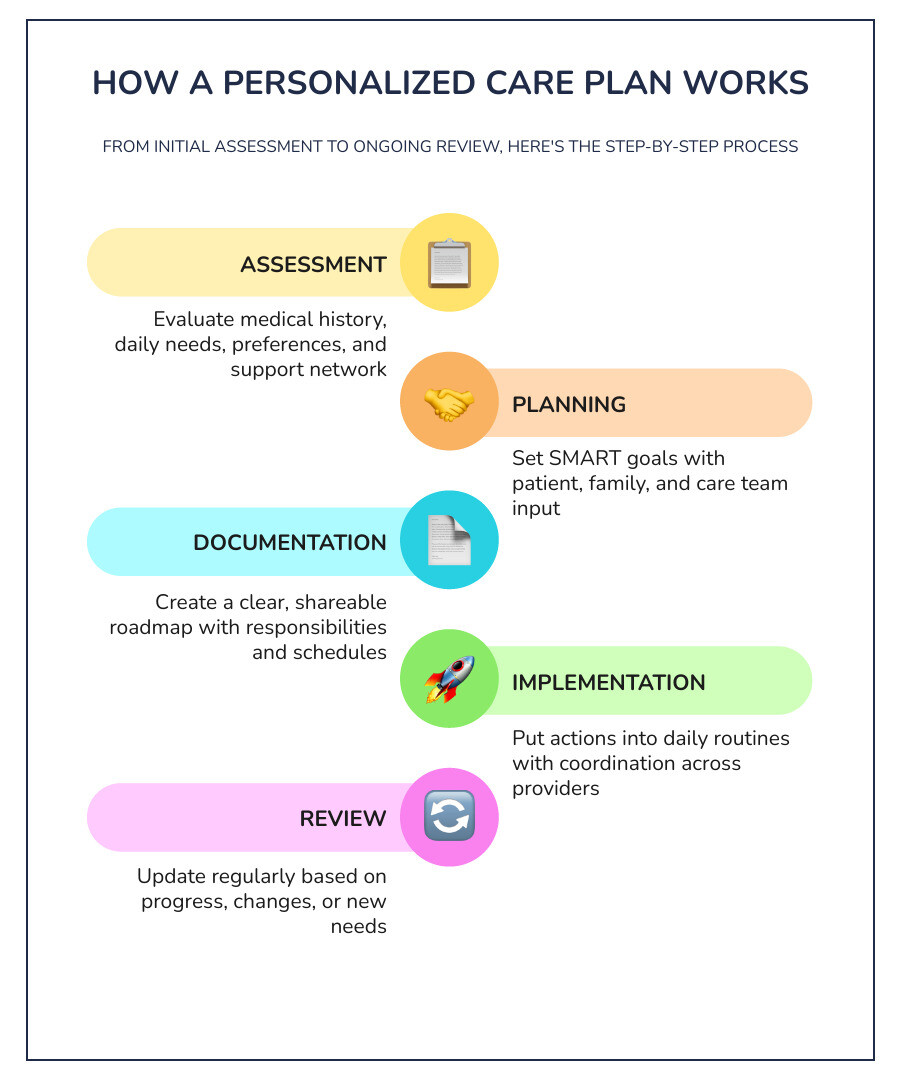
Creating a personalized care plan isn't a one-time event; it’s a cycle of assessment, action, and adjustment. Here is how the process typically unfolds in a professional setting.
Step 1: Start with a full assessment
You can't plan for the future until you understand the present. A comprehensive assessment looks at:
- Medical History: Past surgeries, chronic conditions, and current symptoms.
- Functional Abilities: Can they dress themselves? Prepare a meal? (These are often called Activities of Daily Living or ADLs).
- Cognition and Mental Health: Memory issues, signs of depression, or social isolation.
- Home Safety: Are there trip hazards? Is the lighting adequate?
- Cultural Background: What are their faith practices or language preferences?
Step 2: Build the personalized care plan with the right people
This is a team sport. A multidisciplinary team often includes a physician, a nurse, a social worker, and sometimes a care coordinator. Most importantly, it must include the "patient voice." If the person receiving support isn't part of the conversation, the plan is just a piece of paper. In Virginia, for example, many home health services emphasize this collaborative approach to ensure the plan is culturally sensitive and logistically feasible.
Step 3: Set goals, actions, and responsibilities
We use the "SMART" criteria here:
- Specific: "Increase mobility."
- Measurable: "Walk for 10 minutes."
- Attainable: "Using a walker."
- Relevant: "To be able to go to the mailbox."
- Time-bound: "By the end of next month."
The plan should also clearly state who is responsible for what. Does the son handle pharmacy refills? Does the personal assistant coordinate transportation?
Step 4: Document the plan in a usable format
A 50-page medical file is not a care plan. A real personalized care plan should be written in plain language. It should include a contact list, schedules, and a "red flag" section—warning signs that mean it's time to call the doctor.
For those looking for structured guidance, you can review Scientific research on care plan steps provided by the CDC.
Common sections include:
- Emergency contact information.
- Daily routine and schedule.
- Medication log.
- Nutrition and hydration goals.
- Social and recreational activities.
Step 5: Review and adjust over time
Life changes, and so should the plan. A "yearly wellness visit" is a standard time for a deep dive, but updates should happen whenever there is a "health event," such as a new diagnosis, a fall, or a change in family caregiving capacity.
What to Include in a Personalized Care Plan
When we help families organize their support, we look at the "Whole Person." A personalized care plan is only as good as the details it contains.
Core sections every personalized care plan should have
Every plan needs a foundation of hard data. This ensures that if an emergency happens, anyone picking up the document knows exactly what to do.
| Section | What it Includes |
|---|---|
| Medical | Diagnoses, allergies, current medications, and recent test results. |
| Personal | Preferences for bathing (bath vs. shower), sleep habits, and favorite foods. |
| Lifestyle | Hobbies, spiritual practices, and social connections. |
| Logistics | Insurance info, primary doctor contacts, and pharmacy details. |
Personal needs beyond medical care
We often say that health is about more than just the absence of disease. A truly personalized care plan includes:
- Hydration: "Prefers water with lemon, aim for 6 glasses a day."
- Companionship: "Enjoys playing cards on Thursday afternoons."
- Transportation: "Needs help getting to the Tuesday morning bridge club."
- Spiritual Preferences: "Wishes to watch the Sunday morning service online."
How plans address chronic conditions, culture, and lifestyle
For someone with COPD, the plan might focus on air quality and energy conservation. For someone with diabetes, it might focus on foot checks and low-glycemic meals.
Cultural sensitivity is also paramount. If a member has strong faith practices, the plan should reflect time for prayer or specific dietary restrictions. This isn't just "nice to have"—it’s essential for comfort and dignity. You can see a More info about comprehensive care plans to understand how these layers come together.

Downloadable examples and PDF-style templates to look for
You don't have to reinvent the wheel. Many organizations provide "Care Plan PDFs" or worksheets. Look for templates that include:
- An emergency info sheet for the refrigerator.
- A medication tracker.
- An appointment log.
- A "What Matters to Me" worksheet.
For a deep dive into the technical components, the Virginia Department of Health offers Scientific research on individualized plan components that are used in various health settings.
Where Personalized Care Plans Are Used and What Technology Supports Them
While we focus heavily on the home, personalized care plans are used across the entire spectrum of healthcare. However, they look a little different depending on where you are.
How plans differ by setting
- Hospitals: The focus is on "discharge planning"—getting the patient stable enough to leave and ensuring they have support at the next stop.
- Nursing Homes: Plans are often created by a multidisciplinary team of physicians, nurses, and therapists, with a focus on long-term stability and social engagement.
- Home Support: This is where the plan gets most "real." It focuses on daily routines, errands, and maintaining independence.
- Rehab Centers: The goals are usually short-term and intensive, focused on regaining specific skills like walking or swallowing.
Tools that make care plans easier to manage
In 2026, we have incredible technology to help us stay organized:
- Electronic Health Records (EHRs): Allow doctors to share the plan instantly.
- Telehealth: Enables quick plan reviews without a stressful trip to the office.
- Wearable Devices: Can track heart rate or sleep patterns and feed that data directly into the plan.
- Caregiver Apps: Help family members log when tasks are completed or notes for the next person on shift.
What makes implementation successful in real life
The best plan in the world is useless if it sits in a binder on a shelf. Success comes from:
- Accessibility: Everyone who needs the plan has a copy (digital or paper).
- A Named Coordinator: One person who "owns" the updates (often a family member or a professional concierge).
- Frequent Contact: Checking in to see if the plan is actually working. If the "10-minute walk" is causing pain, the plan needs to change today, not next year.
For a look at how this works on a systemic level, you can read about Scientific research on personalised care and support planning from the NHS, which has pioneered many of these whole-person models.
Frequently Asked Questions About a Personalized Care Plan
We hear a lot of questions from families in Virginia and across the U.S. about the "nitty-gritty" of these documents.
How often should a personalized care plan be updated?
At a minimum, you should review the plan once a year. However, we recommend a "trigger-based" update. If your loved one has a fall, starts a new medication, or receives a new diagnosis (like dementia), the plan should be updated immediately. Even small changes, like a senior preferring a bath over a shower, are worth noting to keep the routine consistent.
Who owns and approves the care plan?
The individual (the "member" or "client") owns the plan. It is their life, after all! However, it is a collaborative document. In most cases, the individual gives consent for their family and their primary doctor to view and contribute to it. This ensures that medical advice is balanced with personal wishes.
Can a personalized care plan be used at home without full-time medical care?
Absolutely. In fact, this is where they are often most valuable. You don't need a nurse on-site 24/7 to have a personalized care plan. A plan can coordinate non-clinical routines, such as meal prep, social outings, and appointment reminders. It acts as a "personal assistant" for the senior's life, helping them stay independent for as long as possible.
Conclusion: Taking the Next Step Toward Independence
A personalized care plan is more than just a document; it’s a commitment to a better quality of life. It’s about moving away from "one-size-fits-all" and toward a world where every senior is seen, heard, and supported in the way they choose.
For families, it offers the ultimate gift: clarity. When you know there is a plan in place—one that covers the meds, the meals, and the "what-ifs"—the weight on your shoulders gets a little lighter.
At Burnie's Way, we believe in the power of this personalized approach. While we aren't a medical provider, we act as a personal concierge and companion for aging adults who want to live confidently at home. We help coordinate the routines and personal support that make a personalized care plan come to life every single day.
If you’re ready to move from a "vague list" to a clear roadmap for your loved one, we’re here to help you navigate the journey. You can find More info about custom care plans and how we support independence through lifestyle coordination and heart-forward assistance.
Ready to get started? Let's build a routine that works for your family. Visit us at https://burniesway.com/resources/custom-care-plans to learn more about our personalized approach to senior support.