

What You Need to Know About Respite Care Through Medicare
Respite care through Medicare is available — but only under very specific conditions. Here's the quick answer:
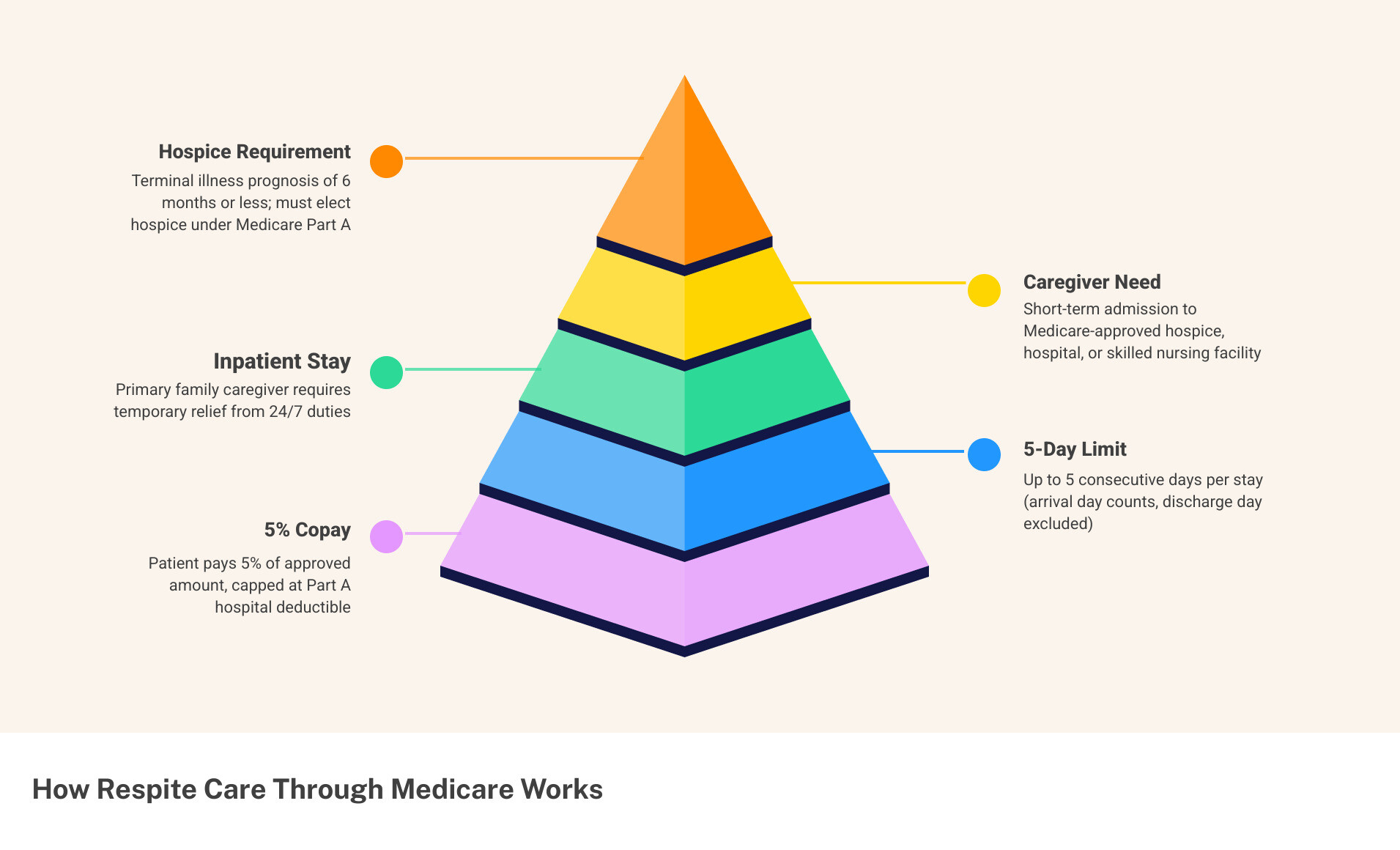
- Who it covers: People enrolled in Medicare who are receiving hospice care for a terminal illness
- What it pays for: Short-term inpatient stays in an approved facility so the primary caregiver can rest
- How long: Up to 5 consecutive days per stay (arrival day counts; discharge day does not)
- What it costs you: You pay 5% of the Medicare-approved amount, capped at the Part A inpatient hospital deductible
- What it does NOT cover: In-home respite, adult day care, or any respite outside the hospice benefit
If you're caring for an aging parent around the clock, you already know how exhausting it gets. Over 40 million Americans are in your shoes — managing medications, appointments, meals, and emotional support, often with little to no break.
Caregiver burnout is real. And it's one of the biggest reasons respite care exists.
The challenge with Medicare is that its coverage for respite care is narrower than most people expect. It doesn't cover a home aide coming in so you can take a weekend off. It doesn't cover adult day programs. What it does cover is a short inpatient stay — but only when your loved one is already enrolled in hospice care under Medicare Part A.
Understanding exactly how this works — and what your options are when Medicare won't pay — can make a real difference in how you plan and cope.
What Respite Care Means and Who It’s For
At its heart, respite care is a "gift of time." It is a temporary service designed to provide a short-term break for family caregivers. Whether you are caring for a spouse with dementia, an adult child with a chronic disability, or a parent facing a terminal illness, the physical and emotional toll can be immense. In fact, research shows that over 40 million people in the United States act as primary caregivers for a family member.
Respite care allows you to step away for a few days to attend a family event, recover from your own illness, or simply catch up on much-needed sleep, while ensuring your loved one is safe and supported by professionals.

What respite care through medicare actually covers
When we talk about respite care through medicare, we are specifically referring to inpatient care. This means your loved one stays temporarily in a Medicare-approved facility, such as a hospital, hospice center, or skilled nursing facility (SNF).
It is important to note that this benefit is strictly tied to the hospice benefit. Medicare provides this coverage to relieve the family members or other unpaid caregivers who are looking after the patient at home. It is not intended for long-term placement, but rather for short "breather" periods.
Who can benefit from respite care through medicare
The primary beneficiaries of this coverage are actually the caregivers themselves. We often see:
- Spouse Caregivers: Who may be aging themselves and need a break from the physical demands of 24/7 care.
- Adult Children: Who are balancing full-time jobs and their own families alongside caregiving duties.
- Dementia Support: Families caring for those with advanced Alzheimer’s or dementia, where the "sundowning" effect can lead to severe sleep deprivation for the caregiver.
Does Medicare Cover Respite Care and Which Parts Apply?
Navigating the different "Parts" of Medicare can feel like alphabet soup. To understand respite care through medicare, you have to look primarily at Part A.
| Feature | Original Medicare (Part A) | Medicare Advantage (Part C) |
|---|---|---|
| Respite Coverage | Only under the Hospice Benefit | Often includes Hospice + extra "Value-Added" respite |
| Location | Inpatient facilities only | May include in-home or adult day care |
| Duration | Up to 5 consecutive days | Varies by plan |
| Cost | 5% coinsurance | Varies by plan (may have $0 copay) |
Medicare Part A rules for respite care through medicare
Original Medicare Part A (Hospital Insurance) is the primary source of respite funding, but it only kicks in once a patient has "elected" the hospice benefit. To qualify, a doctor and a hospice medical director must certify that the patient has a terminal prognosis with a life expectancy of six months or less.
Once hospice is chosen, the focus shifts from "curative" care (trying to fix the illness) to "palliative" or comfort care. Under this umbrella, Medicare will cover inpatient respite to give the caregiver a break. You can find more specific Hospice benefit details from Medicare on their official site.
What Part B, Part D, and Medigap do and do not cover
- Medicare Part B: Does not cover respite care. It covers outpatient services and doctor visits.
- Medicare Part D: While it doesn't pay for the stay itself, Part D (or the hospice plan) covers medications for pain and symptom management during the respite stay. You might have a small copay (usually no more than $5) for these drugs.
- Medigap: Supplemental policies may help cover the 5% coinsurance you would otherwise owe for the inpatient respite stay.
How Medicare Advantage can differ from Original Medicare
Medicare Advantage (Part C) plans must cover everything Original Medicare covers, but many go a step further. In May 2026, many Advantage plans have expanded their "supplemental benefits" to include things like in-home respite care or adult day care services—things Original Medicare won't touch. However, these plans often have specific networks and may require prior authorization from the insurance company before they approve the stay.
Eligibility, Documentation, and Approved Facilities
Medicare doesn't just hand out respite days; there is a checklist of requirements that must be met to ensure the care is "medically necessary" for the caregiver’s relief.
Eligibility requirements Medicare uses to approve respite care
To access respite care through medicare, the following must be true:
- The patient is eligible for and has officially elected the Medicare Hospice Benefit.
- There is an "identifiable caregiver" (usually a family member) who provides the bulk of the care at home.
- The care is provided on an "occasional" basis, not as a permanent living arrangement.
- The patient is not already living in a 24/7 care facility (like a long-term nursing home).
What documentation is required for Medicare approval
Documentation is the "paper trail" that ensures Medicare pays the bill. The medical record must clearly show:
- The Reason: Why the caregiver needs relief (e.g., exhaustion, personal illness, or an out-of-town commitment).
- Level of Care Change: A note showing exactly when the patient moved from "Routine Home Care" to "Inpatient Respite Care."
- Certification: Signed statements from the hospice physician.

Which facilities qualify for Medicare-covered respite care
You can't just check your loved one into a luxury hotel and send the bill to Medicare. The stay must be in a Medicare-participating facility that provides 24-hour nursing care. This includes:
- Hospice Inpatient Units: Dedicated centers specifically for end-of-life care.
- Medicare-Approved Hospitals: General hospitals with the staff to handle hospice patients.
- Skilled Nursing Facilities (SNF): Facilities that meet specific hospice standards.
Crucial Note: Assisted living facilities generally do not qualify for Medicare-covered respite because they are regulated at the state level and often do not meet the strict 24-hour nursing requirements set by Medicare. For more on these distinctions, see the Respite care rules from Medicare Interactive.
How Long Medicare Covers Respite Care and What It Costs
Medicare’s clock for respite care is very specific. Understanding the "5-day rule" is essential for avoiding surprise bills.
Duration and frequency limits you should expect
Medicare covers up to five consecutive days of respite care at a time.
- The Arrival Day: This is counted as Day 1.
- The Discharge Day: Medicare does not pay for the day the patient leaves the facility.
While there is no hard limit on how many times you can use respite care during a benefit period (which consists of two 90-day periods followed by unlimited 60-day periods), it must be used only "occasionally." If you try to use it every single week, Medicare may flag it as a permanent placement and deny coverage.
Costs and copays for Medicare-covered respite care
Medicare is generous here, but it isn't free.
- Medicare Pays: 95% of the approved amount for the inpatient stay.
- You Pay: A 5% coinsurance.
- The Cap: Your total 5% payment cannot exceed the Medicare Part A inpatient hospital deductible for that year.
For example, if a 5-day stay costs $2,000, your 5% portion would be $100. If you are also getting medications for pain during this time, expect a small copay of up to $5 per prescription.
When Medicare does not cover respite care
We see many families get frustrated when they realize Medicare has "gaps." Medicare will NOT pay for respite care if:
- The patient is not in hospice.
- You want the care provided in your own home (Original Medicare).
- The patient is already a resident of a nursing home.
- You use a facility that isn't Medicare-certified (like many assisted living homes).
- You need "Adult Day Care" so you can go to work during the day.
Alternatives When Medicare Doesn’t Pay
If your loved one isn't in hospice, or if you specifically need help at home, you'll need to look beyond Original Medicare.
Average out-of-pocket costs for non-covered respite options
If you are paying privately in 2026, here is what you can expect to pay on average:
- In-Home Care: Approximately $33 per hour.
- 24/7 In-Home Care: Roughly $792 per day.
- Adult Day Care: About $103 per day.
- Facility-Based Respite (Non-Hospice): Around $152 per day.
- Nursing Home (Private Room): Roughly $305 per day.
Other ways to fund respite care
Don't lose heart if Medicare says no. There are several other "buckets" of funding:
- Medicaid HCBS Waivers: Most states, including Virginia, have Home and Community-Based Services (HCBS) waivers that pay for respite to keep seniors out of nursing homes.
- VA Benefits: The VA Caregiver Support Program is excellent. Veterans may qualify for 30 days of respite care per year.
- Lifespan Respite Vouchers: Programs like the Lifespan Respite Voucher - DARS in Virginia provide grants to help families pay for a provider of their choice.
- NFCSP: The National Family Caregiver Support Program provides federal funding to states to help family caregivers with various services, including respite.
How to find respite care providers and Medicare help
Navigating this alone is hard. We recommend reaching out to:
- Area Agency on Aging (AAA): Your local "one-stop-shop" for senior resources.
- SHIP Counselors: State Health Insurance Assistance Programs offer free, unbiased Medicare counseling.
- ARCH National Respite Locator: A great tool for finding local providers.
For more in-depth reading, check out our Long Term Respite Complete Guide or learn about Emergency Aged Care Respite for those times when a break isn't planned, but necessary.
Frequently Asked Questions About Respite Care Through Medicare
Does Medicare cover respite care at home?
Original Medicare (Part A and B) does not cover in-home respite. It only covers inpatient stays. However, some Medicare Advantage (Part C) plans have begun offering in-home support as an extra benefit.
How often can someone use Medicare-covered respite care?
There is no set number of times per year, but it must be "occasional." This usually means it is used to address a specific caregiver need or to prevent burnout, rather than as a recurring weekly schedule.
Does Medicare cover respite care for dementia?
Yes, but only if the dementia has reached a stage where the patient is eligible for hospice (a terminal prognosis of 6 months or less). If the person has dementia but is not terminal, Medicare will not pay for respite.
Conclusion
Taking a break isn't a sign of weakness; it's a vital part of being a good caregiver. While respite care through medicare has strict rules—namely the hospice requirement and the 5-day limit—it remains a life-saving resource for families in the midst of end-of-life care.
At Burnie’s Way, we understand that the goal is always independence and peace of mind. While we aren't a medical provider or a hospice agency, we are here as your personal concierge and companion to help you navigate these complex choices. We help our members live the way they want, coordinating the personal support and routines that make staying at home a reality.
If you are feeling overwhelmed, you don't have to do this alone. Whether it's through Medicare, a state grant, or private coordination, there is a path to getting the rest you deserve.