

When Scheduling Coordination Breaks Down, Everything Else Does Too
Scheduling coordination is the process of organizing people, tasks, resources, and time so that everything happens in the right order, with the right people, at the right moment.
If you're looking for the essentials, here's what effective scheduling coordination comes down to:
- Centralize information — keep all schedules, changes, and approvals in one place
- Automate repetitive tasks — reduce manual effort and human error
- Communicate proactively — notify all stakeholders of changes in real time
- Stay flexible — build in room to adapt when priorities shift
- Use the right tools — software like Calendly or Mazévo can cut coordination time by up to 73%
Most people think scheduling is just about picking a time and putting it on a calendar. It isn't.
Real scheduling coordination means managing dozens of moving parts — people, locations, deadlines, approvals, and last-minute changes — all at once. When it works, everything runs smoothly. When it breaks down, the ripple effects are costly. Research shows poor scheduling can drain up to 30% of an organization's annual productivity.
For families helping an aging parent stay independent at home, that same complexity hits close to home. Who's coming when? What's been arranged? Is anything falling through the cracks? The coordination load can feel overwhelming — fast.
This guide breaks down exactly how scheduling coordination works, what makes it fail, and how to master it in 2026.
Mastering Scheduling Coordination in 2026
As we move through 2026, the landscape of how we manage time has shifted from static paper planners to dynamic, interconnected ecosystems. Mastering scheduling coordination today requires more than just a sharp memory; it demands a blend of high-tech tools and high-touch communication.

A professional coordinator acts as the central nervous system of an organization or a support network. They aren't just "booking appointments"; they are managing workflows, optimizing resource usage, and serving as a vital stakeholder liaison. According to Scheduling Coordinator Salary 2026 data, this role is increasingly recognized as a specialized career path, reflecting how much value organizations place on keeping their operations synchronized.
The Role of a Scheduling Coordination Professional
A Scheduling Coordinator is responsible for the "who, what, when, and where" of daily operations. Their primary duties include creating and managing complex schedules, ensuring personnel and resources are available when needed, and solving the inevitable puzzles that arise when plans conflict.
In a professional setting, this person ensures deadlines are met and administrative services flow without interruption. In the context of supporting seniors, this role is often handled by Senior Care Coordination Resources which help bridge the gap between various service providers, family members, and the senior's personal needs. They act as the "single source of truth," ensuring that if a plan changes at 8:00 AM, everyone involved knows by 8:05 AM.
Essential Skills and Qualifications for Success
What makes someone a "master" of coordination? It starts with a mix of hard and soft skills:
- Organizational Habits: The ability to prioritize tasks based on urgency and impact is non-negotiable.
- Computer Literacy: Proficiency in Excel, CRM systems like Salesforce, and scheduling platforms is essential. In fact, 63% of businesses still rely on spreadsheets for some part of their planning.
- Problem-Solving: Identifying the root cause of a scheduling conflict and proposing a solution before it cascades into a larger issue.
- Communication Frameworks: Using standardized methods to update stakeholders ensures nothing is lost in translation.
For those looking to help loved ones, our Senior Care Planning Guide 2026 highlights that these same skills—organization and clear communication—are the foundation of a stress-free home life.
Overcoming the Chaos of Multi-Location and Dynamic Environments
Managing one calendar is easy. Managing ten calendars across three different cities? That’s where the "chaos" happens. Multi-location management is one of the biggest hurdles in scheduling coordination.
Challenges in Coordinating Schedules Across Diverse Teams
When teams are spread out, communication silos naturally form. A manager in one location might not realize that a team member in another is available to help, leading to unnecessary overtime or burnout. Common challenges include:
- Time Zone Overlaps: Remote teams in different regions may only have a two-hour window for synchronous work.
- Competing Priorities: Different locations often have different "emergencies," making it hard to allocate shared resources.
- Staff Certifications: Ensuring the person scheduled has the specific legal or professional credentials required for that specific site.
- Unexpected Gaps: A last-minute absence in one location can cause a total operational halt if there isn't a centralized view of backup options.
This is Why is Timely Care Coordination Important; a delay in one area doesn't just stay there—it ripples through the entire system, affecting outcomes and satisfaction.
Standardized Policies vs. Location-Specific Flexibility
The secret to Multi-location Scheduling Management is finding the balance between global rules and local needs. We recommend implementing standardized policies for things like overtime caps and break times, which can be automatically enforced by software.
However, "one size fits all" rarely works perfectly. While the framework should be global, managers need the flexibility to adjust for local demand. This is similar to how we approach Custom Care Plans. We use a professional framework to ensure safety and quality, but we tailor the specifics to the unique rhythm of each individual’s home and location.
Leveraging Technology for Seamless Scheduling Coordination
In 2026, relying on manual entry is a recipe for disaster. Automation is the "antidote" to scheduling chaos.
The Role of Technology and Software in Modern Workflows
Technology has transformed scheduling coordination from a reactive task to a proactive strategy. Tools like Calendly (used by 86% of Fortune 500 companies) allow for features like round-robin distribution, where meetings are automatically assigned to the next available team member.
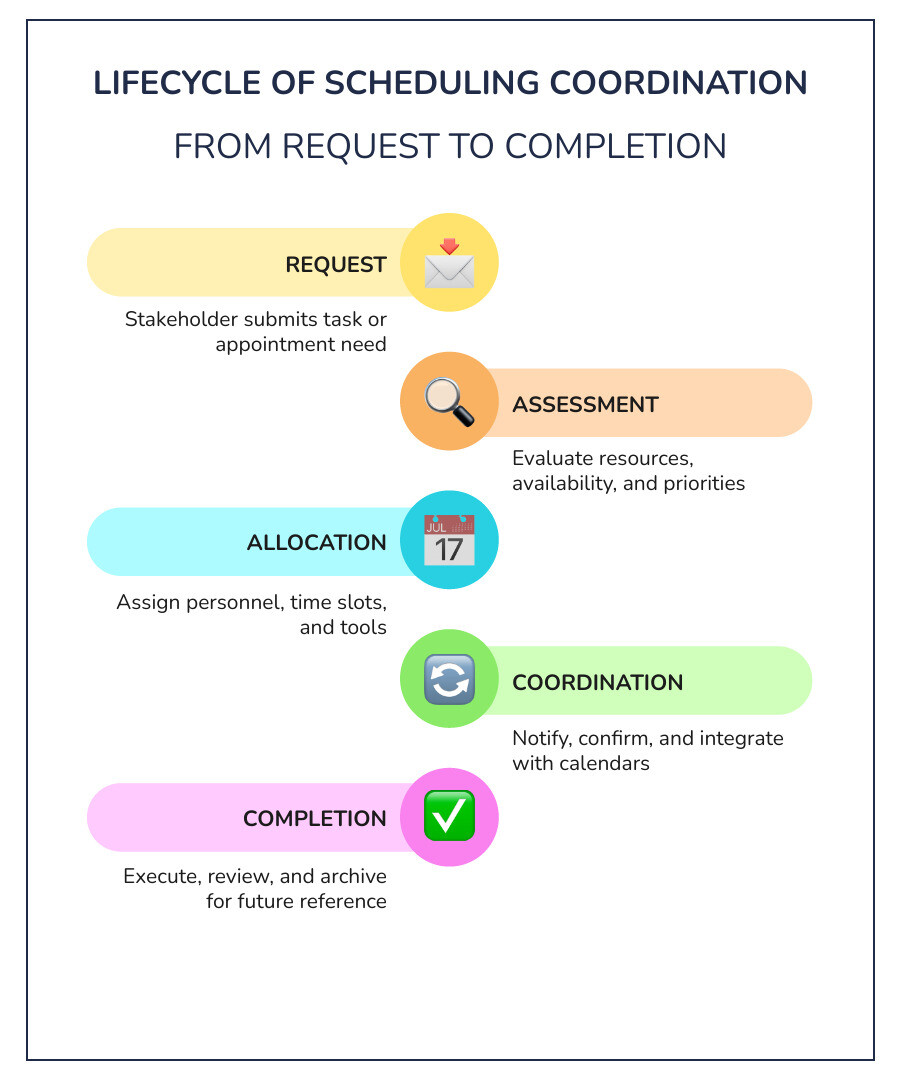
According to the blog Why Scheduling Is About Coordination, the real value of software isn't just the calendar—it's the "coordination lifecycle." This includes:
- Online Submission: Getting all the data upfront through standardized forms.
- Automated Notifications: Alerting all relevant departments the moment a change is made.
- Mobile Accessibility: Ensuring that a person in the field can see their updated schedule on their phone instantly.
By Mastering Team Scheduling with these tools, organizations have seen a 40% reduction in manual scheduling time.
QoS-Based Scheduling and Resource Optimization
In IT and cloud computing, coordination goes even deeper. The QoS based scheduling system (specifically the Koordinator project) uses advanced algorithms to optimize resource utilization in Kubernetes environments.
By using "Quality of Service" (QoS) metrics, these systems can detect interference and ensure that high-priority tasks always have the resources they need. While this sounds very technical, the principle is the same for human scheduling: prioritize high-value activities and ensure the "resources" (people's time and energy) aren't being wasted on low-impact tasks.
Best Practices for Asynchronous and Adaptive Scheduling Coordination
Traditional scheduling is rigid: "The meeting is at 2:00 PM, take it or leave it." Modern scheduling coordination is adaptive.
| Feature | Traditional Rigid Scheduling | Modern Adaptive Scheduling |
|---|---|---|
| Response to Change | Disruptive; requires total rebuild | Seamless; real-time adjustments |
| Communication | Synchronous (Meetings/Calls) | Asynchronous (Status Dashboards) |
| Priority | First-come, first-served | Impact and urgency-based |
| Worker Focus | Interrupted by "check-in" calls | Protected "Flow State" |
Adaptive Scheduling vs. Traditional Rigid Methods
Adaptive scheduling embraces the fact that life is unpredictable. Instead of a fixed timeline, it uses iterative planning. If a stakeholder's needs shift mid-project, an adaptive system allows for real-time rescheduling without compromising the entire project's timeline. This flexibility is a core part of Senior Care Coordination, where a senior's health or energy levels might change from day to day.
Asynchronous Coordination for Remote and Distributed Teams
One of the biggest productivity killers is the "just checking in" meeting. Asynchronous coordination solves this by providing status transparency. When everyone can see the "single source of truth" on a digital dashboard, they don't need to call a meeting to find out if a task is done. This protects the "flow state" of your team, allowing them to do deep work without constant interruptions.
Impact on Project Outcomes and Productivity
When scheduling coordination is handled correctly, the results are measurable. Organizations that adopt modern scheduling tools see an average of 82% improvement in operational efficiency.
Real-Time and Centralized Systems in High-Stakes Industries
In industries like healthcare, the stakes are incredibly high. As noted in the research on Real-Time and Centralized Scheduling, anesthesia departments use centralized systems to reallocate providers in seconds during surgical emergencies. This level of coordination saves lives and prevents cascading delays that can cost hospitals thousands of dollars per minute.
The same principle applies to project management: centralized data reduces rework and ensures that every stakeholder is satisfied because they always know what to expect.
Common Mistakes and How to Avoid Them
Even with the best tools, human error can creep in. Watch out for these pitfalls:
- Double-Booking: Often caused by not having all calendars synced to a single source.
- Manual Entry Errors: Moving data from an email to a spreadsheet is where mistakes happen. Use automation to bridge these gaps.
- Calendar Overloading: Scheduling meetings back-to-back leads to burnout and 20% lost productivity. Always build in "buffer" time.
- Lack of Prioritization: Treating a minor administrative task with the same urgency as a client deadline.
Frequently Asked Questions about Scheduling Coordination
How does automation reduce manual coordination time?
Automation is a game-changer. Research indicates that it can reduce manual scheduling time by 40% and overall coordination time by a staggering 73%. By eliminating the back-and-forth "are you free at 2:00?" emails, organizations see a 20% decrease in scheduling errors and a significant return on investment—Calendly users, for example, report a 169% ROI.
What are the future trends in scheduling coordination?
The future is AI-driven. We are seeing a rise in AI automation that doesn't just book a time but provides "intelligent recommendations" based on a person's past behavior and workload. Multi-location management is also becoming more "predictive," using data analytics to forecast when a specific location will need more staff before the shortage actually happens.
Why is asynchronous coordination better for productivity?
Asynchronous work is about protecting the "flow state." When you eliminate unnecessary meetings and status calls, you give your team the gift of time. Real-time visibility through a shared dashboard means everyone stays informed without being interrupted, leading to higher quality work and less burnout.
Conclusion
At Burnie's Way, we understand that scheduling coordination is about more than just dates on a calendar—it’s about the people behind those dates. Whether you are managing a corporate team or coordinating the personal support needed to help a loved one stay independent, the goal is the same: peace of mind.
We see ourselves as a virtual companion and personal assistant for aging adults. We don't provide medical care; instead, we offer the lifestyle coordination and personal support that allows our members to live confidently and comfortably at home. By handling the complex logistics of daily life—from errands to routine management—we help families move from a state of "uncertainty" to a structured, supportive plan.
If you’re feeling overwhelmed by the "moving parts" of supporting a senior family member, you don't have to do it alone. For More info about senior care coordination, reach out to us. We’re here to help you coordinate a life that is full, independent, and heart-forward.