

Why Life Management Skills Matter More Than Ever
Life management skills are the core abilities that help you organize your time, set meaningful goals, handle stress, and make better decisions — so you can live with more intention and less overwhelm.
Here's a quick look at the essential skills most people need to develop:
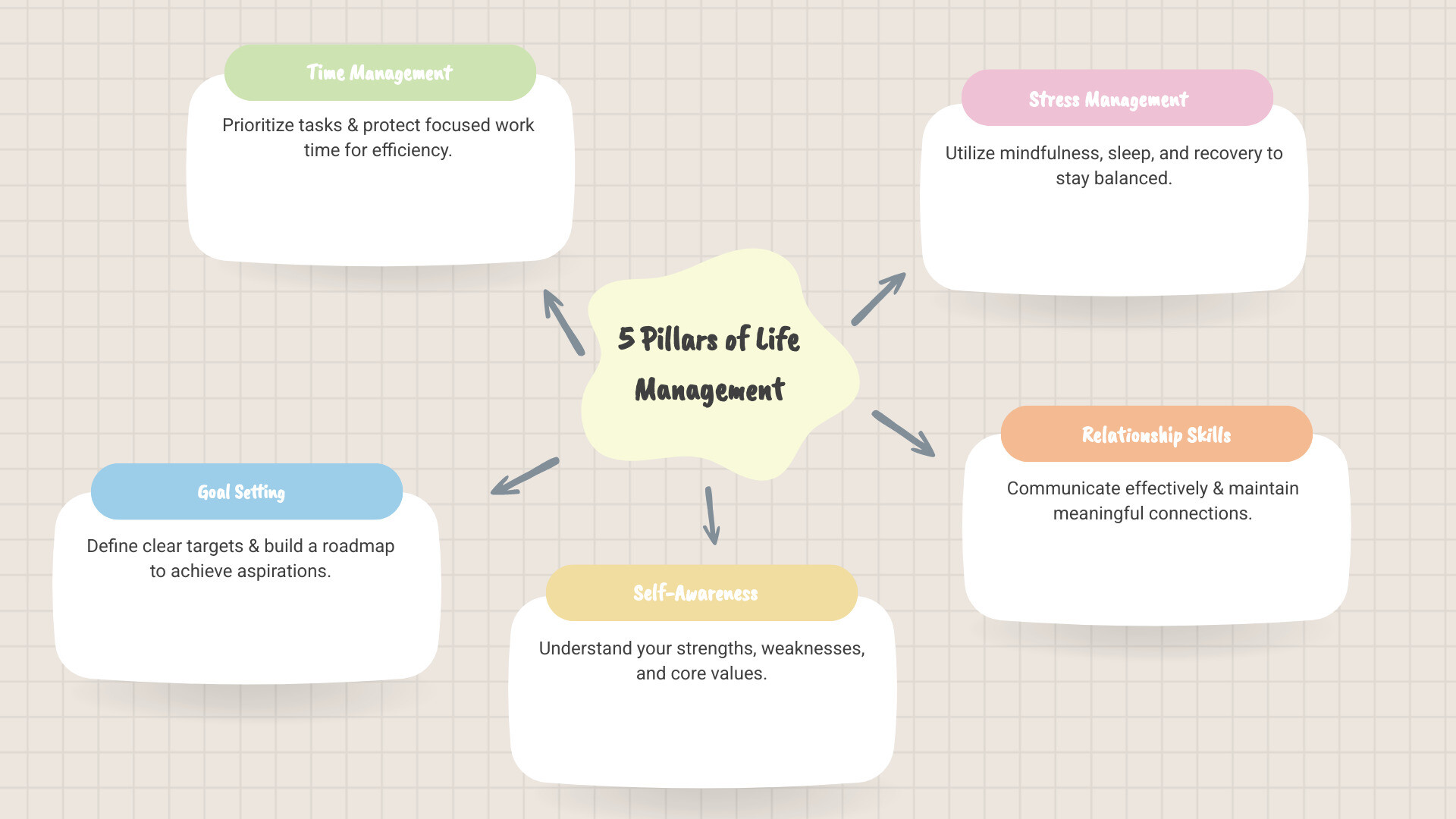
- Time management — prioritizing tasks and protecting focused work time
- Goal setting — defining clear targets and building a roadmap to reach them
- Self-awareness — understanding your strengths, weaknesses, and values
- Stress management — using mindfulness, sleep, and recovery to stay balanced
- Relationship skills — communicating well and maintaining meaningful connections
- Decision-making — thinking critically and acting in line with your values
- Resilience — adapting when life doesn't go to plan
Most people never stop to build these skills deliberately. And that gap is costly. Research shows that very few people actually take the time to plan what they want from life — and as a result, most never fully get it.
Modern life doesn't make this easy. Between digital distractions, competing responsibilities, and the pressure to keep up, it's easy to feel like you're reacting to life rather than directing it. That's especially true for families navigating complex situations — like helping an aging parent stay safe and independent at home — where the stakes feel even higher.
The good news? These are learnable skills. And developing them, even gradually, makes a real difference.
Learn more about life management skills:
What are Life Management Skills and Why Do They Matter?
At its heart, life management is the art of self-regulation and resource allocation. It is about taking the 24 hours we are all given and directing them toward the things that actually matter to us. In April 2026, the world moves faster than ever, and without a solid grasp of these skills, it is easy to feel like a passenger in your own life.

When we talk about life management skills, we are referring to the aptitudes that allow us to take charge effectively. These are the pillars for well-rounded individuals. They include everything from how you handle a stressful Tuesday morning to how you plan for your retirement years. For older adults, Senior Life Management becomes particularly vital, as it involves navigating changes in mobility or routine while maintaining maximum independence.
According to experts, there are 9 Life Management Skills To Thrive, ranging from critical thinking to empathy. These aren't just "soft skills" for the workplace; they are the survival tools for a fulfilling personal life. When you master them, you aren't just "getting things done"—you are creating a holistic sense of well-being where your social life supports your work, and your physical health fuels your mind.
The Impact on Personal Fulfillment
Why should you care? Because the stakes are your happiness and health. Mastering these skills leads to significant stress reduction and a higher rate of goal achievement. When life feels out of control, it’s usually because one of these management pillars has crumbled.
By sharpening your abilities, you improve your productivity and gain a sense of agency. A Guide to Taking Control of Your Life highlights that life management allows for better reactions to unexpected events. Instead of spiraling when a plan fails, you have the emotional intelligence and organizational systems to course-correct. This intentionality leads to a "work smart, not hard" mindset, leaving you with more energy for the people and hobbies you love.
Overcoming Chronic Procrastination
One of the biggest hurdles to effective life management is procrastination. Statistics show that roughly 20% of people are chronic procrastinators. This isn't just about being "lazy"; it’s often a failure of self-management and emotional regulation. Chronic procrastination leads to high levels of cortisol (the stress hormone) and a persistent feeling of unfulfilled potential.
Mastering your time isn't about denying yourself pleasure; it’s about transforming scattered time into unbroken flow. By using a Daily Life Management Tips Guide, you can learn to identify the "why" behind your delays—whether it's fear of failure or simple overwhelm—and build the self-discipline to start.
Core Life Management Skills for Personal Success
Mastering Time Management and Productivity
Time is our most finite resource. We are under constant siege by distractions. Did you know the average person touches their phone over 2,600 times a day? Office workers are often interrupted every three minutes. This "fragmented attention" is the enemy of success.
To regain control, we recommend a few proven techniques:
- Task Batching: Group similar activities (like answering emails or running errands) into one time block to reduce "switching costs" for your brain.
- The Pomodoro Technique: Work in 25-minute bursts followed by 5-minute breaks. This keeps your focus sharp and prevents burnout.
- Distraction-Free Zones: Set your phone to "Do Not Disturb" and use website blockers during your most important work hours.
By following 12 Rules to Master Self-Management, you can move from being reactive to proactive. Aim for just 30-60 minutes of additional undistracted time per day; the compounding effect over a year is life-changing.
Effective Goal Setting and Planning
If you don't know where you’re going, you’re unlikely to get there. Goal setting provides the landmarks, while planning provides the roadmap. We believe in setting clear, challenging targets that push you toward success.
A great strategy is to look for "overlapping targets." For example, if you want to improve your health and spend more time with family, you might schedule a weekly hike together. This hits two goals with one action. Using a Daily Living Assistance Complete Guide can help you structure these routines so they become second nature.
According to Tony Robbins, there are 5 life management skills to achieve your goals faster, including the ability to manage your life, not just a "to-do" list. It’s about focusing on the outcomes you want, rather than just the activities that keep you busy.
Enhancing Self-Awareness and Decision-Making
Self-awareness is the foundation of all other life management skills. If you don't understand your own values or your "limiting beliefs," you’ll keep making decisions that don't actually make you happy.
Critical thinking and emotional intelligence allow you to weigh the pros and cons of a situation without being blinded by temporary feelings. Practice self-reflection to identify your weaknesses. Are you a "yes-man" who overcommits? Do you struggle with social discomfort? Identifying these issues is the first step toward solving them. Check out these 5 Tips for Better Self-Management to begin aligning your daily choices with your long-term values.
Strategies for Health, Stress, and Relationship Management
Success is hollow if you are too stressed or lonely to enjoy it. A holistic approach to life management means treating your body and your relationships with the same care you give your career.
Mindfulness meditation is a powerful tool here. It isn't just "mysticism"—it’s an exercise for the brain. Studies show that meditation strengthens areas of the brain linked to emotional regulation, memory, and concentration. It is a proven way to manage depression, anxiety, and sleep disorders.
Furthermore, never underestimate the power of nature. Access to green spaces has been shown to significantly boost mental health. Even a 20-minute walk in a park can reset your nervous system. In your interactions with others, focus on active listening and empathy. Most conflicts can be resolved—or avoided entirely—if we take the time to truly understand the other person's perspective. For those helping seniors, these skills are essential for Assistance with Daily Activities, ensuring that support is given with dignity and respect.
Physical Wellness and Restorative Techniques
Your body is the engine that powers your life. Managing your physical health should be more about prevention than cure. This includes:
- Sleep Quality: Sleep is the foundation of productivity. Without it, your brain cannot process information or regulate emotions effectively.
- Nutrition: You don't need a fad diet. Simply boosting greens and lean proteins while cutting back on sugar and alcohol can radically improve your energy levels.
- Morning Routines: Starting your day with a few stretches or a quiet cup of tea sets a calm tone for the hours ahead.
As noted in this guide on Leading a Healthy and Constructive Lifestyle, wellness is multidimensional. Your physical, mental, and social health are all interconnected.
Building Resilience and Adaptability
Life is unpredictable. Resilience is your "adversity quotient"—your ability to handle stress and bounce back from setbacks. This is often more important than IQ when it comes to long-term success.
Building resilience requires self-discipline and the formation of healthy habits. It means seeing obstacles as opportunities for growth rather than personal attacks. Whether you are navigating a career change or seeking Daily Life Assistance for a loved one, being adaptable allows you to "go with the flow" without losing your sense of self.
Integrating Life Management Skills into Your Daily Routine
The secret to mastering these skills is consistency. You cannot manage your life in a single weekend; you do it in the small choices you make every morning and evening.
| Habit Category | Reactive (Low Management) | Proactive (High Management) |
|---|---|---|
| Mornings | Checking emails in bed | Journaling and goal review |
| Work Style | Multitasking and interruptions | Time blocking and focus sessions |
| Health | Eating whatever is fast | Meal planning and scheduled movement |
| Evening | Late-night scrolling | Monthly reviews and restorative sleep |
To make these skills stick, consider finding an accountability partner or using a mentor. Sharing your goals publicly or with a trusted friend makes you much more likely to follow through. For more on this, explore these 7 Powerful Life Management Skills for faster success.
Frequently Asked Questions about Life Management
How do life management skills lead to better work-life balance?
By mastering prioritization and the "art of saying no," you protect your personal time. When you are organized, you get your work done more efficiently, which reduces burnout and leaves you with the mental energy to enjoy your home life. It’s about setting boundaries that honor both your professional ambitions and your personal needs.
What role does organization play in daily life?
Organization is the "system" that runs your life. It involves managing information, decluttering your physical space, and tracking your resources. A well-organized environment leads to mental clarity. When you aren't wasting time looking for lost keys or missing emails, your brain is free to focus on higher-level problem-solving.
Can these skills be improved at any age?
Absolutely. Thanks to neuroplasticity, our brains are capable of learning and adapting throughout our entire lives. Whether you are a student preparing for adulthood or a senior looking to maintain independence, self-reflection and practice can always lead to improvement. It is never too late to start directing your life with more intention.
Conclusion
At Burnie's Way, we believe that everyone deserves to live a life that feels organized, purposeful, and independent. We see ourselves as your personal concierge for aging adults—a virtual companion and personal assistant wrapped into one. While we don't provide medical or caregiving services, we are experts in lifestyle coordination.
Our mission is to help you or your loved ones navigate the complexities of daily life with confidence. By mastering life management skills, you aren't just surviving; you are thriving. Whether it’s coordinating trusted services or helping you stick to a routine that brings you joy, we are here to provide the personal support that makes independence possible.
In April 2026, wellness isn't just about the absence of illness—it’s about having the skills to manage your world with heart and heart-forward competence.
Explore our personal support services today and see how we can help you live life on your own terms.