

Why Managing Your Daily Life Matters More Than Ever
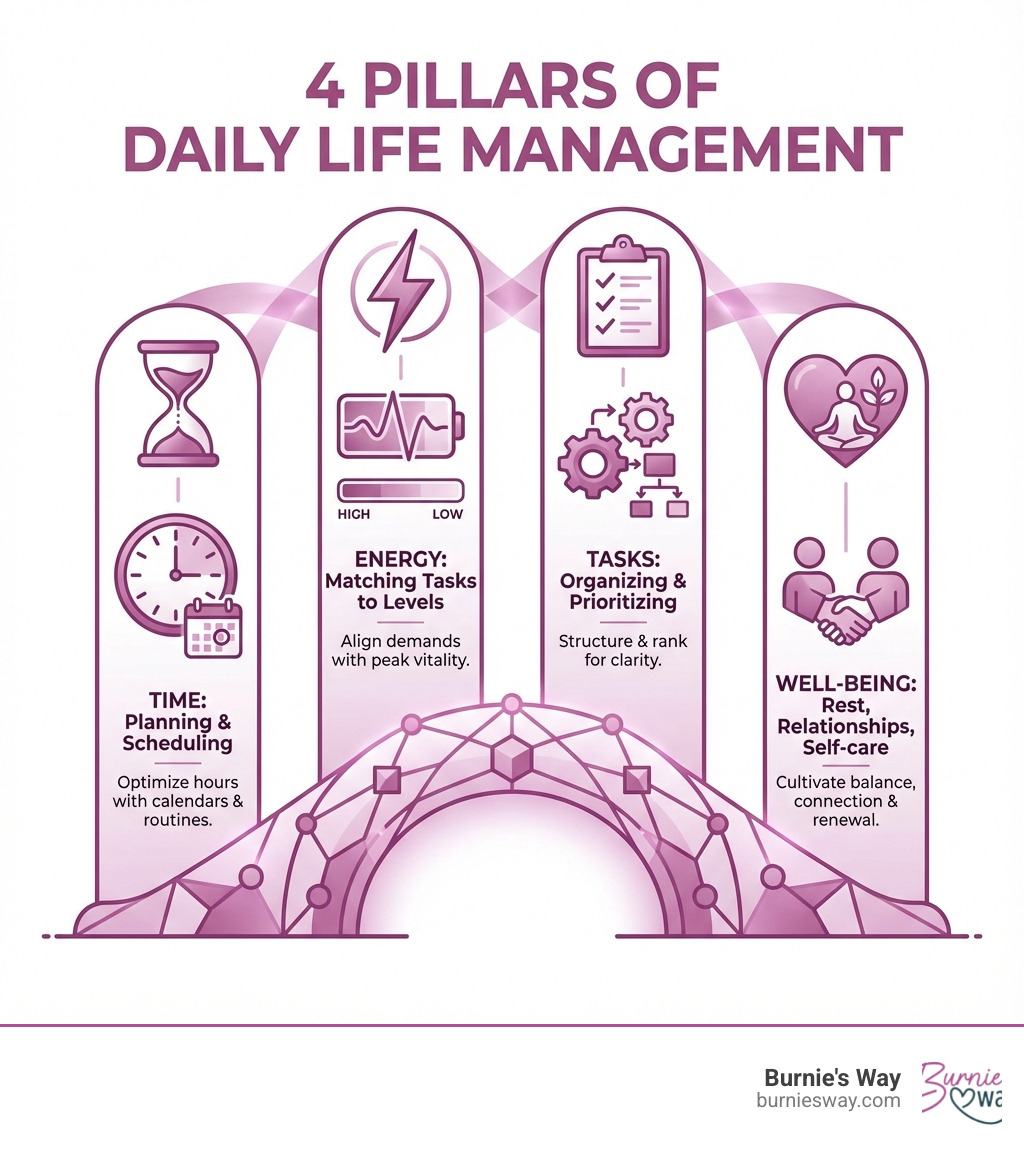
Daily life management is the practice of organizing your time, tasks, energy, and well-being so you can accomplish what matters most without feeling overwhelmed. It's not about cramming more into your day—it's about making intentional choices that align with your values and goals.
Quick answer: Daily life management involves:
- Prioritizing tasks based on importance and urgency
- Planning your time using calendars, schedules, and reminders
- Choosing the right tools that fit your personal style (planners, apps, or both)
- Managing your energy by scheduling demanding tasks during peak hours
- Building in flexibility to handle life's unexpected moments
- Making time for self-care to maintain your well-being
College can be a stressful time for many students, and time management can be one of the most crucial—but tricky—skills to master. But it's not just students who struggle. Whether you're a busy professional, a parent juggling multiple responsibilities, or an adult helping an aging loved one maintain their independence, keeping life organized often feels like a juggling act.
You're not alone in feeling overwhelmed. Many people experience stress and anxiety around organization and planning, missing deadlines, and feeling like there's no time for activities outside of work or school.
The good news? Time management—or more accurately, event management in relation to time—is a learnable skill. It's not something you're born with or without. Good time management leads to lower stress and anxiety levels, improved focus, increased productivity, better work-life balance, and ultimately more energy for the activities and people you care about.
This isn't about perfection. It's about progress. It's about finding systems that work for you and adapting them as your life changes. Whether you're managing your own daily life or helping coordinate support for a loved one who wants to live independently at home, the principles remain the same: awareness, arrangement, and adaptation.
The Foundations: Understanding and Prioritizing Your Life
When we talk about daily life management, we're really talking about how we consciously plan and control the time we spend on specific tasks to boost our efficiency and reach our goals. It's crucial for everyone, from students navigating their first semester to seasoned professionals balancing demanding careers. Students, for instance, often find it one of the most challenging yet vital skills to master. For professionals, it's increasingly recognized as a key behavioral skill for success in the modern workforce.
Why is it so crucial? Because effective daily life management leads to a healthier, more balanced life. It reduces stress and anxiety, sharpens our focus, and makes us more productive. Imagine ending your day with a genuine sense of accomplishment, rather than a nagging feeling that you've forgotten something important. That's the power of good daily life management. It improves our reputation, boosts our decision-making abilities, and ultimately gives us more free time and energy for what truly matters outside of work or studies.
At its core, daily life management is about setting clear goals and boundaries. Without a destination, how do we know which path to take? Without boundaries, how do we protect our journey from constant detours? Prioritization plays a starring role here. It's about deciding what's most important, what needs our attention now, and what can wait. As Parkinson's Law cleverly reminds us, "work expands to fill the time available for its completion." If we don't prioritize and set limits, our to-do list will happily gobble up every spare minute we have.
How to Determine Your Priorities
So, how do we figure out what's truly important when everything feels urgent? This is where strategic tools come in handy.
One of the most powerful tools is the Eisenhower Matrix. This simple yet effective method categorizes tasks into four quadrants:
- Important and Urgent: Do these immediately. These are crises, pressing problems, or deadlines.
- Important but Not Urgent: Schedule these. This is where strategic planning, goal setting, and relationship building live. This is often where we make the most progress.
- Not Important but Urgent: Delegate these. Think interruptions, some emails, or minor requests.
- Not Important and Not Urgent: Delete these. These are distractions and time-wasters.
The key here is understanding the distinction between "urgent" and "important." Urgent tasks demand immediate attention, often from others. Important tasks contribute to our long-term goals and values. The trap we often fall into is letting urgent but unimportant tasks dominate our day, leaving little time for the truly important ones. For additional advice on prioritizing, we recommend exploring resources like How to Prioritize When There’s Always More To Do.
Another fantastic approach is to define your goals using the SMART method:
- Specific: Clearly defined, not vague.
- Measurable: You can track progress.
- Achievable: Realistic and attainable.
- Relevant: Aligns with your broader objectives.
- Time-bound: Has a deadline.
We can also apply the Pareto Analysis, also known as the 80/20 rule. This principle suggests that roughly 80% of our results come from 20% of our efforts. Identifying that crucial 20% of tasks is a game-changer for productivity. Similarly, the ABCDE Method helps us categorize tasks: A (most important), B (important but less so), C (nice to do), D (delegate), and E (not necessary).
The Role of Clear Goals and Boundaries
Setting clear goals isn't just about knowing what you want to achieve; it's about providing purpose and direction for your daily efforts. Goals, especially SMART ones, give us a roadmap and help us filter out distractions.
Equally important are boundaries. Learning to say "no" is a superpower in daily life management. It means respectfully declining requests that don't align with your priorities or current capacity. This isn't selfish; it's self-preservation. It prevents overcommitment, protects your valuable time, and is essential for preventing burnout. When we say "yes" to everything, we often end up saying "no" to our own well-being and most important tasks. Saying "no" doesn't have to be dramatic; it can be a simple, "I appreciate you thinking of me, but I can't take that on right now."
For those navigating their own lives or coordinating support for aging loved ones, establishing these clear goals and boundaries is paramount. It ensures that the support provided truly aligns with the individual's desire for independence and a confident lifestyle at home. To understand more about how we approach personalized support, you can find More info about our approach to personalized support.
Building Your System: Strategies for Daily Life Management
Before diving into specific tricks, let's clarify some terms. In daily life management:
- Strategies are your overall plans or approaches. Think of them as your general game plan.
- Techniques are the specific methods or tools you use to execute your strategy. These are the plays within the game.
- Skills are the abilities you develop to effectively apply those strategies and techniques. These are your athletic prowess and understanding of the game.
Our most effective strategies for daily life management involve creating calendars, setting reminders, and building personalized schedules. These are the building blocks of an organized life.

Creating Your Master Plan
When it comes to scheduling, consistency is key. We find that combining a bird's-eye view with daily detail works best.
- Digital Calendars: Tools like Google Calendar, Apple Calendar, or Fantastical are invaluable for tracking appointments, classes, work meetings, and deadlines. The beauty of digital calendars is their accessibility across devices and the ease of setting recurring events and reminders. You can even integrate them with your to-do list apps!
- Physical Planners: For many, the act of writing things down solidifies commitments. A physical planner from brands like Papier or Moleskine offers a tactile experience that some digital tools can't replicate. It can be a great place for weekly reviews and creative planning.
- Setting Reminders: Don't rely solely on your memory! Set periodic reminders for tasks, both large and small. These can be calendar alerts, app notifications, or even sticky notes for highly visible cues.
- Building a Personalized Schedule: This is where you map out your day, week, and even semester. Crucially, it needs to be personalized. Consider your natural energy rhythms. Are you a morning person or a night owl? Schedule your most demanding tasks during your peak productivity hours. Don't forget to include time for meals, exercise, self-care, and even "fun" activities – treat them like important appointments.
- Planning Backwards from Deadlines: For larger projects, this is a lifesaver. Instead of just noting the due date, work backward to set mini-deadlines for each step. This helps us gauge task timing realistically and avoid last-minute crunches.
- Time Blocking: This technique, popularized by figures like Elon Musk, involves dividing your day into smaller, specific time chunks and dedicating each block to a particular task or type of activity. It's like making an appointment with yourself for each item on your to-do list.
Choosing Your Tools
The best tools are the ones you'll actually use. What works for one person might be a distraction for another. We encourage experimentation!
- Planners: From the neat Moleskine to the customizable Papier (which even offers student discounts), there's a physical planner for every aesthetic and planning style.
- Digital Apps: Beyond calendars, consider:
- Task Managers: Apps like Todoist, Asana, or Trello can help you organize to-do lists, set due dates, and track progress.
- Note-taking Tools: Notion or Evernote are fantastic for capturing ideas, organizing research, and keeping all your information in one place.
- Focus Apps: Tools like Forest or StayFocused can help block distractions and create a more productive environment.
- Software: For more complex project management, software solutions can be integrated with your daily planning.
The most important thing is to choose tools that suit your organizational and time management needs, and then actually use them consistently. There's no magic bullet; the magic is in the method and your commitment to it.
Powerful Techniques to Boost Your Productivity
Once you have your basic system in place, you can boost your daily life management with specific techniques designed to improve focus and efficiency. These methods aren't just for work; they can be applied to household chores, personal projects, and even leisure activities.
Popular Time Management Techniques Explained
- Pomodoro Technique: This popular method involves working in focused 25-minute intervals, separated by 5-minute breaks. After four "pomodoros," you take a longer 20-30 minute break. The name, fun fact, comes from the tomato-shaped kitchen timer the creator used! It's fantastic for improving concentration and preventing burnout.
- Timeboxing: Similar to time blocking, Timeboxing allocates specific, fixed time periods ("timeboxes") to planned activities. The goal is to complete the task within the allocated time, fostering efficiency and preventing tasks from dragging on indefinitely.
- Getting Things Done (GTD): Created by David Allen, the GTD method is a comprehensive system for organizing and tracking tasks. Its five steps are: Capture, Clarify, Organize, Reflect, and Engage. It's about getting everything out of your head and into a trusted system. You can learn more in Getting Things Done: The Art of Stress Free Productivity.
- Eat That Frog: This technique, inspired by a quote attributed to Mark Twain, suggests tackling your most strenuous, difficult, or important task first thing in the morning. Once the "frog" is eaten, the rest of your day feels easier and more productive.
- 1-3-5 Technique: A simple daily prioritization method where you commit to completing 1 big task, 3 medium tasks, and 5 small tasks each day. This keeps your daily to-do list manageable and focused on impact.
Advanced Methods for Task Management
Beyond the basics, several other techniques can lift your daily life management:
- Kanban Method: Originally from Toyota, Kanban uses a visual board (physical or digital) with columns representing stages of a workflow (e.g., To Do, In Progress, Done). You move tasks through the columns, providing a clear visual of your progress and bottlenecks.
- The Two-Minute Rule: A gem from David Allen's GTD, this rule advises: if a task takes less than two minutes, do it immediately rather than deferring it. It's surprisingly effective for clearing small, nagging items off your plate.
- Deep Work: Coined by Cal Newport, Deep Work refers to focused, uninterrupted, cognitively demanding work that produces high-quality results. It requires minimizing distractions and dedicating specific blocks of time to complex tasks. We often find that our most valuable work comes from these deep work sessions.
- Rapid Planning Method (RPM): Developed by Tony Robbins, RPM focuses on being Results-oriented, Purpose-driven, and creating a Massive Action Plan. It encourages you to clarify your desired outcomes and the purpose behind them before outlining the steps to get there.
Consistency with any technique is more important than finding the "perfect" one. Experiment, adapt, and make it your own. For more useful strategies and insights, check out More productivity tips on our blog.
Cultivating Skills for a Balanced and Productive Life
Effective daily life management isn't just about applying techniques; it's about developing core skills and understanding how to manage your most valuable resource: your energy.
Essential Skills for Effective Daily Life Management
While strategies and techniques are the "what" and "how," skills are the "who." These are the abilities we cultivate to make our systems work:
- Organization: This goes beyond a tidy desk. It's about structuring information, tasks, and physical space so everything has its place. This reduces mental clutter and makes finding what you need effortless. For tips on organizing your space, explore Strategies for organizing your space.
- Concentration: In a world of constant pings and notifications, the ability to focus deeply on one task is a rare and powerful skill. It means minimizing distractions, limiting multitasking (which often leads to inefficient context switching), and ensuring you get enough sleep.
- Delegation: Knowing when and how to hand off tasks to others is crucial, especially for busy professionals or those coordinating support for loved ones. It frees up your time for higher-value activities and empowers others.
- Stress Management: Poor time management often leads to stress and anxiety. Developing coping mechanisms, taking regular breaks, maintaining a healthy lifestyle, and knowing when to ask for help are vital for long-term well-being and productivity.
Managing Energy, Not Just Time
Here's a radical thought: stop managing your time, and start managing your energy. We all have peaks and troughs in our daily energy levels. The Biological Prime Time technique suggests identifying when you're most alert and focused and scheduling your most demanding tasks during those periods. For example, if you're a morning person, tackle complex problem-solving then. If your energy dips in the afternoon, save administrative tasks or lighter work for that time.
Our physical well-being plays a huge role in our energy. Studies show that regular exercise and a healthy diet significantly boost energy levels. The link between exercise and energy is undeniable. And let's not forget the paramount importance of sleep. Being sleep-deprived not only makes us irritable and less capable of dealing with stress, but it also severely impacts our concentration and overall productivity. Aim for at least 7-9 hours of quality sleep each night.
Practical daily habits like preparing your to-do list the night before, or limiting email checks to specific times (e.g., not until noon) can also significantly boost productivity by protecting your peak energy hours for important work.
Adapting to Life's Curveballs
Life rarely goes exactly according to plan, and a rigid schedule is bound to break. That's why flexibility is an essential skill in daily life management.
- Build in Buffer Time: Always add extra time to your estimates. Meetings run over, a child's temper tantrum can take over your morning, or an unexpected phone call can derail your plans. Buffer time acts as your safety net.
- Accept the "Pivot": When unexpected circumstances disrupt your schedule, don't despair. Instead of abandoning your plan entirely, pivot. Adjust your priorities, reschedule non-urgent tasks, and focus on what's still achievable. Daily life management is about progress, not perfection.
- Managing Executive Dysfunction: For individuals, especially students, facing challenges like executive dysfunction (ED), which affects planning, organizing, task management, and focus, flexibility is even more critical. It's not uncommon for students with disabilities to experience unexpected flare-ups or reduced energy. In these cases, visual schedules, breaking down large assignments into smaller, specific, observable steps (S-O-S strategy), and building in rest breaks are vital. Resources like Support for students with disabilities offer valuable strategies. If one schedule doesn't work, don't give up; try creating a different one.
Beyond Work: Making Time for Well-being and Connection
Daily life management isn't just about maximizing output; it's about optimizing your life for joy, connection, and peace. We often get so caught up in the grind that we forget to schedule the very things that make life worth living.
Intentionally Scheduling Self-Care and Fun
Making time for fun, relaxation, and self-care isn't a luxury; it's a necessity for maintaining well-being and preventing burnout. We need to treat these activities with the same importance as work appointments.
- Schedule Relaxation: Block out time in your calendar for hobbies, reading, exercise, or simply quiet reflection. These "guilt-free breaks" can actually make you more productive when you return to your tasks.
- Hobbies and Interests: Engage in activities that bring you joy. Whether it's painting, gardening, playing an instrument, or exploring a new skill, hobbies provide mental breaks and a sense of accomplishment outside of daily demands.
- Work-Life Balance: This isn't a mythical creature; it's an achievable state. It means committing to an official end time to your workday, taking regular vacations, and consciously unplugging. A "work shutdown ritual"—like reviewing your to-dos for tomorrow and tidying your desk—can help create a clear boundary between work and personal life.
The Power of Support and Automation
You don't have to manage everything alone. Seeking support and leveraging technology can significantly lighten your load.
- Accountability Partners and Study Buddies: Sharing your goals and progress with a trusted friend, family member, or colleague can provide motivation and keep you on track. Just knowing someone is expecting an update can be a powerful incentive!
- Delegating Tasks: This is where we shine! Don't hesitate to ask for help. Whether it's asking a family member to take on a chore, or for a professional, concierge-style helper to coordinate services, delegating frees up your time and mental energy for what only you can do. For aging adults, this might mean having support with errands, scheduling, or household organization.
- Using Automation Tools: Technology can be your best friend in daily life management.
- Task Management: Use apps that can automatically turn new emails into tasks or integrate with other platforms to streamline your workflow.
- Financial Management: Automate bill payments and savings transfers to reduce mental load.
- Email Management: Use tools like Boomerang for Gmail to schedule emails and set follow-up reminders, or simply turn off notifications and check email at designated times.
- Distraction Blockers: Apps like Freedom or StayFocused can block distracting websites and apps during your focused work periods.
By strategically delegating and automating, we can streamline workloads, reduce cognitive load, and free up precious time for important tasks and personal well-being.
Frequently Asked Questions about Daily Life Management
How do I start managing my daily life if I feel completely overwhelmed?
We understand that feeling. It's like looking at a mountain and not knowing where to begin the climb. Our best advice is to start small.
- Pick One Simple Technique: Don't try to implement every strategy at once. Maybe start with the "two-minute rule" (if a task takes less than two minutes, do it immediately) or try a basic to-do list.
- Break Tasks Down: Overwhelm often comes from looking at a huge, daunting task. Break it into tiny, manageable steps. Instead of "Clean the house," try "Wipe down kitchen counters."
- Focus on One Day at a Time: Plan your day the night before, identifying just 1-3 essential tasks that, if completed, would make it a successful day.
- Be Kind to Yourself: Progress, not perfection, is the goal. If a day goes off track, simply reset and try again tomorrow.
What's the difference between being busy and being productive?
Ah, the age-old question! It's easy to confuse motion with action. Being busy often means constantly doing things, but not necessarily the right things. You might be responding to every email, attending every meeting, and feeling perpetually swamped.
Being productive, on the other hand, means getting important things done consistently. It's about focusing on high-impact tasks that align with your goals and values, even if it means saying "no" to other things. It's about strategic action rather than constant motion. We can be incredibly busy without being productive at all, simply because we're spending our time on urgent but unimportant tasks.
How can I stay consistent with a new time management system?
Consistency is the secret sauce! Here's how we can cultivate it:
- Habit Formation: Focus on building small, repeatable habits. James Clear, author of Atomic Habits, suggests making habits obvious, attractive, easy, and satisfying. For example, make reviewing your schedule a daily morning ritual.
- Weekly Reviews: Set aside time once a week (we love Sunday evenings!) to review the past week's accomplishments and challenges, and plan for the week ahead. This helps you adapt your system and stay on track.
- Flexibility is Your Friend: Don't abandon your system the moment something goes wrong. Life happens! Instead, adjust and adapt. The goal isn't a perfect schedule, but a resilient one.
- Find a System You Enjoy: If a tool or technique feels like a chore, you won't stick with it. Experiment until you find what genuinely resonates with your personal style and preferences.
- Accountability: Share your goals with a trusted friend or family member. Knowing someone is rooting for you (or gently nudging you) can be a powerful motivator.
Conclusion: Your Journey to a More Organized and Fulfilling Life
Daily life management is a profoundly personal journey, not a rigid destination. It's about gaining control over your time, energy, and tasks, which ultimately contributes to your overall well-being. We believe that by understanding the principles, experimenting with the techniques, and cultivating the essential skills we've discussed, you have the power to create a more balanced, productive, and fulfilling life.
For seniors and their families, managing daily life is key to maintaining independence and enjoying life at home. Burnie's Way provides compassionate, personalized support to help coordinate tasks and maintain a confident lifestyle at home, allowing individuals to live the way they want, with ease and connection.
We hope this extensive guide empowers you to start on your own journey toward mastery in daily life management. Every small step forward is progress.