

Understanding Support Options for Aging Adults
Finding the right old people care taker or support professional starts with understanding what kind of help your loved one actually needs. This might include companionship, help with daily routines, coordination of services, or personal assistance—not necessarily medical or healthcare services.
Quick Answer: Key Types of Support for Older Adults
| Support Type | What It Includes | Best For |
|---|---|---|
| Companion Services | Social engagement, conversation, activities | Reducing isolation, maintaining connections |
| Personal Assistant | Errands, appointments, coordination | Staying organized and independent |
| Household Help | Cleaning, meal prep, light maintenance | Managing daily home life |
| Lifestyle Coordination | Service coordination, routine support | Overall quality of life and peace of mind |
Nearly 38.2 million people in the United States provided unpaid support to older adults in 2023-2024. Most spent an average of 3.9 hours per day helping with everything from household tasks to transportation and companionship.
If you're reading this, you're likely one of the millions of adult children trying to figure out how to help an aging parent live safely and comfortably at home. The options can feel overwhelming. In-home care? Personal support? Assisted living? And what exactly is the difference between them all?
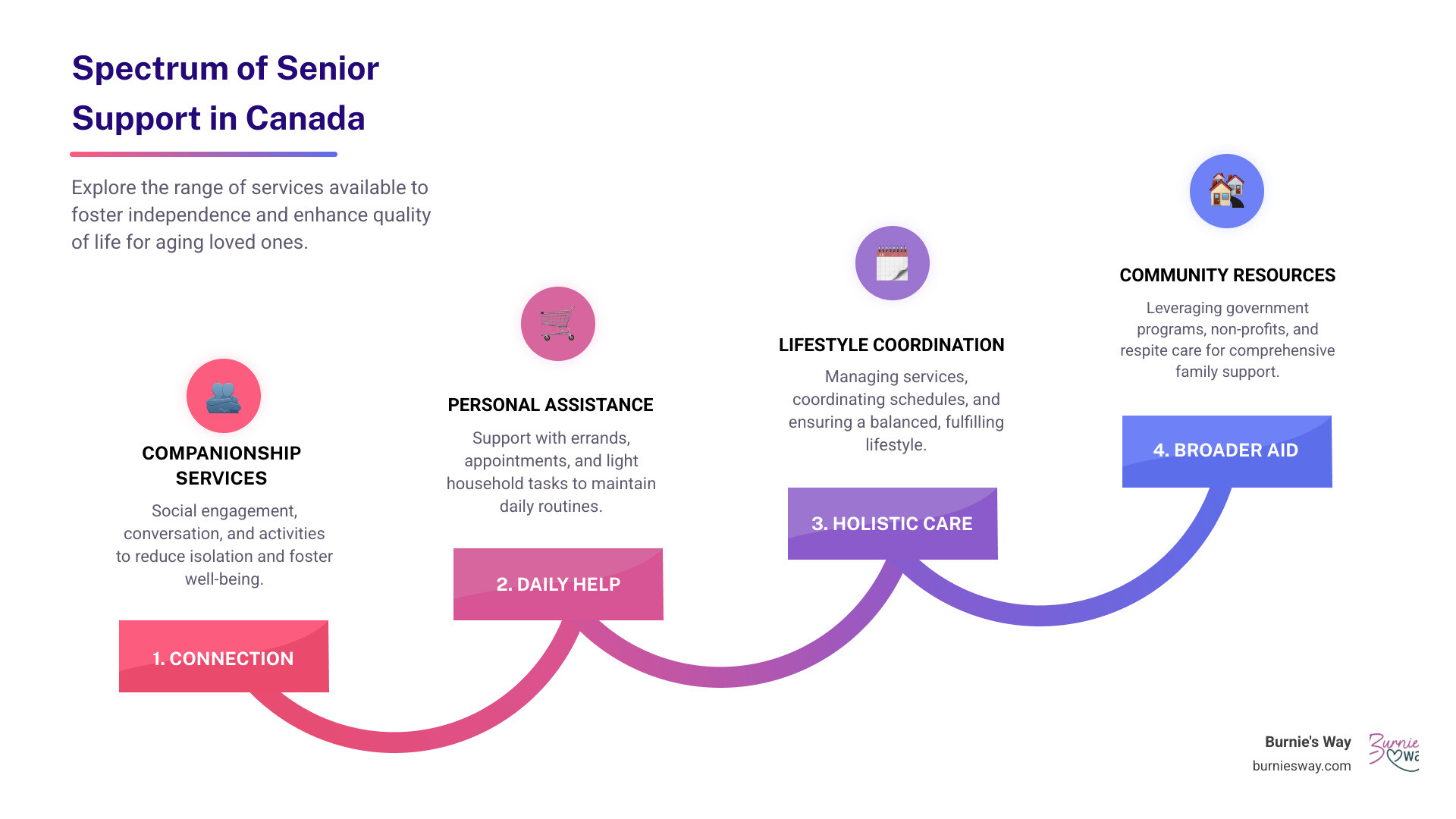
This guide cuts through the confusion. We'll walk you through the spectrum of support available in the United States, from companionship and personal assistance to lifestyle coordination and community resources. You'll learn how to assess your loved one's needs, what qualifications matter when hiring help, and how to steer the financial and logistical realities of supporting someone you love.
Most importantly, you'll understand that support doesn't have to mean giving up independence. It can mean enhancing it—helping your loved one live the way they want, with the right kind of help in place.
Explore more about old people care taker:
- adapting to aging
- body hygiene in aged care
- home care solutions
Understanding Your Loved One's Needs
As our loved ones age, their needs can evolve, sometimes subtly at first. Recognizing these changes and understanding the best way to offer support is a crucial first step. It’s about helping them maintain their independence and comfort, not taking it away.

Assessing Daily Routines and Independence
We believe in a personalized approach, which starts with observing and assessing your loved one's daily routines. Are they managing tasks like meal preparation, getting dressed, or light housekeeping with ease? Or are there areas where a little extra support could make a big difference? This isn't about looking for flaws, but rather identifying opportunities to improve their quality of life. For instance, if grocery shopping or meal prep becomes a challenge, a personal assistant can step in to help with errands and ensure nutritious meals are available.
Distinguishing Between Personal Support and Household Help
It's important to clarify the different types of assistance available. Personal support focuses on helping individuals manage their daily lives, such as coordinating appointments, organizing schedules, or providing companionship. Household help, on the other hand, typically involves tasks like cleaning, laundry, or yard work. Both are vital for maintaining a comfortable home environment, but they address different needs. For example, our services lean towards being a personal concierge, helping with the coordination and management of these daily life areas, ensuring everything runs smoothly.
Recognizing the Value of Companionship and Social Engagement
One of the most significant needs for many older adults is companionship. The U.S. Bureau of Labor Statistics reported that many unpaid eldercare providers engage in companionship activities. Social isolation can have a profound impact on well-being. A friendly face, engaging conversation, or an escort to social outings can brighten spirits and keep minds active. We know that the connection between a client and their support professional can feel like that of a close friend, not just an employee providing a service. This human connection is at the heart of what we do.
Noticing When More Support May Be Needed
Sometimes, the signs that more support is needed are clear, like an increase in falls or missed medications. Other times, they are more subtle: a change in hygiene habits, a less tidy home, or a withdrawal from social activities. Approaching these conversations with sensitivity is key. Your loved one might be hesitant to admit they need help, so explaining that personal support can improve their independence and ease their daily life can make a big difference.
The Importance of Including Your Loved One in Decisions
The goal is to help your loved one live the way they want. This means including them in every step of the decision-making process. Discuss their preferences, concerns, and hopes for their future. This collaborative approach fosters trust and ensures that the support provided truly meets their unique needs and respects their autonomy. For more on getting started, you might find useful insights in the guide on Getting Started With Caregiving.
Exploring Personal Support and Lifestyle Coordination
When we talk about supporting older adults in their homes, draw a clear line between personal support and health-related care. We focus on empowering independence through lifestyle coordination and personal assistance, leaving medical and clinical care to qualified healthcare professionals.
Understanding the Difference Between Personal Support and Health-Related Care
Personal support is about helping individuals manage their daily lives and maintain their chosen lifestyle. This includes assistance with household tasks, errands, transportation, social engagement, and overall coordination of life's demands. It's about making life easier and more enjoyable. For instance, a personal support professional might help organize appointments, manage correspondence, or accompany a client to social events.
Health-related care, conversely, involves medical treatments, medication administration, wound care, physical therapy, or skilled nursing services. These are clinical tasks performed by licensed healthcare providers. We want to be very clear: we are not a healthcare provider. Our role is to be a personal concierge, helping to coordinate life's activities and ensure peace of mind, not to provide medical services.
Companion Services and Lifestyle Coordination
Our services are designed to be a virtual companion, events coordinator, and personal assistant rolled into one. We connect clients with compassionate, competent support professionals who can provide companionship, engage in meaningful activities, and facilitate social connections. This focus on companionship is crucial for mental and emotional well-being. Lifestyle coordination means we help manage the details of daily living, ensuring routines are supported and life runs smoothly. This can involve anything from arranging grocery deliveries to coordinating home maintenance services.
The Role of Personal Assistants and Support Professionals
A personal assistant or support professional, often referred to as an old people care taker in broader terms, plays a pivotal role in enabling independence. They are there to assist with tasks that have become challenging, not to take over. This might include helping with light housekeeping, preparing meals, running errands, or simply being present for safety and social interaction. Their aim is to provide practical help while fostering a sense of autonomy for the client.
The Value of Respite and Family Breaks
Caring for a loved one can be incredibly rewarding, but it's also demanding. Millions of family members, 55% of whom are women, provide unpaid eldercare, spending an average of 3.9 hours per day. This often leads to burnout. Respite care, which provides short-term relief for primary family members, is invaluable. While we don't provide the respite care directly, we can help coordinate these services, ensuring that family members get the breaks they need to recharge. This temporary support can take place at home, in a facility, or at an adult day center.
Flexible Arrangements to Fit Unique Needs
We understand that every individual and family is unique. That's why flexibility is at the core of our approach. Whether it's a few hours a week for companionship, daily assistance with errands, or comprehensive lifestyle coordination, we work with you to create a plan that fits your loved one's specific needs and preferences. This ensures that the support is always custom, effective, and respectful of their individuality. For more information on various services that can help older adults live at home, you can refer to Services for Older Adults Living at Home.
Comparing Types of Personal Support
| Support Type | Tasks Typically Included | Qualifications (for Support Professionals) | Best For |
|---|---|---|---|
| Companionship | Conversation, shared activities, outings, social engagement | Patience, strong communication, empathy, reliability | Reducing loneliness, mental stimulation, social connection |
| Personal Assistance | Errands, appointment scheduling, light meal prep, organizing, transportation coordination | Organizational skills, reliability, trustworthiness, initiative | Maintaining daily routines, managing logistics, staying organized |
| Household Support | Light cleaning, laundry, grocery shopping, pet care, simple home maintenance coordination | Efficiency, attention to detail, physical capability, trustworthiness | Keeping the home tidy and functional, managing household chores |
| Lifestyle Coordination | Managing schedules, service referrals, communication with family, financial organization (non-fiduciary) | Strong organizational and communication skills, problem-solving, proactivity | Comprehensive daily life management, reducing family stress, enhancing independence |
Finding the Right Old People Care Taker or Support Professional
Finding the right support professional, sometimes broadly termed an old people care taker, is a significant decision. It's about finding someone who not only performs tasks but also connects with your loved one and improves their daily life.

Choosing Between Agencies and Private Arrangements for Personal Support
In the United States, you generally have two main avenues for finding personal support: agencies or private arrangements.
- Agencies often provide vetted professionals, manage scheduling, handle payroll, and offer backup support if a professional is unavailable. They typically charge a higher hourly rate to cover these overheads.
- Private arrangements involve directly hiring an individual. This can offer more flexibility and potentially lower costs, but it places the responsibility for vetting, background checks, contracts, and payroll squarely on your shoulders. Online platforms list thousands of candidates, with hourly rates often ranging from $20 to $35, but require families to do the vetting.
We help bridge this gap by offering a coordinated approach. While we don't directly employ the support professionals, we guide our clients through understanding their options and help coordinate the right personal support that fits best.
Vetting Qualifications and Experience
Regardless of how you find a support professional, thorough vetting is essential. Look for individuals with verifiable experience in similar roles. Testimonials and references are invaluable. It's not just about the number of years, but the quality and relevance of that experience.
The Importance of Background Checks
For peace of mind and safety, comprehensive background checks are non-negotiable. This should include criminal record checks, reference checks, and verification of any stated certifications. This step helps ensure that the person entering your loved one's home is trustworthy and reliable.
Contracts and Legal Considerations
When engaging a personal support professional, especially through a private arrangement, it’s wise to have a clear contract in place. This should outline the scope of services, hours, compensation, confidentiality, and any other expectations. This protects both parties and clarifies the professional relationship. For more about our approach to ensuring a good fit and seamless process, visit More info about our approach.
Key Qualifications to Look for in an Old People Care Taker
When seeking a personal support professional, certain qualities stand out as crucial for a successful and positive experience:
- Relevant certifications (where applicable, such as CPR, First Aid): While we focus on non-medical support, knowing a professional has basic safety certifications can provide an extra layer of reassurance.
- Verifiable experience and references: Look for a track record of reliability and positive interactions with previous clients.
- Strong communication skills: The ability to listen, understand, and clearly convey information is vital for effective coordination and building trust.
- A compassionate and patient demeanor: This is perhaps the most important quality. A warm, understanding, and patient attitude fosters a comfortable and respectful environment.
- Reliability and professionalism: Punctuality, consistency, and a professional approach to their role are fundamental for maintaining trust and ensuring continuous support.
Handling Specialized Needs for an Old People Care Taker
Some older adults have specific needs that require a support professional with particular skills or a deeper understanding.
- Experience with memory support and social engagement: For clients experiencing memory changes, a professional who can gently guide conversations, engage in memory-stimulating activities, and maintain a calm, reassuring presence is invaluable. Our focus is on social engagement and meaningful interaction, not clinical diagnosis or treatment.
- Familiarity with mobility or accessibility challenges: A professional familiar with safe transfer techniques, or who can assist with navigating mobility aids, can significantly improve safety and independence within the home and community.
- Support after hospital stays (coordinating logistics, not medical care): Returning home after a hospital stay can be daunting. A personal support professional can help coordinate logistics such as scheduling follow-up appointments, managing household needs, and ensuring a comfortable recovery environment. We emphasize that this is about logistical coordination, not providing medical care or nursing services.
- Comfort and companionship for those with advanced needs: Even in advanced stages of life, the need for comfort, dignity, and companionship remains. A professional who can provide a calming presence, engage in gentle interaction, and offer emotional support is a true asset. For insights into supporting individuals with specific conditions, such as Alzheimer's disease, you can consult resources like Information on caring for someone with Alzheimer’s disease to understand the broader context of support.
The Financial and Logistical Side of Elderly Support
Navigating the financial and logistical aspects of elderly support can feel like a labyrinth. We aim to shed some light on what to expect and how to manage it effectively.
Typical Hourly Rates for Private Personal Support in the U.S.
The cost of private personal support can vary significantly based on location, the professional's experience, and the specific services required. In the United States, hourly rates for private support professionals typically range from $25 to $35 per hour, though this can be higher in major metropolitan areas or for professionals with specialized experience. It's important to get a clear understanding of the hourly rate and any additional fees upfront. For more details on what we offer, you can check our FAQ.
Strategies for Long-Distance Family Coordination
Many families face the challenge of supporting an aging loved one from a distance. In fact, the FTC highlights that long-distance caregivers face added challenges. Effective strategies include:
- Establishing a communication plan: Regular check-ins with your loved one and their support professional are vital.
- Utilizing technology: Video calls, shared calendars, and online portals can help everyone stay connected and informed.
- Appointing a local coordinator: This could be a trusted friend, neighbor, or a service like ours that acts as a local point of contact to oversee arrangements and respond to needs. This can be especially helpful if you're not physically present to coordinate daily activities.
- Regular visits: Plan visits to assess the situation and spend quality time.
Ensuring Consistent Quality of Support
Consistency and quality are paramount. This involves:
- Clear expectations: Ensure the role and tasks are well-defined and understood by the support professional.
- Regular feedback: Maintain open lines of communication with your loved one and the professional to address any concerns or adjust services as needed.
- Backup plans: Discuss what happens if the primary support professional is unavailable due to illness or vacation.
- Periodic reviews: Regularly assess whether the current arrangement still meets your loved one's evolving needs.
Maintaining Open Communication with Support Professionals
A strong relationship with a support professional is built on open and respectful communication. Regular check-ins, whether daily notes, weekly calls, or periodic meetings, ensure everyone is on the same page. Transparency about your loved one's preferences and any changes in their routine helps the professional provide the best possible support.
Financial Assistance and Tax Credits
In the U.S., several programs and tax considerations can help offset the costs associated with supporting an older adult:
- Credit for Other Dependents: This non-refundable tax credit may be available if your aging loved one qualifies as your dependent.
- Medical Expense Deduction: If you provide more than half of a parent's support, you may be able to deduct the medical expenses you pay for them. Certain personal support services, if prescribed by a licensed healthcare practitioner for a chronically ill individual, can qualify as medical expenses.
- State-Level Programs: Many states have programs that provide financial assistance for in-home support. Check with your state's Department of Health or Area Agency on Aging for information on available resources.
- Family and Medical Leave Act (FMLA): While it provides unpaid leave, the FMLA is a federal law that offers job protection for up to 12 weeks if you need to take time off to care for a parent with a serious health condition. Some states also offer paid family leave benefits.
Resources for Family Caregivers
Family members often form the backbone of support systems, with 47% of unpaid eldercare providers caring for a parent in the US. However, this role can be emotionally and physically taxing.
- The role of respite and family breaks: Taking breaks is not a luxury; it's a necessity for caregivers to avoid burnout. Respite care allows primary caregivers to step away, even for a few hours, knowing their loved one is in capable hands. We can help coordinate such breaks.
- Finding emotional support groups: Connecting with others who share similar experiences can provide immense emotional relief and practical advice. Your doctor, local senior center, or Area Agency on Aging can often provide referrals.
- Online forums and communities: The digital age offers numerous platforms where caregivers can share experiences, ask questions, and find solidarity.
- Organizations like the Family Caregiver Alliance offer valuable resources and support networks.
The Role of Government and Non-Profits in the U.S.
The United States has a robust network of government programs and non-profit organizations dedicated to supporting older adults and their families.
- Area Agencies on Aging (AAAs): This nationwide network is a primary resource for older adults. AAAs provide a wide range of services, including information and referral, meal programs, transportation assistance, and help with understanding benefits. You can find your local AAA through the national Eldercare Locator service.
- Community support programs (211): A vital resource, 211 is a free, confidential 24/7 service available across most of the U.S. It connects individuals with local community services, including support for seniors, housing assistance, and food programs.
- Non-profit organizations for seniors: Many non-profits offer specialized support. For instance, Meals on Wheels America provides nutritious meal delivery, while organizations like AARP and the National Council on Aging (NCOA) offer extensive resources, advocacy, and programs to help older adults.
- Regional programs for older adults: Many cities and counties offer specific programs through senior centers, parks and recreation departments, and local health departments. These can include fitness classes, social activities, and health screenings.
- Finding local resources: To find services specific to your area, we recommend starting with the Eldercare Locator (1-800-677-1116) or calling 211. These resources can guide you to programs and organizations that best fit your loved one's needs.
Frequently Asked Questions about Elderly Support
How do I start the conversation about needing help with my parent?
Starting this conversation can be delicate. We recommend approaching it with empathy and focusing on how support can improve their independence and ease their daily life, rather than implying a loss of capability. You might say, "I've noticed you've been working hard to keep up with X, and I've been thinking about ways we could make things a little easier for you so you can enjoy Y more." Or, "Many people find that having a little help with errands or household tasks frees up time for their favorite activities." Involve them in the process, making it about their preferences and choices.
What is the difference between personal support and health-related care?
This is a very important distinction! Personal support focuses on non-medical assistance that helps someone live confidently and independently at home. This includes lifestyle coordination, companionship, help with errands, meal preparation, light housekeeping, and transportation. It's about making daily life easier and more enjoyable.
Health-related care, on the other hand, involves medical interventions, such as administering medications, wound care, physical therapy, or skilled nursing. These are clinical services provided by licensed healthcare professionals. We want to be clear that our services, and the support professionals we coordinate, provide personal support and lifestyle assistance, not health-related medical care.
Can I get paid to help a family member in the U.S.?
Yes, it is possible in some situations, though it can be complex. Some Medicaid programs, through 'self-directed' or 'consumer-directed' waivers, allow eligible individuals to hire family members as paid personal assistants. Some long-term care insurance policies may also cover payments to family members. Additionally, certain programs for veterans, like the VA's Veteran-Directed Care program, provide a budget that can be used to hire a family member for personal assistance. It's essential to check the specific rules for your state's Medicaid program and any relevant insurance policies.
Conclusion
The journey of finding the right personal support and lifestyle coordination for an older adult is a significant one, filled with decisions and considerations. We've explored the spectrum of options, from understanding your loved one's unique needs to navigating financial considerations and leveraging government and non-profit resources.
At the heart of it all is the value of a personalized, independence-focused approach. We believe that receiving support shouldn't diminish autonomy but rather improve it, allowing older adults to live the way they want, safely and comfortably in their own homes.
Navigating these options can feel complex, but you don't have to do it alone. We are here to be your partner, guiding you through understanding choices and coordinating the personal support that fits best. We offer a compassionate, competent, and heart-forward approach to lifestyle assistance, ensuring peace of mind for families and vibrant, connected lives for our clients.
Ready to explore how we can support your loved one's independence and well-being?