11 min read

Home Sweet Home: Alzheimer's Care That Makes a Difference

Home Sweet Home: Alzheimer's Care That Makes a Difference

Why Alzheimer's Home Care Matters for Families Today

Alzheimer's home care refers to the range of support services that help individuals with Alzheimer's disease or dementia continue living safely and comfortably in their own homes. These services can include companionship, help with daily routines, medication reminders, meal preparation, and coordination of skilled medical care when needed.

Quick Overview of Alzheimer's Home Care Options:

  • Companion Services - Supervision, social engagement, and light housekeeping
  • Personal Support - Help with daily routines, reminders, and activity coordination
  • Homemaker Services - Meal preparation, errands, shopping, and household tasks
  • Skilled Health Care - Medical services from licensed nurses or therapists (when ordered by a doctor)
  • Cost Range - Varies by location and services; typically hourly rates with limited Medicare coverage for medical services only

Caring for someone with Alzheimer's takes a lot of time and effort. It often exceeds what one person can provide on their own.

As memory loss and confusion increase, simple tasks become difficult. Your loved one may need more supervision. They might struggle with bathing or dressing. Meals become harder to prepare. Safety concerns grow.

More than 11 million family members provided 18 billion hours of unpaid care in 2023 to people with Alzheimer's and other dementias. That's an enormous physical and emotional toll.

But here's the thing: most people with memory challenges do better in familiar surroundings. Moving to a facility can cause confusion and disorientation. Home offers comfort, routine, and dignity.

This guide helps you understand the different types of support available. You'll learn how to assess your loved one's needs, find qualified providers, steer costs, and protect your own wellbeing as a caregiver.

You don't have to figure this out alone. With the right information and coordination, your loved one can continue living the life they want at home.

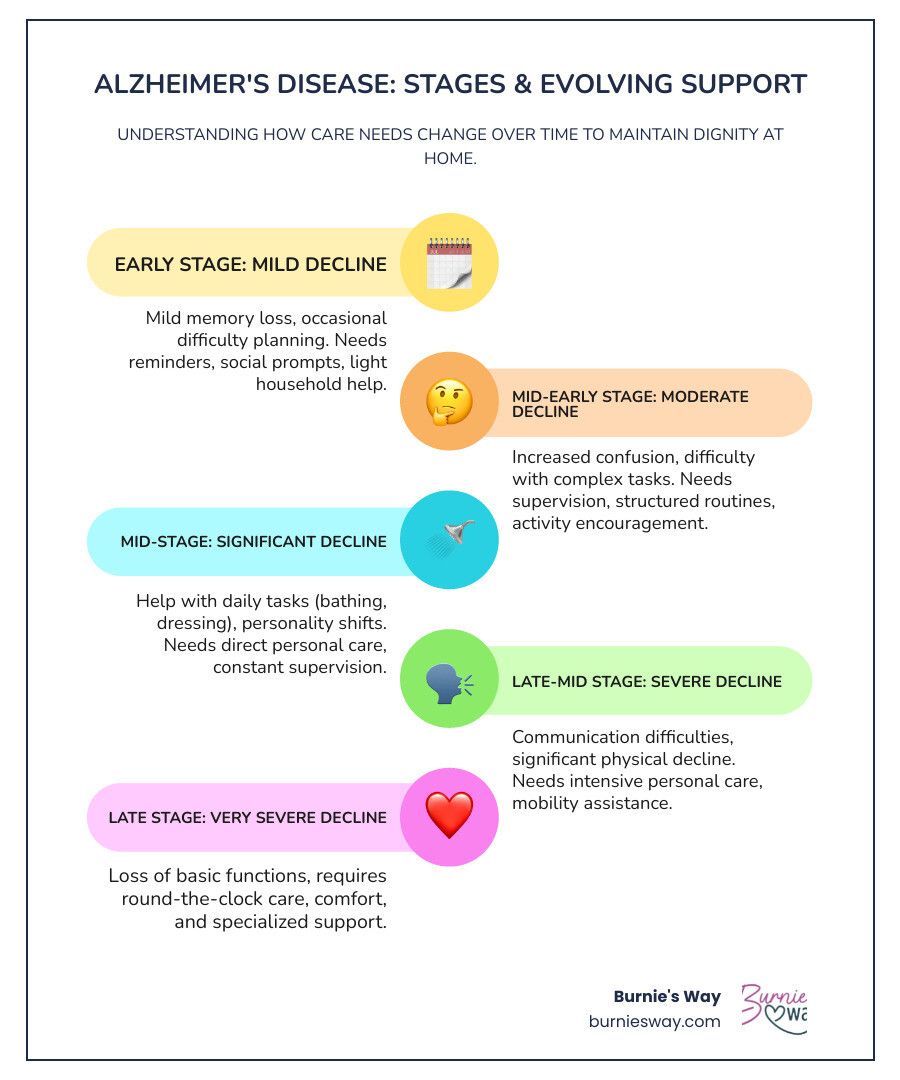
Infographic showing the progression of Alzheimer's disease through early stage (mild memory loss, difficulty with planning), middle stage (increased confusion, need for supervision, help with daily tasks), and late stage (severe memory loss, round-the-clock care needs, difficulty with basic functions). Each stage shows corresponding support needs from occasional help to full-time assistance. - Alzheimer's home care infographic infographic-line-5-steps-colors

Understanding the Spectrum of In-Home Support

When we talk about Alzheimer's home care, we're referring to a broad spectrum of services designed to help individuals live safely and independently in their own homes. These services can range from simple companionship to complex medical interventions. At Burnie's Way, we specialize in providing personal support and coordination, helping families understand the various external options available and ensuring their loved one receives the right blend of assistance. We guide you through these choices, helping to coordinate the personal support that truly fits best.

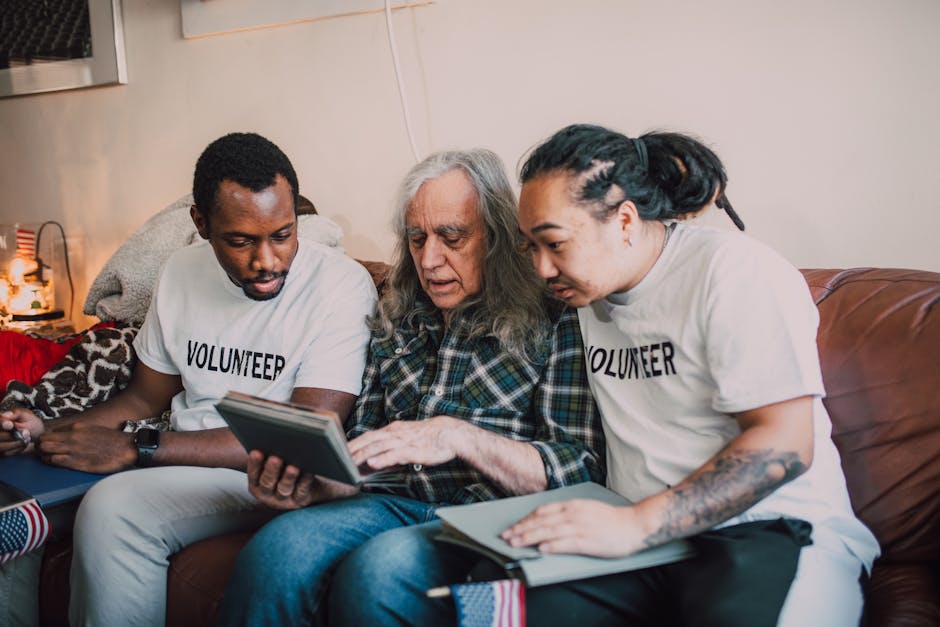
A compassionate helper and a senior looking at a photo album together - Alzheimer's home care

Companion and Homemaker Services

These services focus on social engagement, supervision, and maintaining a comfortable home environment. They are typically non-medical and aim to improve the quality of life and safety of the individual.

  • Supervision: Ensuring your loved one is safe, especially if they are prone to wandering or confusion.
  • Recreation & Companionship: Engaging in hobbies, games, conversation, or simply being a friendly presence to alleviate loneliness.
  • Light Housekeeping: Assisting with tidying up, laundry, and maintaining a clean living space.
  • Meal Preparation: Planning and preparing nutritious meals, and ensuring your loved one eats regularly.
  • Errands & Transportation: Helping with grocery shopping, prescription pickups, and accompanying your loved one to appointments or social outings.

This is where our personal support and coordination can truly shine. We can help you identify and coordinate trusted third-party providers for these essential services, making daily life smoother and more enjoyable. We believe in helping our clients live the way they want, with support in key areas of daily life. You can learn more about how we help coordinate these types of support by visiting Our Services.

Personal Support and Daily Living Assistance

While Burnie's Way focuses on personal support and coordination, it's important to understand the broader context of daily living assistance. These services involve more hands-on help with what are often called Activities of Daily Living (ADLs). They include:

  • Help with Routines: Encouragement and assistance with tasks like bathing, dressing, grooming, and toileting.
  • Reminders: Ensuring medications are taken on time and appointments are kept.
  • Social Engagement: Facilitating opportunities for interaction and participation in meaningful activities.
  • Coordination of outside services for personal care needs: We can help you find and arrange for external providers who offer these more hands-on services, ensuring your loved one receives comprehensive support while maintaining their dignity and independence.

Skilled Home Health Care (Educational Overview)

It's crucial to distinguish between personal support and medical care. Skilled home health care involves medical services provided by licensed health professionals, such as nurses or physical therapists. Burnie's Way does not provide these direct medical services, but we understand their importance and can help you steer finding them when needed. These services typically require a doctor's order and include:

  • Nursing Care: Administering medications, wound care, monitoring vital signs, and managing chronic conditions.
  • Physical Therapy: Helping to improve mobility, strength, and balance.
  • Injections: Administering necessary injections.
  • Wound Care: Professional care for wounds to prevent infection and promote healing.

Medicare provides limited coverage for home health service costs. The services must be short-term and provided by agencies certified by Medicare. For detailed information on home health services and to find certified agencies, you can refer to Information on home health services from Medicare.

Comparing In-Home Support Services

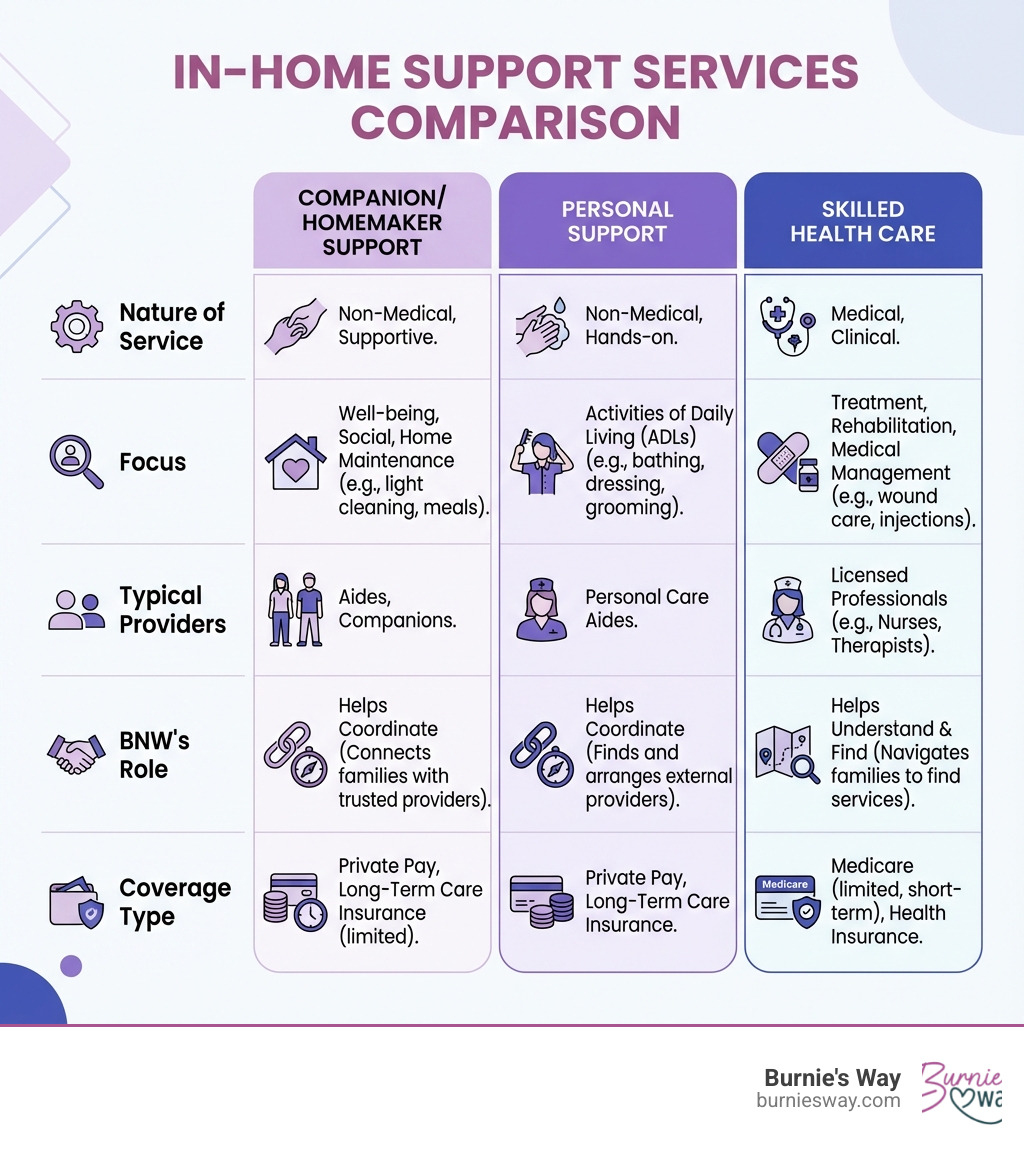
To help clarify the different types of support available, here’s a quick comparison:

Table comparing Companion/Homemaker Support, Personal Support, and Skilled Health Care. The table lists categories like "Nature of Service," "Focus," "Typical Providers," "BNW's Role," and "Coverage Type." Companion/Homemaker is non-medical, focuses on well-being/home maintenance, provided by aides/companions, and BNW helps coordinate. Personal Support is non-medical, focuses on ADLs, provided by personal care aides, and BNW helps coordinate. Skilled Health Care is medical, focuses on treatment/rehabilitation, provided by licensed professionals, and BNW helps families understand and find. - Alzheimer's home care infographic

How to Assess Your Loved One's Specific Needs

Effective Alzheimer's home care begins with a clear understanding of your loved one's current needs and how they might evolve. It's not a one-size-fits-all situation; each person experiences Alzheimer's differently, and their requirements change over time. Our role at Burnie's Way is to help you think through these crucial needs, guiding you toward making informed decisions about the external services that will best support your loved one.

When assessing needs, we encourage families to consider several key areas, always striving to involve the person with dementia in decisions as much as possible, especially in the earlier stages. This respects their autonomy and preferences, which is central to living a fulfilling life.

Here are key areas to evaluate:

  • Mobility and Fall Risk: Does your loved one have difficulty walking, balancing, or navigating stairs? Are there rugs or obstacles in the home that could pose a hazard? Safety is paramount, and identifying potential fall risks is a critical first step.
  • Medication Reminders and Management Needs: Can they remember to take their medications correctly and on time? Do they understand why they are taking them? This is a common area where support, such as medication reminders coordinated by us, can prevent significant health issues.
  • Ability to Perform Daily Routines (bathing, dressing, eating): As Alzheimer's progresses, these basic tasks can become challenging. While we don't provide direct hands-on assistance, we can help families coordinate external personal care providers who do, ensuring dignity and proper hygiene.
  • Nutritional Needs and Meal Preparation Ability: Is your loved one eating healthy, regular meals? Can they safely prepare food, or do they forget to eat? Homemaker services, which we can help coordinate, can ensure they receive nutritious meals.
  • Level of Social Interaction and Signs of Isolation: Is your loved one withdrawing from social activities? Do they seem lonely? Companionship services can significantly improve their emotional well-being. At Burnie's Way, fostering connection is a core part of our mission.
  • Home Safety Hazards (rugs, lighting, locks): Evaluate the physical environment. Are doors and windows secure? Is the lighting adequate? Are dangerous items out of reach? A thorough home safety assessment is vital for peace of mind.

Understanding the stages of Alzheimer's can also help in anticipating future needs. The FAST (Functional Assessment Staging Test) scale can be a useful tool for families to track functional changes and symptoms, providing a framework for understanding the progression of the disease and adapting support accordingly.

Finding and Choosing the Right In-Home Support and Services

Once you have a clear picture of your loved one's needs, the next step is to find and choose the right external providers for Alzheimer's home care and support. This can feel overwhelming, but you don't have to steer it alone. At Burnie's Way, we guide families through this process, connecting them with reputable resources and helping to coordinate the chosen services to ensure a seamless experience.

Where to Find Trusted Services

Finding reliable support is crucial. We recommend starting with these trusted avenues:

  • Doctor Recommendations: Your loved one's primary physician or neurologist is an excellent starting point. They often have experience with local Alzheimer's home care providers and can offer valuable recommendations.
  • Area Agency on Aging: These local agencies are fantastic resources for connecting with community services. Find your local agency at Area Agency on Aging.
  • Alzheimer's Association Community Resource Finder: The Alzheimer's Association offers a comprehensive online tool to search for local dementia care providers, community services, and support groups. Use the Alzheimer's Association Community Resource Finder.
  • Eldercare Locator: This public service connects you to services for older adults and their families. Search by zip code, city, or state through the Eldercare Locator.
  • Personal Referrals: Don't underestimate the power of word-of-mouth. Ask friends, family, and neighbors who have experience with in-home support services for their recommendations.
  • Geriatric Care Managers: These professionals can assess needs, create care plans, and find community services. They can be particularly helpful for families living at a distance.

Key Questions for Screening Providers

When you begin contacting potential external providers, whether agencies or individuals, ask thorough questions. We encourage families to be diligent in their screening process. Here are some critical questions to ask:

  • What is your experience with dementia support?
  • Are your staff trained specifically in Alzheimer's support?
  • Are you bonded and insured?
  • Do you perform background checks on all employees?
  • How do you handle emergencies or backup support if a regular helper is unavailable?
  • Can you provide references from other families?
  • What is your approach/philosophy to caring for someone with dementia?
  • Are you trained in first aid and CPR?
  • What kind of quality control checks are made?
  • Is there 24-hour call-in to a registered nurse available (for skilled care agencies)?
  • What is the cost of the service, and what are the billing procedures?

Vetting a Provider for Alzheimer's Home Support

Screening goes beyond initial phone calls. We advise a comprehensive vetting process for any external Alzheimer's home care provider you consider:

  • In-home Interviews: Always conduct interviews with prospective providers in your loved one's home. This allows you to observe their interaction with your loved one and assess their comfort in the environment. It's often helpful to have a third person present to offer another perspective.
  • Checking References: Don't skip this step! Contact at least three references provided by the agency or individual. Ask specific questions about reliability, compassion, problem-solving skills, and experience with dementia.
  • Verifying Credentials: For skilled care, ensure all licenses and certifications are current. For personal care or homemaker services, inquire about any specialized training in dementia care.
  • Understanding the Support Process: Ask how care plans are created, reviewed, and adjusted. A good provider will have a flexible approach that adapts as your loved one's needs change.
  • Observing Interaction with Your Loved One: This is perhaps the most important aspect. Does the provider show patience, empathy, and respect? Do they engage your loved one in a positive way? A genuine connection is invaluable.

At Burnie's Way, we believe in empowering families to make the best choices. While we don't directly provide these external services, we are here to support you through the vetting process, helping you organize information and coordinate the logistics. Our approach is detailed at How We Work, showcasing how we partner with families for comprehensive daily life management.

Understanding the financial aspects of Alzheimer's home care is a significant concern for many families. Costs can vary widely depending on the type of services needed, the number of hours, and your geographic location in the United States. Home care services generally charge by the hour, and some may charge a flat rate for overnight stays.

The total cost of care for people with Alzheimer's and other dementias in the U.S. is projected to reach $1.1 trillion in 2050 (in 2024 dollars), highlighting the substantial financial burden families face. It's essential to explore all potential payment avenues.

Understanding What Insurance May Cover

  • Medicare Coverage for Skilled Care: Medicare provides limited coverage for home health service costs. The services must be short-term, medically necessary, and provided by agencies certified by Medicare. This typically covers skilled nursing care, physical therapy, occupational therapy, and speech-language pathology, but generally not non-medical personal care or companionship.
  • Non-Medical Support Coverage: Unfortunately, Medicare and most private health insurance plans generally do not cover non-medical home care services like companionship, personal care assistance, or homemaker services.
  • Private Insurance Policies: It's crucial to review your loved one's private health insurance policy carefully. Some policies may offer limited coverage for certain in-home services, but this is not universal.
  • Long-Term Care Insurance: If your loved one has a long-term care insurance policy, it may cover a significant portion of Alzheimer's home care costs, including personal care and homemaker services. These policies are designed to cover extended care needs. For more details, you can visit Details on long-term care insurance.

Exploring Financial Assistance Programs

Beyond traditional insurance, several programs can offer financial relief for Alzheimer's home care:

  • Medicaid State Programs: Medicaid is a state and federal program that provides health coverage to low-income individuals. Eligibility and covered services vary significantly by state, but many states offer waivers or programs that cover in-home personal care for individuals with dementia.
  • Participant-Directed Services / Cash Assistance Programs: Some states have programs for seniors with limited resources and assets that allow them to pay a person of their choosing, including family members, for in-home services. These are often called "cash and counseling" or "participant-directed" programs. This offers flexibility and empowers families to manage care.
  • Veterans Benefits: If your loved one is a veteran or the spouse of a veteran, they may be eligible for benefits through the U.S. Department of Veterans Affairs (VA) that can help cover Alzheimer's home care costs. The VA offers various programs, including Aid and Attendance, and support for caregivers. You can learn more at VA caregiver support programs.
  • Benefit-Finding Tools: Resources like BenefitsCheckUp from the National Council on Aging can help you find federal and state benefit programs that may be able to help save money and access care and support. Additionally, Benefits.gov is another resource for federal benefits.

Navigating these financial complexities can be challenging, but understanding all your options is the first step towards securing sustainable Alzheimer's home care. Our team can help you understand these choices and coordinate the personal support that fits best within your financial framework.

Supporting the Supporter: Alleviating Caregiver Stress

Providing Alzheimer's home care is a profound act of love, but it also carries a heavy burden. Family caregivers often face immense physical, emotional, and mental challenges. The sheer volume of unpaid care underscores this: In 2023, 11.5 million family members and friends provided 18.1 billion hours of unpaid care to people with Alzheimer's and other dementias. This statistic highlights the critical need for support systems for these dedicated individuals.

Recognizing the Signs of Caregiver Burnout

Caregiver burnout is a state of physical, emotional, and mental exhaustion. It's not a sign of weakness; it's a natural consequence of the demanding nature of caregiving. Recognizing the signs early is crucial for both the caregiver's well-being and the quality of care provided. Look out for:

  • Exhaustion: Persistent fatigue, even after rest.
  • Anxiety & Irritability: Feeling constantly worried, on edge, or snapping at others.
  • Lack of Sleep: Difficulty falling or staying asleep, or feeling unrested.
  • Social Withdrawal: Neglecting friends, family, and social activities.
  • Feelings of Guilt or Resentment: Feeling guilty for wanting a break, or resentful towards the care recipient or other family members.
  • Changes in Appetite or Weight: Eating too much or too little.
  • Loss of Interest: No longer finding joy in hobbies or activities you once loved.

Asking for help is not a failure; it's a sign of strength and self-awareness. It's about protecting your own health so you can continue to be there for your loved one.

How Professional Support and Coordination Helps

This is precisely where our personal support and coordination services come in. While we don't provide direct hands-on care, we play a vital role in alleviating caregiver stress by helping to coordinate external services and managing daily life logistics.

  • Provides Respite: By coordinating external companion or homemaker services, we can arrange for qualified individuals to step in, giving you much-needed breaks to rest, recharge, or attend to your own needs. These breaks are not a luxury; they are essential for preventing burnout.
  • Reduces Daily Workload: We can help manage the complexities of schedules, appointments, and household tasks, taking some of the organizational burden off your shoulders.
  • Offers Peace of Mind: Knowing that your loved one's needs are being coordinated and that trusted external support is in place allows you to breathe easier. We help ensure everything's okay.
  • Allows for Personal Time: Whether it's for a doctor's appointment, a hobby, or simply quiet reflection, we help create opportunities for you to have personal time without guilt.
  • Prevents Isolation: Caregivers often become isolated. By coordinating external support, we help ensure your loved one is engaged, which in turn can free you up to maintain your own social connections.

We understand the loneliness caregivers might feel. Our compassionate approach acknowledges the struggles and worries of caregivers, emphasizing that taking care of yourself is one of the most important things you can do. Connecting with support systems is crucial. The ALZConnected online support community is also a valuable resource for connecting with other caregivers.

Conclusion: Creating a Supportive and Independent Life at Home

Navigating the journey of Alzheimer's home care for a loved one is undeniably complex, but it doesn't have to be a solitary path. We've explored the diverse types of in-home support available, from companion and homemaker services to the coordination of skilled medical care. We've digd into how to carefully assess your loved one's evolving needs, ensuring their safety, comfort, and engagement. We've also provided guidance on finding and vetting reputable external providers, understanding the financial landscape, and crucially, recognizing and alleviating the profound stress that often accompanies caregiving.

The overarching goal of Alzheimer's home care is to enable individuals to remain in their familiar surroundings, preserving their dignity and independence for as long as possible. This approach not only benefits the person living with dementia by reducing confusion and promoting emotional well-being but also offers peace of mind to families.

While navigating these options can be intricate, you don't have to do this alone. Burnie's Way offers personal concierge support, acting as your trusted guide and companion. We help families understand their choices, coordinate the essential external services, and provide continuous support for comprehensive daily life management. Our personalized approach, backed by our experience, ensures that your loved one can continue to live the way they want, confidently and comfortably at home.

We believe in empowering you and your family every step of the way. To learn more about how our personal support and coordination services can make a difference in your life, please visit Our Services.

The Ultimate Guide to At-Home Elder Care: Services, Specialists, and Support

12 min read

The Ultimate Guide to At-Home Elder Care: Services, Specialists, and Support

Why Finding the Right Support Matters Most Reliable home care starts with understanding what you need and knowing where to find trustworthy help....

Read More
Unlocking Support: Essential Private Elder Care Services for Seniors

10 min read

Unlocking Support: Essential Private Elder Care Services for Seniors

Why Understanding Your Options Matters Now Private elder care services are non-medical and specialized support options that help seniors live...

Read More
Beyond the Walls: Finding Your Perfect Home Care Solution

12 min read

Beyond the Walls: Finding Your Perfect Home Care Solution

The Comfort of Home and the Path to Independence Home care solutions are the services and support that help aging adults live safely, comfortably,...

Read More