13 min read
Beyond the Search: How to Pick the Best Caregiver Matching Service
Why Finding the Right Support Partner Matters A caregiver matching service connects families with qualified support companions or personal...
11 min read
Sydney Giffen
:
February 26, 2026

Assistance with daily activities helps people maintain independence and safety at home as they age. These activities fall into two categories:
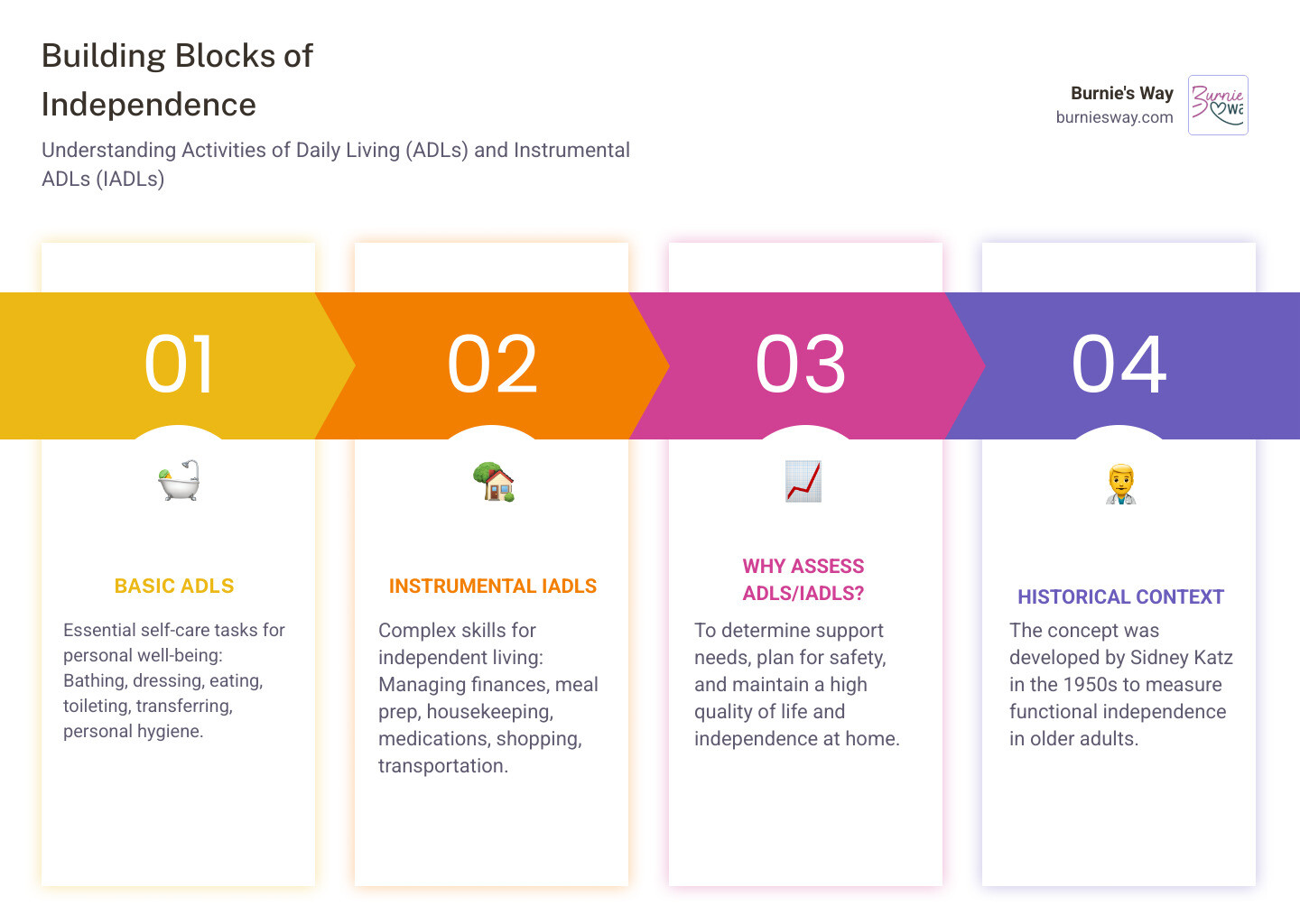
Basic ADLs (Activities of Daily Living) - Essential self-care tasks:
Instrumental ADLs (IADLs) - Complex tasks for independent living:
Most of us take these daily tasks for granted. We wake up, shower, get dressed, make breakfast, and go about our day without a second thought.
But for many older adults, these once-simple activities become harder. Maybe your mom struggles to button her shirt. Perhaps your dad forgets whether he took his medication. Or your aunt can't safely step into the bathtub anymore.
These changes don't mean someone needs to move out of their home. They mean it's time to understand what support looks like—and how to find the right help.
The concept of Activities of Daily Living (ADLs) was developed in the 1950s by Sidney Katz to measure functional independence. Today, healthcare professionals use ADL assessments to determine what kind of support someone needs and whether they can safely live independently.
This guide explains what ADLs and IADLs are, why they're assessed, what challenges people face, and how families can find the right support to help their loved ones live confidently at home.

Key assistance with daily activities vocabulary:
To truly understand assistance with daily activities, we first need to define the fundamental tasks that underpin our independence. These are collectively known as functional status and are divided into two main categories: Basic Activities of Daily Living (ADLs) and Instrumental Activities of Daily Living (IADLs). The pioneering work of geriatrician Sidney Katz in the 1950s laid the groundwork for these classifications, initially to measure changes in physical function for patients with disabling conditions. Today, these classifications remain crucial tools for assessing an individual's ability to live independently and identifying areas where support may be needed.
Basic ADLs are the fundamental self-care tasks essential for our physical survival and well-being. These are the routine activities most healthy individuals perform without assistance. When someone struggles with these tasks, it often indicates a need for direct, hands-on support.
Here are the 6 core ADLs, along with personal hygiene, that healthcare professionals commonly assess:
These basic tasks are often the first indicators of a decline in physical function, and difficulty with them can significantly impact an individual's quality of life and safety.
Instrumental Activities of Daily Living (IADLs) are more complex skills that are necessary for independent living within a community. In addition to basic physical functioning, these tasks require higher-level cognitive abilities, organizational skills, and judgment. They were developed in the late 1960s to identify disabilities that might not be apparent from ADL scales alone. Many people who need help with IADLs can still perform basic ADLs just fine.
Here are the common IADLs:
Difficulty with IADLs can signal a need for support to maintain an independent lifestyle. For example, someone with early-stage Alzheimer's disease might first need help with managing finances and preparing meals before requiring assistance with daily activities like bathing or dressing. At Burnie's Way, we understand the nuances of these needs. To learn more about how we can support a vibrant and independent lifestyle, you can find More info about our services.
Assessing an individual's ability to perform ADLs and IADLs is more than just a checklist; it's a critical step in ensuring their safety, planning for their future, and determining the right level of support. These assessments are essential for predicting future needs, such as the likelihood of needing in-home support, residential care, or hospitalization. For example, when someone needs help with at least two ADLs or IADLs, it's often an indication that in-home support or residential care may be needed.
Beyond personal planning, ADL and IADL assessments also play a significant role in eligibility for various programs. Many private long-term care policies require policyholders to demonstrate a need for assistance with daily activities to begin using their benefits. Similarly, the VA requires beneficiaries to need help with at least two ADLs before covering the cost of home support through the Aid and Assistance benefit.
When concerns arise about an individual's ability to manage daily tasks, a formal assessment by trusted professionals is often the next step. Healthcare providers such as nurses, occupational therapists, physical therapists, case managers, and social workers are typically involved in this process.
The assessment usually involves a combination of methods:
Several standardized tools are used to quantify functional abilities. The The Katz Index of Independence in Activities of Daily Living is a common instrument for gauging independence in basic ADLs. It asks about six tasks (bathing, dressing, toileting, transferring, continence, feeding), assigning one point for each task completed independently. For IADLs, the The Lawton-Brody Instrumental Activities of Daily Living Scale (IADL) is frequently used, assessing more complex tasks like managing finances and meal preparation. While these checklists are valuable, it's always best to involve a healthcare provider for accurate assessment and guidance.
Life events and subtle changes can often trigger the need for an ADL assessment. It's not always a sudden crisis; sometimes, it's a gradual shift that becomes noticeable over time. Here are some common situations that typically warrant an ADL assessment:
It’s easy to shrug off such challenges as normal for aging. But if you notice it’s harder to do a basic ADL than it used to be, don’t keep it to yourself. Your provider may make suggestions for simple changes or coordinate further support.
As we age or face health changes, performing daily activities can become challenging. It's a journey that often involves physical problems, cognitive shifts, and significant emotional adjustments. We understand that what might seem like a simple task to one person could be a major hurdle for another.
Common physical challenges often revolve around mobility, strength, and balance. Getting in and out of bed, walking across a room, or even lifting a teacup can become difficult due to conditions like arthritis, muscle weakness, or neurological disorders. This can increase the risk of falls, which have a poor prognosis for older adults.
Cognitive changes, such as those seen in dementia or mild cognitive impairment, profoundly affect a person's ability to perform ADLs and IADLs. Memory problems can lead to forgetting steps in a task, while impaired judgment can make managing finances or medications dangerous. Executive function, which includes planning and problem-solving, is crucial for IADLs and often declines with cognitive impairment. This means an individual might forget to turn off the stove or get lost while driving.
The emotional aspects of needing help are also significant. Asking for assistance with daily activities can feel embarrassing, demoralizing, or like a loss of independence and dignity. It's a sensitive topic, and we believe approach it with empathy and respect, creating an environment where individuals feel safe sharing their concerns and preferences.
Fortunately, there are many strategies and tools available to help individuals maintain their independence and continue living comfortably at home.


When an individual needs support with ADLs or IADLs, a network of resources can be tapped into.
Once ADL and IADL assessments are completed, the real work begins: interpreting the results and making informed decisions about the best path forward. If an assessment reveals that an individual needs help with two or more ADLs or IADLs, it's a strong indicator that a structured support plan is necessary. Our goal is to match the support to the specific needs, ensuring independence is maximized while safety and well-being are prioritized.
The decision about where an individual lives is deeply personal and depends heavily on their ADL and IADL capabilities, as well as personal preferences.
Here's a simplified comparison:
| Feature | Home Support (Aging in Place) | Community Living Options (e.g., Assisted Living) |
|---|---|---|
| Environment | Familiar home setting. | Dedicated facility with communal and private spaces. |
| Personalization | Highly customizable support custom to individual needs and preferences. | Structured environment with services available to all residents, some personalization. |
| Privacy | Maximum privacy and control over daily life. | Reduced privacy, shared spaces and staff interactions. |
| Cost | Can vary widely depending on hours and types of support coordinated. | Monthly fees covering housing, meals, and assistance with daily activities. |
| Medical Care | Coordinated externally with existing healthcare providers. | On-site medical staff or readily available medical support (varies by facility type). |
| Social Interaction | Relies on community engagement, family visits, and coordinated activities. | Built-in social activities, common areas, and peer interaction. |
| BNW's Role | Coordinates support services, manages schedules, provides companionship, and helps steer options to maintain independence. | Can help families understand these options and coordinate transitions or additional non-medical support for residents. |
Regardless of the chosen path, open and honest communication is the cornerstone of successful support. This means talking with loved ones, discussing their preferences, and involving trusted professionals to create a collaborative support plan.
When initiating these conversations, it's crucial to approach them with empathy and respect. We know that admitting a need for help can be difficult, so framing the discussion around maintaining independence and quality of life is key. Encourage your loved one to express their wishes and concerns. As our internal philosophy emphasizes, genuine conversations are at the heart of what we do, ensuring our clients and their families feel heard and valued.
Involving professionals like geriatric care managers or mental health professionals can also be invaluable. They can offer objective perspectives, identify specific needs, and help mediate discussions. A strong support system, whether through family, friends, or services like Burnie's Way, helps ensure that everyone is aligned in supporting the individual's well-being and independence. We believe in empowering older adults to take charge of their lives, recognizing their strengths, and fostering a sense of autonomy and dignity in everything we do.
We often encounter common questions about assistance with daily activities. Here are some of the most frequent ones:
This is a critical distinction. You might be able to move from one spot to another in your home, but if you feel off balance as you do so, or have near misses where you almost fall, it’s important to tell a healthcare provider. The difference between doing an ADL and doing it safely lies in the risk involved. An individual might perform a task (e.g., showering), but if it puts them at high risk for injury (e.g., falling in the tub), they are not performing it safely. Independence isn't just about completion; it's about safe, sustainable completion. Proactive measures, like installing grab bars or using a shower chair, can bridge this gap between ability and safety.
Starting this conversation can be challenging because it touches on sensitive topics like independence and aging. We recommend choosing a calm, private moment, rather than during a stressful event. Express your concerns with empathy, focusing on their well-being and how support can help them maintain the lifestyle they cherish. Phrases like, "I've noticed you seem a bit tired lately, and I want to make sure you're comfortable and safe at home," can be less confrontational than, "You can't do this anymore." Offer solutions collaboratively, asking for their input on what kind of support would be most helpful. The goal is to empower them, not to diminish their autonomy. At Burnie's Way, we emphasize an open and genuine dialogue, ensuring clients and their families feel heard and valued.
Absolutely! Technology offers a growing array of solutions for assistance with daily activities. Smart home devices can automate lighting, adjust thermostats, and even remind individuals about appointments. Automatic pill dispensers can ensure medication adherence. Emergency alert systems, often worn as pendants or bracelets, provide immediate connection to help in case of a fall or medical emergency. For IADLs, meal delivery apps and online grocery services can simplify food management, while telehealth platforms allow for remote medical consultations, reducing the need for transportation. These tools don't replace human support but can significantly improve safety, convenience, and independence.
Understanding ADLs and IADLs is the first step toward proactive planning for a future where independence and quality of life remain paramount. As we've explored, recognizing changes in the ability to perform daily tasks is crucial, and a thoughtful assessment provides the roadmap for effective support.
At Burnie's Way, we believe in the value of a personalized support system. We act as your dedicated personal concierge, coordinating services and managing the complexities of daily life so you or your loved one can continue to thrive at home. We empower older adults to live confidently, ensuring they have the support needed to steer challenges while preserving their dignity and autonomy. Our compassionate approach focuses on lifestyle coordination and independence-focused assistance, helping you live the way you want, with peace of mind.
To find how Burnie's Way can create a custom plan that supports your unique needs and aspirations, we invite you to explore our offerings. Learn more about our personalized services and let us help you or your loved one continue to live a full and independent life at home.
13 min read
Why Finding the Right Support Partner Matters A caregiver matching service connects families with qualified support companions or personal...
13 min read
What Continuous Care Services Really Mean for You and Your Family Continuous care services are specialized, short-term support designed to help...
12 min read
Understanding Long-Term Care: What It Means for You and Your Family Long term care is a range of services and supports designed to help people meet...