10 min read
Unlocking Support: Essential Private Elder Care Services for Seniors
Why Understanding Your Options Matters Now Private elder care services are non-medical and specialized support options that help seniors live...

9 min read
Sydney Giffen
:
Jan 15, 2026 8:41:25 PM
Elderly in-home care includes a range of services that help older adults maintain independence at home. If you're exploring options for a loved one, here's a quick overview:
Quick Overview: Types of In-Home Support
The desire to age in place is strong, with 88% of adults ages 50-80 wanting to stay home as long as possible. It's about maintaining dignity, independence, and connection. However, coordinating the right support can feel overwhelming, leaving families to juggle questions about cost, quality, and safety.
This guide cuts through the confusion. We'll explain the types of support available, help you recognize when help is needed, break down costs, and show you how to find trustworthy providers. Whether you're just starting your search or actively seeking solutions, this resource will provide the clarity to make confident decisions.

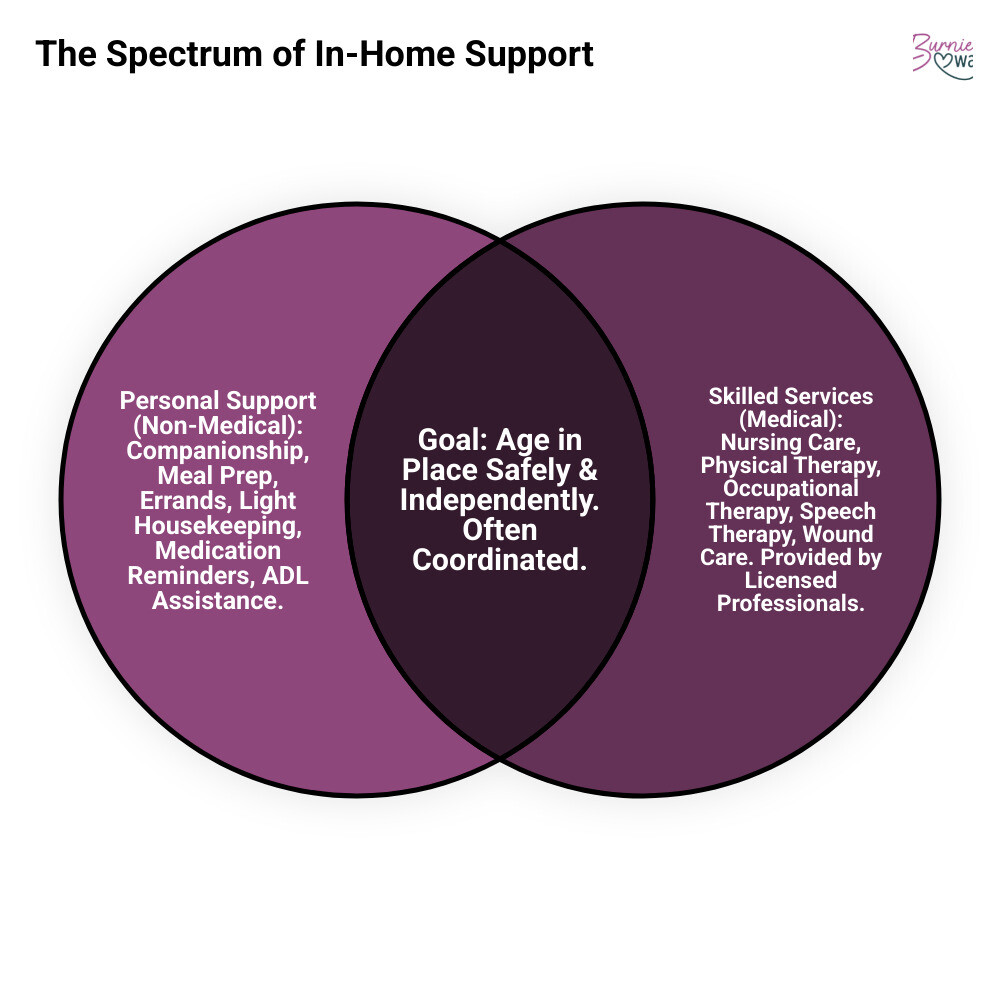
When we talk about elderly in-home care, it's an umbrella term for a spectrum of services. These are typically categorized into two main types: personal support (non-medical) and skilled services (medical). Burnie's Way focuses on personalized, non-medical support and lifestyle coordination, helping individuals live comfortably at home. We also help families understand and coordinate external skilled services when needed.
The key distinction is the nature of the assistance. Personal support helps with daily living and maintaining an independent lifestyle, while skilled services are medical and require licensed professionals.
To better illustrate, let's look at what each category entails:
Here's a quick comparison:
| Feature | Personal Support (Non-Medical) | Skilled Services (Medical) |
|---|---|---|
| Provider Type | Personal concierges, home care aides, companions (e.g., Burnie's Way team members) | Licensed healthcare professionals (e.g., Registered Nurses, Physical Therapists, Occupational Therapists) |
| Focus | Lifestyle coordination, companionship, assistance with ADLs/IADLs, emotional well-being, promoting independence | Medical treatment, rehabilitation, clinical monitoring, recovery from illness/injury |
| Services | Meal planning & prep, light housekeeping, errands, transportation, medication reminders, social engagement, personal care | Wound care, injections, medication administration, physical therapy, occupational therapy, speech therapy, health monitoring |
| Regulation | Varies by state; often less stringent than medical services | Highly regulated; requires state licensing and certification |
| Burnie's Way | We excel in providing these personalized services. | We help families understand and coordinate these external services. |
Our personal support services improve life at home, foster independence, and ensure peace of mind. It's about maintaining connections and enjoying the comfort of one's own space.
Here’s a closer look at the types of personal support we offer:
Our approach is always personalized to meet the unique needs of each individual.
More info about our personal support services
While Burnie's Way specializes in personal support, we understand medical needs can arise. Skilled services refer to medical care provided by licensed healthcare professionals, which are distinct from our non-medical support.
These services are provided by external agencies and can include:
Burnie's Way does not provide these skilled medical services. However, we help families steer the elderly in-home care landscape by coordinating with external licensed providers to ensure a comprehensive support system is in place.
Identifying when a loved one needs additional support can be a gradual process. Recognizing these signs early can make the transition to receiving help much smoother.
According to the Administration for Community Living, many older adults face challenges with independence, with 39% reporting trouble with mobility, such as walking or climbing stairs. Here are common signs that could indicate a need for elderly in-home care or personal support:
If you notice several of these indicators, it's a good time to consider how personal support could help.
Initiating a conversation about needing help can be challenging. Our approach is to focus on supporting autonomy and well-being.
Here are some tips for this sensitive discussion:
For more in-depth guidance on caregiving conversations, we recommend you Explore this guide for caregivers. It offers valuable insights into getting started and finding support.
The desire to age in place is strong, with 88% of adults ages 50-80 expressing this preference. For many, personal support at home, like the services we offer at Burnie's Way, is a key enabler of this goal.

When considering elderly in-home care, it's natural to weigh it against other senior living choices. Each has pros and cons regarding cost, independence, and personalized attention.
Cost is a significant factor, but personal support can be flexible to fit a family's budget and needs.
According to recent data, the median monthly cost for in-home homemaker services in the U.S. is approximately $4,957, based on 44 hours of support per week. For home health aide services from external agencies, the median is slightly higher at $5,148.
Actual costs vary based on:
Many families start with fewer hours and increase support as needs evolve. We encourage an open discussion about budget and needs to create a plan that works.
More info about pricing for personal support
Understanding how to pay for elderly in-home care is crucial for long-term planning. While personal support can be flexible, it's still a significant investment. We believe in empowering families with information on their financial options.
Consulting a financial advisor specializing in elder care can help you develop a comprehensive plan.
Understanding the specific roles of Medicare and Medicaid is important. Burnie's Way provides non-medical personal support, which is not covered by Medicare or Medicaid. However, we can help families understand these options for medically necessary services.
Understanding these distinctions is vital for blending personal assistance with medically necessary services.
Finding the right support for your loved one is a journey. Whether you seek personal support like ours or other forms of elderly in-home care, trustworthiness and a good fit are paramount.
There are two main routes to finding help:
Asking for referrals from friends, neighbors, or healthcare providers is an excellent starting point. For broader resources, national and local organizations can help:
A thorough vetting process is essential. Here are some best practices:
These steps help ensure that anyone providing support is competent, trustworthy, and aligns with your family's values.
We understand that navigating elderly in-home care brings up many questions. Here are answers to some common inquiries.
The main difference is the nature of the assistance. Personal support, which Burnie's Way specializes in, is non-medical help with daily living, companionship, and lifestyle coordination to improve quality of life.
Skilled services are medical in nature and must be provided by licensed healthcare professionals like nurses or therapists. These include services like wound care or rehabilitation therapy. Burnie's Way does not provide skilled medical services but can help coordinate these external options.
Costs for elderly in-home care vary by location, services, and hours. Nationally, the median monthly cost for non-medical homemaker services is about $4,957, while home health aide services are around $5,148. These figures are based on 44 hours of support per week and can be higher or lower depending on your state and needs.
No, Medicare does not cover 24/7 elderly in-home care or long-term personal support. Its home health benefit covers medically necessary, part-time skilled nursing and therapy for individuals certified as homebound. It does not cover non-medical services like companionship or housekeeping if those are the only services needed. Families typically use private pay or long-term care insurance for ongoing personal support.
Choosing the right path for elderly in-home care is a significant family decision. We've explored the landscape of support, from vital companionship and personal assistance to specialized skilled services from external medical professionals. We've also covered how to recognize the need for help and steer financial considerations.
The goal is clear: maintaining independence and quality of life at home is a deeply held desire for most older adults. With the right support system, this can be a reality, empowering your loved ones to live on their own terms in their cherished home.
We believe in personalized support, custom to the unique needs of each individual. Our goal is to foster independence and connection while giving families peace of mind.
For families seeking to coordinate services, Burnie's Way offers personal concierge assistance to help manage daily life with confidence. We're here to be your guide on this journey.
10 min read
Why Understanding Your Options Matters Now Private elder care services are non-medical and specialized support options that help seniors live...
12 min read
Why Finding the Right Support Matters Most Reliable home care starts with understanding what you need and knowing where to find trustworthy help....
12 min read
The Comfort of Home and the Path to Independence Home care solutions are the services and support that help aging adults live safely, comfortably,...