
What Is a Health Care Aide and Why So Many Families Are Searching for Answers
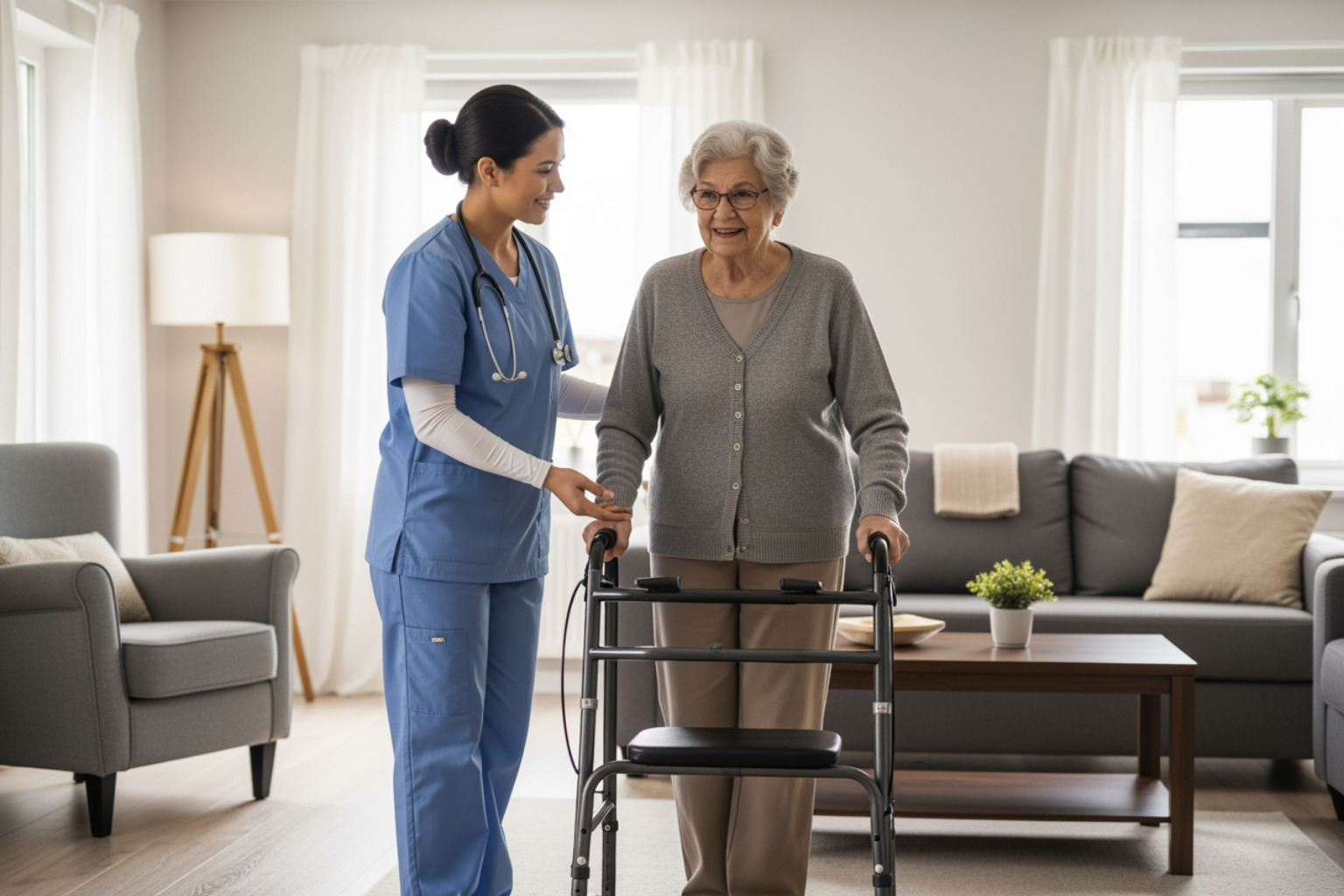
A health care aide is a trained support worker who helps people with daily living tasks - things like bathing, dressing, eating, moving safely, and staying connected to the world around them.
Here is a quick overview of what you need to know:
| Question | Quick Answer |
|---|---|
| What do they do? | Help with personal care, mobility, meals, grooming, and daily routines |
| Where do they work? | Homes, hospitals, long-term care, assisted living, community settings |
| Who do they help? | Older adults, people with disabilities, those recovering from illness |
| Are they nurses? | No - they work under the supervision of regulated health professionals |
| What are they called? | HCA, home health aide, personal care aide, care aide, nursing assistant |
| How fast is demand growing? | 17% projected growth from 2024-2034 - much faster than average |
If your family is trying to figure out whether a health care aide is the right support for an aging parent, you are not alone. More than half of people turning 65 today are expected to need significant long-term care at some point - and the demand for qualified aides is growing faster than almost any other occupation.
The terminology can be confusing. Health care aide, home health aide, personal care aide, CNA - these titles mean different things depending on where you live, who is hiring, and what care is needed. In Canada, "health care aide" or "health care assistant" is the most common term. In the US, you will often see "home health aide" or "personal care aide."
This guide cuts through the confusion. Whether you are exploring this as a career, trying to hire support for a loved one, or just trying to understand what these roles actually involve, you will find clear, practical answers here.
At Burnie's Way, we help aging adults and their families navigate exactly these kinds of decisions - not as a care provider, but as a trusted guide, concierge-style support partner, and source of day-to-day coordination.
What Is a Health Care Aide and What Do They Actually Do?
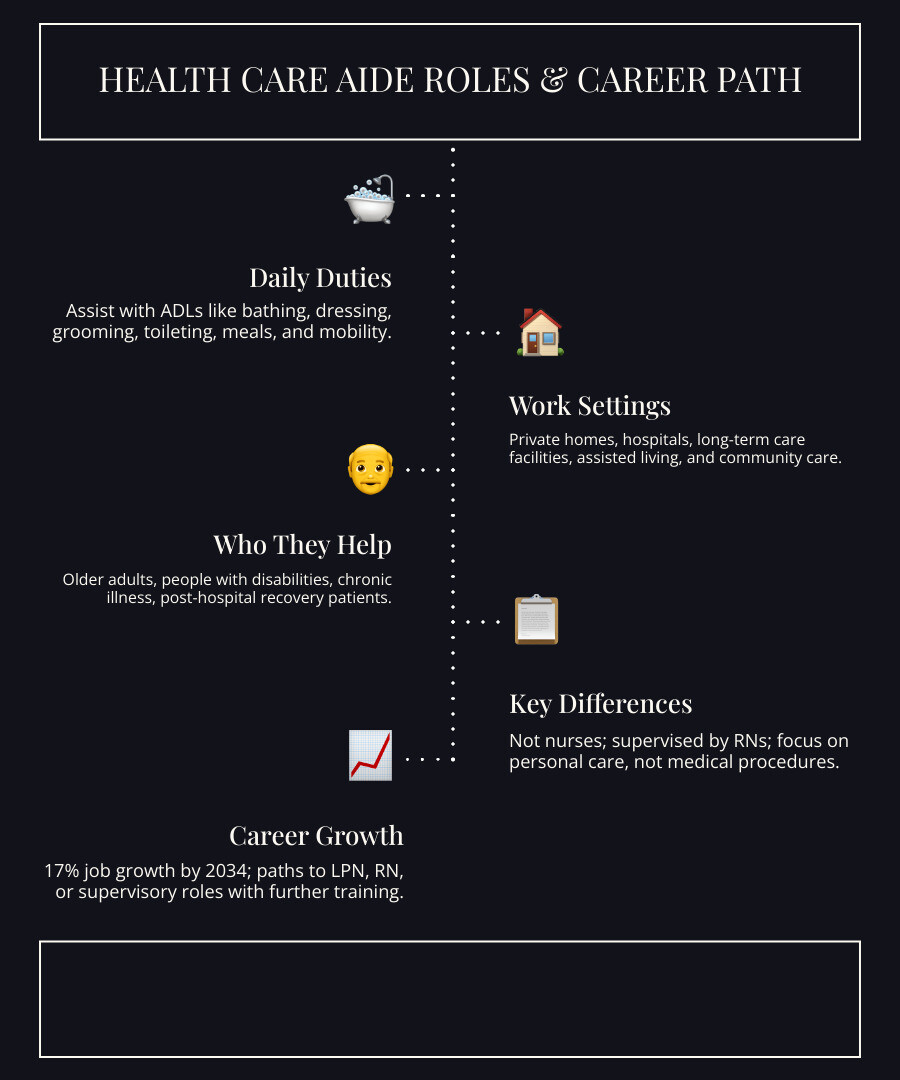
A health care aide helps people with activities of daily living, often called ADLs. That usually includes bathing, dressing, grooming, toileting, eating, mobility help, and general day-to-day support. They may also offer companionship, notice changes in condition, and report concerns to a nurse or supervisor.
In plain English: they help people get through the ordinary parts of the day when those “ordinary” tasks are no longer easy.
Health care aides are commonly needed by:
- Older adults who want to remain at home
- People living with disability or chronic illness
- Adults recovering after hospitalization
- Families needing respite support
- Veterans who qualify for home-based aide programs
- People who are isolated or need regular routine support

What a health care aide does day to day
Daily responsibilities vary by setting, but often include:
- Assisting with getting out of bed and safe transfers
- Helping with bathing, grooming, oral care, and dressing
- Supporting toileting and continence routines
- Preparing simple meals and assisting with feeding
- Helping with walking, repositioning, and mobility devices
- Providing medication reminders
- Taking and recording basic vital signs in some roles
- Changing linens and keeping the living space tidy
- Following infection-control and safety practices
- Documenting what was done and reporting concerns
In home settings, the day may feel more personal and less “institutional.” In facilities, the pace may be faster and more team-based. Either way, dignity matters. A good aide does not just complete tasks; they help a person feel respected while doing them.
What a health care aide cannot do
This role has limits, and that is important.
A health care aide is not a nurse, doctor, or therapist. They usually cannot independently perform skilled nursing tasks, diagnose conditions, change treatment plans, or handle complex medical procedures unless a task is specifically allowed, delegated, and supervised under employer policy and state rules.
That means duties such as medication administration, wound care, injections, or advanced clinical procedures may be restricted or only allowed in tightly defined settings. Scope depends on:
- State regulations
- Employer policy
- Training completed
- Whether a nurse supervises the work
- The specific care setting
When families hire help, this is one of the biggest points of confusion. “Can they do meds?” is not a one-size-fits-all question. It depends.
Who benefits most from health care aide services
The people who benefit most are usually those who need regular help, but not always full-time nursing care. Examples include:
- A parent who needs bathing and mobility support
- A senior with memory loss who benefits from structure
- Someone recovering after surgery who needs temporary help at home
- A veteran using VA homemaker or home health aide benefits
- A family caregiver who needs breaks before turning into a very tired superhero
Health Care Aide vs Home Health Aide vs Personal Care Aide vs CNA
These titles overlap, but they are not always identical.
| Role | Main focus | Typical setting | Medical tasks | Common training level |
|---|---|---|---|---|
| Health Care Aide | Personal support and daily living help | Homes, long-term care, hospitals | Limited, supervised, setting-dependent | Employer or program-based |
| Home Health Aide | Personal care plus basic health-related support | Client’s home | More likely to monitor health or assist under nurse direction | Formal training often required |
| Personal Care Aide | Non-medical daily support | Home or community | Usually no clinical tasks | Often short training or on-the-job |
| CNA | Bedside support in clinical settings | Nursing homes, hospitals | More structured patient-care tasks under nursing supervision | State-approved training and exam |
Health care aide vs home health aide
In the US, “home health aide” is the more common term for aides who work in a person’s home and may do both personal care and limited health-related tasks under supervision. According to the Bureau of Labor Statistics, these workers help with self-care, household tasks, and sometimes basic health monitoring.
So what is the practical difference?
- A health care aide is often a broader umbrella term
- A home health aide usually works specifically in the home
- Home health aides may be more likely to work under nurse direction
- The exact duties depend on employer and state standards
Health care aide vs personal care aide and CNA
A personal care aide usually focuses on non-medical help such as meal prep, housekeeping, dressing, supervision, and companionship. A CNA, by contrast, tends to work in more clinical settings and must complete state-approved nurse aide training and pass a competency exam.
For a simple comparison of nursing assistant and home care roles, the Virginia Health Workforce resource is useful.
A shortcut:
- PCA = mostly non-medical support
- HHA = home-based support with some health-related tasks
- CNA = more formal nursing-assistant role with state testing
- HCA = broad term that may overlap with any of the above, depending on location
Education, Training, Certification, and Registration Requirements
In the US, requirements vary by state and employer. There is no single national “health care aide” license that covers every title and setting. That is why job postings can look wildly different even when the work sounds similar.
How to become a health care aide
A common pathway looks like this:
- Earn a high school diploma or GED, if required
- Choose the role you want: PCA, HHA, or CNA
- Complete the required training program
- Finish clinical practice if the program includes it
- Obtain CPR or first aid if the employer asks for it
- Pass background checks and onboarding
- Apply for jobs and complete employer orientation
For CNAs, training is usually more standardized. For home health aides and personal care aides, training may be delivered by an employer, a vocational school, or a state-approved program.
Province and state requirements for health care aide roles
If you are researching this online, you will see many references to Canadian systems such as HealthLink BC or the BC Care Aide & Community Health Worker Registry. These are helpful for understanding the role generally, but they do not apply to Virginia hiring rules.
For US readers, the key point is this: requirements depend on title and setting.
In Virginia and elsewhere in the US:
- CNAs follow state nurse aide requirements
- HHAs may need formal training depending on agency and funding source
- Medicare-certified home health agencies must meet federal Conditions of Participation
- Private-duty non-medical roles may have employer-specific standards instead of state certification
Always check the employer, the state board if CNA is involved, and whether the role is agency-based, facility-based, or private hire.
Typical program length, cost, and what training includes
Training length can range from a few weeks to several months depending on the role.
Programs often cover:
- Body mechanics and safe transfers
- Infection prevention
- Communication skills
- Documentation basics
- Personal care techniques
- Nutrition and meal assistance
- Dementia basics
- End-of-life or hospice awareness
- Emergency response
- Professional boundaries
CNA programs are usually the most structured. Home health aide programs may include classroom work plus supervised practical training. Personal care aide roles may rely more heavily on employer onboarding.
Where Health Care Aides Work, What They Earn, and Job Outlook in 2026
Health care aides work in many environments, not just private homes.
Common settings include:
- Private homes
- Home health agencies
- Assisted living communities
- Long-term care facilities
- Hospitals
- Hospice and community support programs
Common work environments and what the job feels like
This is hands-on work. Literally.
The job often involves:
- Standing and walking for long periods
- Lifting, repositioning, and helping with transfers
- Very close physical contact
- Constant interaction with clients and staff
- Exposure to illness and infection risks
- Evening, weekend, or holiday shifts
- Emotional situations, including decline and grief
It also involves relationship-building. Many aides become the steady, familiar presence in someone’s week. That emotional side is part of what makes the work meaningful and demanding at the same time.
Salary ranges and employment outlook
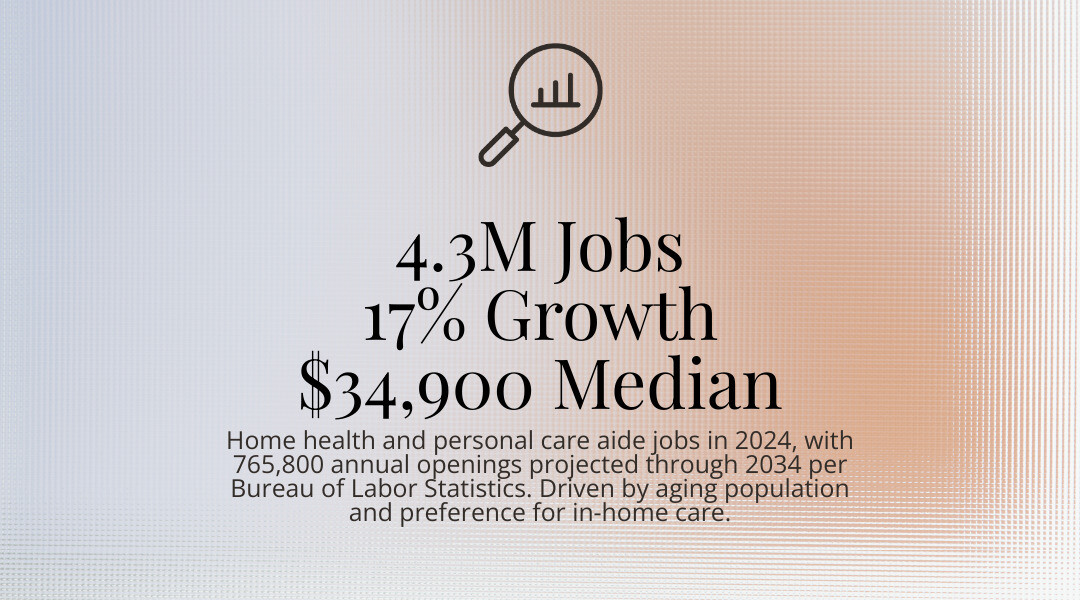
The outlook is strong. The Bureau of Labor Statistics reports:
- 4,347,700 home health and personal care aide jobs in 2024
- 17% projected growth from 2024 to 2034
- About 765,800 openings each year on average over the decade
- Median pay of $34,900 per year, or $16.78 per hour, in May 2024
That growth is driven by an aging population, more chronic illness, and a strong preference for receiving support at home rather than moving into institutional care.
Pay varies widely based on:
- State and local labor market
- Agency vs private hire
- Home care vs facility setting
- Experience and certifications
- Shift differentials for nights or weekends
Skills and personal qualities that matter most
The best aides are not just trained. They are steady.
Important qualities include:
- Empathy
- Patience
- Reliability
- Clear communication
- Observation skills
- Time management
- Physical stamina
- Respect for boundaries
- Professionalism
- Cultural sensitivity
A good aide notices when something small changes before it becomes something big. Maybe appetite drops. Maybe walking becomes slower. Maybe confusion increases. Those observations matter.
Hiring a Home Health Aide for a Loved One: What Families Should Know
Finding the right aide can feel overwhelming, especially if the need is urgent. The key is to slow the process down just enough to ask smart questions.
At Burnie's Way, we help families understand support options and coordinate the practical pieces around daily life at home. In-home care is one of many choices families consider, and we can help make that process less confusing through personal support, guidance, and trusted coordination.
How to find and choose the right aide
Start with the need, not the job title.
Ask:
- Does your loved one need hands-on personal care?
- Is the support mainly companionship and routine help?
- Are transfers, bathing, or toileting involved?
- Is memory loss part of the picture?
- Do you need part-time, overnight, or live-in support?
Then look for:
- Relevant training or certification
- Experience with similar needs
- Background checks
- References
- Clear scheduling expectations
- Transportation reliability
- Good communication style
- Personality fit
A trial period can be very helpful. Skills matter, but fit matters too. Someone can have perfect credentials and still be the wrong match if the interaction feels rushed or cold.
For more guidance, see how to get elderly carer guide and live-in carer for elderly person.
How to manage care successfully at home
Once support begins, families need structure.
Helpful tools include:
- A written task list
- A weekly schedule
- Notes on routines and preferences
- A communication log for updates
- Emergency contacts
- Clear boundaries around duties
Watch for red flags such as:
- Frequent lateness
- Poor communication
- Rough transfers or unsafe technique
- Missed tasks
- A loved one becoming fearful or withdrawn
- No backup coverage when someone calls out
Good home support is not "set it and forget it." It works best when families review what is and is not working.
Related reading: old people care taker and elder care specialists.
Veterans programs and other support resources
Some veterans may qualify for VA Homemaker and Home Health Aide Care. This program can help enrolled veterans who meet clinical criteria receive help at home with activities such as bathing, dressing, eating, mobility, and toileting.
Important details:
- Services are provided in the home
- Aides are supervised by a registered nurse
- The benefit may be combined with other community-based services
- Availability varies by location
- Copays may apply depending on disability status and eligibility
Families considering this option should talk with a VA social worker and ask about decision tools and caregiver self-assessment resources.
Career Growth and Next Steps in Personal Support
Aide roles are often entry points into a much bigger career path.
Advancement opportunities after entry-level work
With experience and additional training, workers may move into:
- Senior aide roles
- Dementia support specialization
- Restorative aide work
- Medication aide roles where permitted
- Unit clerk or coordinator positions
- CNA to LPN pathway
- LPN to RN pathway
- Team lead or supervisory roles
Many people start in personal support, then discover they want to build a long-term healthcare career. Others stay in aide roles because they value direct human connection more than paperwork and meetings. Honestly, that is understandable.
Is this the right path for you or your family?
As a career, this path can be a strong fit if you:
- Like practical, active work
- Communicate well with older adults
- Can stay calm under pressure
- Are comfortable with close personal assistance
- Want meaningful work with strong demand
As a family decision, aide support may be right if your loved one needs more than companionship but less than full-time nursing.
And if your family is trying to figure out the bigger picture, that is where we come in. Burnie's Way helps aging adults stay independent through personal support, coordination, companionship, and trusted day-to-day guidance. We are not a medical provider, and we do not provide caregiving services, but we can help families sort through options and build a more workable plan.
You may also like aged care aides and caretaker for old age.
Frequently Asked Questions about Health Care Aides
Do health care aides give medication or perform medical procedures?
Sometimes, but only within limits. Many aides can give medication reminders. Some may assist with certain tasks if state rules, training, employer policy, and nurse oversight allow it. They should not perform skilled medical procedures independently unless specifically authorized.
Is a health care aide the same as a CNA everywhere?
No. Titles vary by employer and location. In the US, CNA is a more regulated title tied to nurse aide training and testing. “Health care aide” is broader and may overlap with home health aide or personal care aide roles.
How many hours can a home health aide provide each week?
It depends on need, funding, and the service model. Some people use just a few visits a week. Others need daily support, overnight coverage, respite blocks, or live-in arrangements. The right number of hours depends on safety, routine, and what family members can realistically manage.
Conclusion
A health care aide can make a major difference for both individuals and families. The role sits at the intersection of dignity, daily function, and independence. It is also one of the fastest-growing support occupations in the US, with strong demand expected well beyond 2026.
The big takeaways are simple:
- Health care aides help with daily living and personal support
- They are not nurses, and their scope has limits
- Titles like HCA, HHA, PCA, and CNA are related but not identical
- Training and certification vary by role and setting
- Hiring the right person takes planning, clarity, and communication
If you are exploring support for yourself or someone you love, Burnie's Way can help you make sense of the options and coordinate the personal support that helps older adults stay independent at home. Learn more about our services.