
No More Heavy Lifting: A Guide to Senior Grocery Care and Home Support

Why Getting Groceries Is Harder Than It Looks for Aging Adults
Home care senior groceries support is one of the most searched topics by families trying to help an aging parent stay independent at home. And it makes sense — food is foundational. But getting it isn't always simple.
Here's a quick snapshot of what's available:
| Support Type | Best For | Cost Range |
|---|---|---|
| Personal companion/errand helper | Seniors who want company and flexibility | ~$20/hr avg. (June 2026) |
| Phone-based grocery concierge | Tech-averse seniors, no smartphone needed | Varies by service |
| Live video shopping | Seniors who want to choose items themselves | ~$75/hr |
| Grocery delivery apps (Instacart, etc.) | Seniors comfortable with technology | Delivery fee + optional tip |
| Government programs (SNAP, CSFP) | Low-income seniors 60+ | Free or subsidized |
| Volunteer programs | Homebound seniors in participating areas | Low cost or free |
The challenge is real. Physical changes, transportation barriers, and the sheer weight of grocery bags can quietly chip away at an older adult's ability to feed themselves well. In 2024 alone, 63 volunteers completed over 1,900 grocery shopping trips just for seniors in Berks County, Pennsylvania — a small window into how widespread this need truly is.
For many adult children, the worry isn't just what their parent is eating. It's whether they're safe navigating a crowded store, and whether they're getting the right foods for their health needs.
This guide walks through every option available — from personal lifestyle support and companion services to delivery apps, government programs, and nutritional tips — so you can find the right fit for your family.
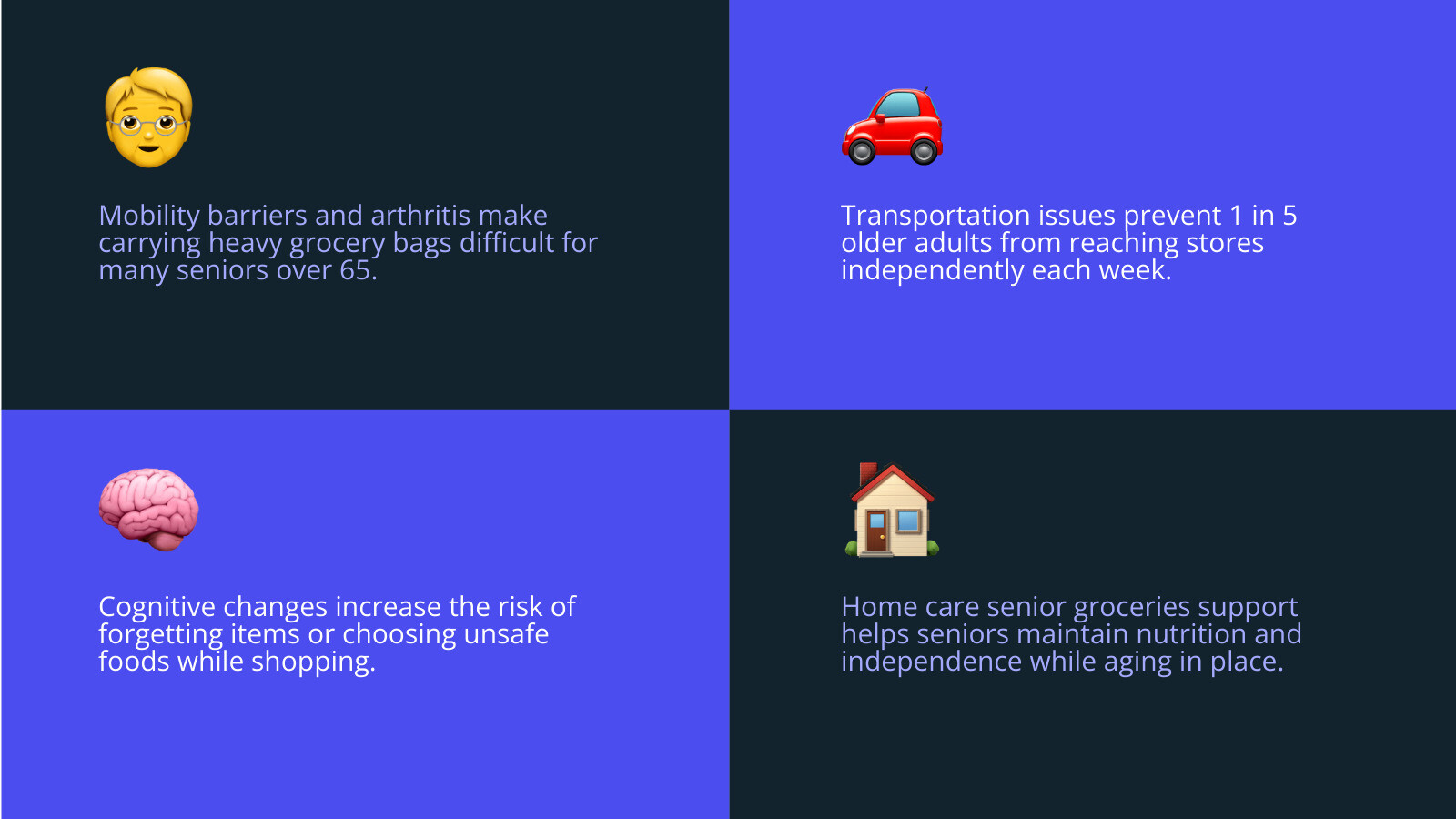
Home care senior groceries definitions:
The Challenges of Independent Grocery Shopping for Older Adults
As we age, tasks that once felt automatic can become major physical and mental hurdles. Grocery shopping is a prime example. It isn't just about picking up a loaf of bread; it is a multi-step journey requiring physical strength, reliable transportation, sharp senses, and cognitive focus.
First, consider the physical and mobility barriers. Walking long aisles, reaching for high shelves, and bending down to grab heavy items can cause severe fatigue or pain. For seniors managing arthritis, osteoporosis, or balance issues, pushing a heavy shopping cart is a safety hazard.
Transportation is another significant roadblock. When driving is no longer safe or comfortable, relying on public transport or waiting for rides can make routine shopping trips stressful. Even if a senior manages to get to the store, there is the challenge of getting those heavy, awkward bags back inside the house.
Physical stamina also declines with age. What used to be a quick 30-minute trip can turn into an exhausting multi-hour ordeal. Senses like vision can change, making it difficult to read small nutrition labels, expiration dates, or price tags.
Finally, cognitive changes can make grocery shopping overwhelming. Navigating crowded, brightly lit supermarkets, managing complex budgets, and remembering a list can cause high anxiety. For a deeper look into how these challenges impact daily life, read our guide on Grocery Shopping for Elders.
Navigating Home Care Senior Groceries and Support Options
When families realize that independent shopping is no longer viable, they often explore "home care" options. It is helpful to understand the landscape of in-home support.
In-home care is one of many options families consider. Traditional care agencies typically provide hands-on medical or physical caregiving. However, many seniors do not need clinical supervision; they simply need practical, everyday help to keep their household running smoothly. This is where personal lifestyle support and concierge companion services shine.
By focusing on non-medical, personal support, families can maintain their loved one’s independence without the clinical feel of a health agency. These services help bridge the gap, ensuring seniors have access to fresh, nutritious food while remaining in control of their routines. To explore how these services fit into a broader lifestyle plan, check out our resources on Grocery Shopping Assistance.
Professional Companionship and Home Care Senior Groceries Assistance
For seniors who want to stay active but need a helping hand, professional companionship and lifestyle assistance are ideal. Rather than doing the chore for them, a companion works with them, turning a routine task into an enjoyable social outing.
A personal companion can assist with:
- Collaborative Meal Planning: Sitting down together to plan a week of delicious, healthy meals.
- Safe Transportation: Providing a comfortable ride to and from the local grocery store.
- Mobility Support: Helping navigate the store aisles, reaching high shelves, and lifting heavy items.
- Errand Coordination: Combining grocery trips with other essential stops, like picking up prescriptions or visiting the post office.
- Pantry Organization: Helping unpack bags, check expiration dates, and organize the kitchen for safety and ease of use.
This model has a profound impact on mental health. It combats isolation by providing meaningful social connection. Families report immensely high satisfaction rates—often exceeding 95%—when utilizing personalized companion services to manage these daily routines. For families living in Virginia, you can learn more about local, specialized options through our Virginia Elder Grocery Service.
How Burnie's Way Coordinates Your Grocery Needs
At Burnie's Way, we believe that aging in place should feel empowering, not limiting. We do not provide clinical caregiving or medical services. Instead, think of us as a virtual companion, events coordinator, and personal assistant—all wrapped into one. We offer compassionate, personalized lifestyle coordination backed by 50 years of experience.
We make grocery management seamless. Our team coordinates with trusted local companions and helpers to ensure your loved one's kitchen is always stocked with fresh, healthy food. Whether they want someone to accompany them to the store or prefer a helper to handle the shopping and delivery entirely, we customize the support to match their exact preferences.
We serve families across the United States, including Virginia. If you are looking for trusted assistance in the coastal region, explore our direct resources on Grocery Helpers in Virginia Beach, VA to see how we coordinate localized support.
Technology-Driven Solutions: Grocery and Meal Delivery Services
Technology has transformed how we access food. For seniors who prefer to stay home, online ordering, curbside pickup, and delivery apps offer unprecedented convenience. These services reduce physical strain, limit exposure to seasonal illnesses, and save energy.
However, different services suit different tech comfort levels. To help you evaluate the best option, we have compared the primary tech-driven solutions below:
| Service Type | How It Works | Pros | Cons |
|---|---|---|---|
| Phone-Based Concierge | Seniors call an agent to place their order from local stores. | No smartphone or internet needed; incredibly simple. | Cannot see items in real time; slightly higher service fees. |
| Live Video Shopping | A personal shopper walks the aisles on a live video call. | High autonomy; seniors choose exact produce; great social interaction. | Requires a basic smartphone/tablet connection; higher hourly rates. |
| Standard Delivery Apps | Orders are placed via smartphone apps or web browsers. | Massive store selection; fast delivery; easy digital tracking. | Confusing interfaces; unpredictable substitutions; high markups. |
To understand how to integrate these digital tools into a senior's weekly routine, take a look at our guide on Home Food Delivery for Elderly.
Phone-Based and Video-Assisted Shopping for Tech-Averse Seniors
For seniors who do not use smartphones or find apps confusing, phone-based and video-assisted services are a game-changer. These options preserve independence without requiring digital literacy.
Phone-based concierge programs allow seniors to dial a toll-free number and dictate their grocery list to a live representative. The service then coordinates the shopping and delivery through standard networks. For more details on how these phone-based systems operate, you can read about how Grocery Delivery For Seniors & Disabled People Made Easy works.
Alternatively, video-assisted shopping brings the store to the senior's living room. Using services like Selectido, a real person walks the store aisles while streaming a live video call. The senior can point to the exact bunch of bananas or cut of meat they want, ensuring high quality and zero substitution surprises. This model is highly personal and interactive. You can learn more about this approach by reading our overview of a Personal Shopper for Seniors.
Standard Delivery Apps and Home Care Senior Groceries Integration
For seniors who are comfortable with tablets or computers, mainstream apps like Instacart, Shipt, or direct store services (like Walmart and Kroger delivery) are highly efficient.
To make this successful, family members or companion coordinators can assist with setup. We recommend:
- Saving Favorites: Pre-loading the senior's account with their frequently purchased items to make reordering a one-click process.
- Shared Shopping Carts: Allowing adult children to log in remotely, add items to the cart, and handle the payment, while the senior simply enjoys the delivery.
- Clear Delivery Instructions: Adding permanent notes for the delivery driver, such as "Please ring doorbell and place bags on the porch table, senior has limited mobility."
Integrating these apps with a companion's schedule ensures that someone is always there to help unpack and store the items safely. For a complete breakdown of the best digital platforms, read our Grocery Delivery Guide 2026 and our tips on Grocery Delivery for Seniors.
Government and Community Food Assistance Programs
For older adults living on a fixed income, budgeting for nutritious food can be challenging. Fortunately, several federal and state programs are designed specifically to help seniors access healthy groceries.
- SNAP (Supplemental Nutrition Assistance Program): This program provides monthly financial assistance via an Electronic Benefits Transfer (EBT) card, which can be used at grocery stores and even some online delivery platforms.
- CSFP (Commodity Supplemental Food Program): Often called the "Senior Food Box" program, CSFP distributes free, monthly boxes of nutritious, shelf-stable USDA foods (including fruits, vegetables, canned proteins, and grains) to low-income seniors aged 60 and older.
- Senior Farmers' Market Nutrition Program (SFMNP): This program provides low-income seniors with vouchers that can be exchanged for fresh, locally grown fruits, vegetables, and herbs at farmers' markets and roadside stands.
To learn more about eligibility requirements and how to apply for these programs, visit the official Food assistance programs for older adults portal and explore Senior Food Programs, Free Senior Meals .
Volunteer-Led Grocery Programs
In addition to government aid, many communities offer volunteer-led grocery programs. These are typically run by local non-profits, faith-based organizations, or local Area Agencies on Aging.
In Virginia, programs like the Shepherd's Center of Northern Virginia (SCNOVA) utilize background-checked volunteers to shop for and deliver groceries to homebound elders. These services are often free or require a very low administrative fee, making them an excellent resource for seniors on tight budgets. To understand how these community networks operate, read Senior Food Delivery Program: What Are The Benefits?.
Nutritional Tips for Seniors Using Grocery and Meal Delivery
Relying on grocery delivery or pre-prepared meals makes life easier, but it requires mindful planning to maintain a balanced diet. As we age, our nutritional needs change; we generally require fewer calories but more nutrient-dense foods.

When ordering groceries or meal kits, keep these tips in mind:
- Prioritize Nutrient Density: Focus on leafy greens, vibrant berries, and lean proteins.
- Choose Easy-to-Chew Options: If chewing or swallowing is difficult, stock up on soft fruits (like bananas, peaches, and ripe pears), steamed squash, and cooked spinach.
- Incorporate Healthy Fats: Monounsaturated fats from avocados, olive oil, and chia seeds support brain health and keep skin hydrated.
- Simplify Protein Prep: Protein is vital for muscle retention. Opt for canned beans, eggs, or tender cuts of meat (like chicken drumsticks) that become soft when slow-cooked.
- Transition Gradually: If your loved one is used to processed foods, gradually mix whole grains (like brown pasta or brown rice) with refined grains to make the transition easier on their digestive system.
For more practical advice on managing nutrition and household wellness, explore our Daily Life Management Tips Guide.
Frequently Asked Questions about Senior Grocery Assistance
What are the average costs of hiring a grocery helper in 2026?
As of June 2026, the average posted rate for a grocery helper is approximately $20.00 per hour. Rates can vary depending on your location, the frequency of the visits, and whether the helper is hired independently or coordinated through a companion agency. On platforms like Care.com, there are over 10,313 grocery helpers listed with an average rating of 4.7 stars, making it easy to find rated support. To learn more about budgeting for these services, check out our guide on Assistance with Daily Activities.
Can government food programs be combined with home delivery?
Yes! In 2026, many major grocery delivery services and online retailers accept SNAP EBT payments for online orders. While SNAP covers the cost of eligible food items, please note that it typically cannot be used to pay for delivery fees or driver tips. You will need a secondary payment method on file to cover those costs. For more information on combining benefits, read our Home Food Delivery Guide Seniors 2026.
How do families choose the right grocery support service?
Choosing the right service starts with assessing your loved one's physical capabilities, cognitive comfort, and tech-savviness. If they enjoy the social aspect of shopping, a companion helper is the best fit. If they are highly independent but homebound, a phone-based delivery service or live video shopping may be ideal. Always ensure that any helper entering the home has undergone a thorough background check. For a step-by-step vetting checklist, review our Helping Elderly in Their Homes Guide.
Conclusion
No older adult should have to struggle with heavy shopping carts, confusing apps, or empty pantries. Whether through professional companionship, phone-based grocery concierges, or community volunteer networks, there is a grocery support solution that fits your family's needs and budget.
At Burnie's Way, we specialize in coordinating personalized lifestyle support that keeps seniors independent, active, and connected. By taking the stress out of daily errands like home care senior groceries, we give families ultimate peace of mind. To learn more about how we can help your family, explore our Senior Grocery Delivery resources.
How Burnie's Way Supports Your Independence:
- Personalized Match: We coordinate trusted companions tailored to your loved one’s personality and lifestyle.
- Flexible Routines: Support is fully customized—whether it's weekly accompanied store trips or simple home deliveries.
- Peace of Mind: We manage the details so you can focus on quality family time.
- 50 Years of Experience: A trusted legacy of helping seniors live comfortably and confidently at home.
Ready to simplify your daily routine? Explore our personalized support services today.