

Why Finding the Right Family Care Assistance Feels So Overwhelming (And What to Do About It)
If you're trying to figure out what help is available for an aging parent or loved one, here's a quick overview of the main family care assistance options:
| Program Type | Who It's For | Key Benefit |
|---|---|---|
| Medicaid Long-Term Care (e.g., Wisconsin Family Care) | Low-income adults 18+ with disabilities or frailty | In-home personal care, daily living support |
| Medicaid Self-Directed Services | Medicaid-eligible individuals needing ongoing care | Allows family members to be paid as caregivers |
| Structured Family Caregiving | Adults needing 24/7 live-in care (select states) | Monthly tax-free stipend for live-in family caregivers |
| VA PCAFC | Family caregivers of eligible Veterans | Monthly stipend, health insurance, respite care |
| State FamilyCare Programs (e.g., IL, NJ) | Low-income families with children | Free or low-cost health coverage |
| TANF Child-Only Grants | Relative caregivers raising children | Monthly cash assistance |
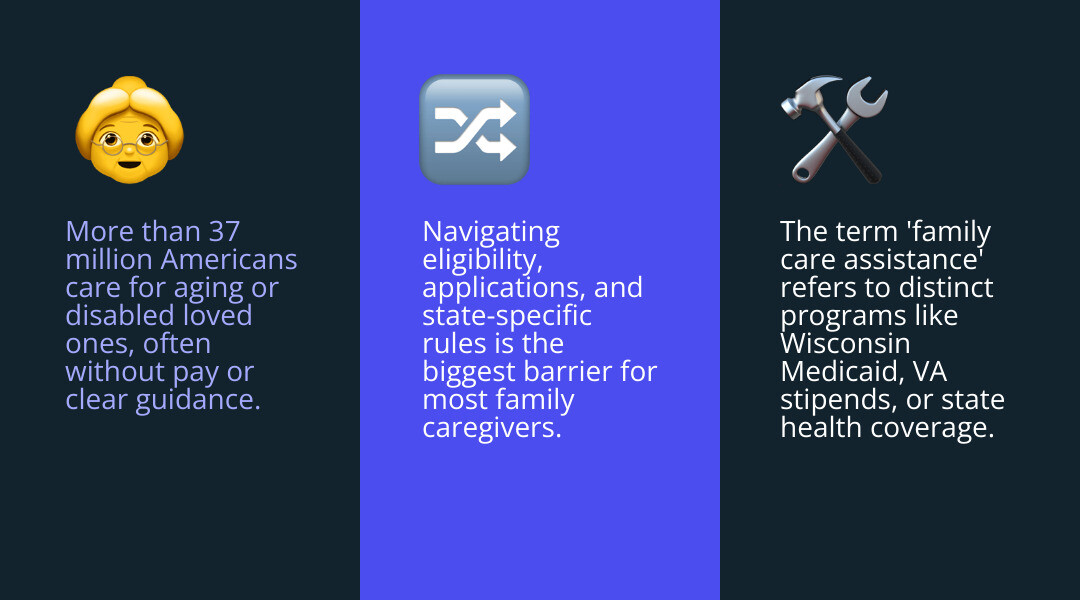
More than 37 million Americans are quietly doing one of the hardest jobs there is — caring for an aging or disabled loved one, usually without pay, and often without knowing what help is available.
The landscape of family care programs is genuinely confusing. The same phrase — "family care assistance" — can mean a health insurance program for Illinois parents, a long-term Medicaid program serving 57,000+ members in Wisconsin, or a federal stipend program for military caregivers. They're all real programs. They just serve very different people.
And if you're an adult child trying to figure out what your parent qualifies for? You're often starting from scratch, navigating state agency websites, Medicaid rules, and eligibility screens — all while managing work, family, and the emotional weight of watching someone you love need more help.
This guide cuts through the noise. It explains what family care assistance programs actually exist, who qualifies, what they cover, and how to apply — so you can stop guessing and start taking action.
Understanding Family Care Assistance: What It Is and How It Works

When people search for "family care assistance," they are often looking for two entirely different types of support: health insurance coverage for low-income families, or long-term care programs designed to help elderly or disabled adults remain in their homes. Understanding this distinction is the first step toward getting the right help.
If your primary goal is finding Assistance Caring for Elderly Parents, you are likely looking for long-term care programs. These programs are designed to provide physical, emotional, and practical support so your loved one can avoid institutional care and live as independently as possible.
Defining the Program and Key Differences
At its core, long-term family care assistance refers to a network of federal, state, and local programs that provide non-medical support to individuals with functional limitations.
Historically, many of these programs grew out of Title XX of the Federal Social Security Act, which provides block grants to states for social services. Today, they are primarily administered through state Medicaid waivers (often called Home and Community-Based Services, or HCBS waivers).
Unlike standard health insurance, which pays for doctor visits and hospital stays, long-term care assistance focuses on daily functional support. The goal is to keep individuals out of expensive, institutional nursing homes by funding services directly in their own houses or community settings.
Who Qualifies for Family Care Assistance?
Eligibility for these programs is not one-size-fits-all. To qualify, an applicant must generally meet three distinct sets of requirements:
- Functional Eligibility: The applicant must demonstrate a genuine physical or cognitive need for help. This is usually determined through a state-administered clinical assessment. For example, in many states, an applicant must score above a certain threshold on a functional needs assessment to prove they require a "nursing facility level of care" to qualify for at least six hours of care per week.
- Age and Disability Requirements: Most adult long-term care programs are restricted to frail elders (typically age 65 or older) or adults aged 18 to 64 with qualifying physical or developmental disabilities.
- Residency and Financial Limits: Because these programs are largely funded by Medicaid and state block grants, applicants must be legal residents of the state in which they apply. They must also meet strict income and asset limits, which vary significantly depending on the state and the specific waiver program.
Navigating these requirements can feel like learning a foreign language. For a step-by-step breakdown of how to assess your loved one's needs and prepare for the eligibility process, check out our Family Caregiver Support Guide.
Covered Services, Benefits, and Financial Support

If your loved one meets the eligibility requirements, what does family care assistance actually look like in daily life?
While exact benefits depend on the program and state, the core objective is to provide comprehensive, non-skilled assistance. You can learn more about how these programs fit into a broader care philosophy in our guide on Family Focused Care.
To understand how structured state guidelines define these services, you can reference the official policy manuals, such as the 4400, Family Care Services | Texas Health and Human Services manual, which outlines allowable and excluded tasks for state-funded personal attendant care.
Personal Care and Daily Living Support
The bulk of family care services involves help with Activities of Daily Living (ADLs) and Instrumental Activities of Daily Living (IADLs). These are non-technical, non-skilled tasks that do not require professional medical training. Covered services typically include:
- Personal Care: Assistance with bathing, grooming, dressing, toileting, and mobility.
- Homemaker Services: Light housekeeping, laundry, and maintaining a clean, safe living space.
- Meal Preparation: Grocery shopping, planning, and cooking nutritious meals.
- Escort Services: Accompanying the individual to medical appointments or essential community errands (though the time spent traveling is typically deducted from the total authorized care hours).
It is important to note that these programs explicitly exclude skilled medical tasks. An authorized personal care assistant cannot administer medication, manage ventilators, or perform sterile wound care.
Respite Care and Caregiver Relief
One of the most valuable, yet underutilized, benefits of family care programs is respite care. Caring for a family member is a beautiful act of love, but it is also physically and emotionally exhausting. Without regular breaks, family caregivers are highly susceptible to burnout.
Respite care provides temporary, short-term relief by bringing in a professional assistant or utilizing an adult day center so the primary family caregiver can rest, run errands, or take a vacation. Under federal initiatives like the National Family Caregiver Support Program - ACL.gov , states receive funding to provide respite care, counseling, and support groups directly to family members.
Taking advantage of these programs isn't selfish — it is essential for sustaining your ability to care. For practical tips on managing your daily emotional health, read our resources on Caregiver Stress Relief and Caregiver Self Care.
How Family Caregivers Can Get Paid
Many family members step into caregiving roles out of necessity, often reducing their working hours or leaving their jobs entirely. Fortunately, there are pathways that allow family members to receive financial compensation for the vital work they do.
To find out which programs are active in your area, you can visit the official federal portal to Get paid as a caregiver for a family member - USAGov . For a broader look at financial assistance, read our Care Giver Grants Complete Guide.
Medicaid Self-Directed Services and Structured Family Caregiving
Every state in the country (with very few historical exceptions) now offers some form of Medicaid "self-direction" or "consumer-directed" services. These programs allow the care recipient to act as the employer, choosing who provides their care — including family members.
In states that offer Structured Family Caregiving (SFC), eligible live-in family caregivers can receive ongoing support, coaching from a dedicated care team (including a nurse and care coach), and a monthly tax-free stipend. Depending on the state and the level of care required, these stipends can range from several hundred dollars to upwards of $1,200 to $2,000 per month.
However, these programs come with strict rules. For example, some states require a minimum of 3 hours of daily care and cap reimbursable hours at 10 hours per day, as seen in policies like Family Personal Care 525-05-30-32 . Additionally, many programs exclude legally responsible relatives, such as spouses or parents of minor children, from being paid.
VA Caregiver Support and Federal Programs
For those caring for military Veterans, the U.S. Department of Veterans Affairs offers some of the most robust caregiver support programs in the nation.
The Program of Comprehensive Assistance for Family Caregivers (PCAFC) provides enhanced clinical and financial support to family caregivers of eligible Veterans who have a serious service-connected disability rating of 70% or higher.
To learn more about the application process and specific health benefits, visit the VA Family Caregiver Assistance Program | Veterans Affairs portal.
Primary family caregivers approved under the PCAFC receive:
- A monthly financial stipend (paid via direct deposit).
- Access to health insurance coverage through the Civilian Health and Medical Program of the Department of Veterans Affairs (CHAMPVA), if they do not already have insurance.
- Mental health counseling and specialized caregiver training.
- At least 30 days of supported respite care per year.
State-by-State Variations and Application Processes
Because long-term care programs are primarily run at the state level, the name of the program, the application process, and the available benefits change dramatically depending on where you live.
| State | Primary Program | Key Caregiver Paid Option | Agency to Contact |
|---|---|---|---|
| Virginia | Commonwealth Coordinated Care Plus (CCC Plus) Waiver | Consumer-Directed Services | Local Dept. of Social Services / DARS |
| Wisconsin | Wisconsin Family Care | Self-Directed Personal Care (IRIS) | Local ADRC |
| New Jersey | NJ FamilyCare / MLTSS | Personal Preference Program (PPP) | County Board of Social Services |
| Florida | Statewide Medicaid Managed Care (SMMC) | Consumer Directed Care Plus (CDC+) | Area Agency on Aging |
How to Apply for Family Care Assistance in Your State
The application process for state programs can be lengthy, often taking anywhere from 30 to 90 days to finalize. If you are feeling overwhelmed by the paperwork, read our guide on Help Looking After Elderly Parents for practical tips on managing the process.
To get started, follow these three steps:
- Contact Your Local Aging and Disability Resource Center (ADRC): Your local ADRC (or Area Agency on Aging) acts as the "No Wrong Door" entry point. They will conduct an initial screening and point you toward the right waivers.
- Gather Required Documentation: You will need extensive documentation, including proof of residency, birth certificates, military discharge papers (if applicable), detailed bank statements, and medical records documenting the applicant's physical or cognitive limitations.
- Complete the Functional and Financial Screens: A caseworker will visit your loved one's home to conduct a functional assessment, while the state Medicaid office reviews their financial eligibility.
Comparing State-Specific Programs
To illustrate how much these programs vary, let's look at a few state-specific examples:
- Virginia: Virginia provides excellent support through the Caregiver Support - DARS (Department for Aging and Rehabilitative Services) network. Virginia residents can also find comprehensive local resources and peer support networks through the Services By State: Virginia - Family Caregiver Alliance portal.
- Wisconsin: Wisconsin Family Care is a mature, managed-care program serving over 57,000 members. It integrates long-term care services under a single plan managed by regional Managed Care Organizations (MCOs).
- New Jersey: NJ FamilyCare operates primarily as a comprehensive health insurance program, but it also includes the Managed Long Term Services and Supports (MLTSS) program for individuals who require a nursing home level of care.
- Florida: Florida Medicaid coordinates care through its Statewide Medicaid Managed Care program. Due to the end of continuous coverage policies after the federal Public Health Emergency, Florida has implemented a detailed redetermination process, making it vital for residents to keep their contact info updated to avoid coverage gaps.
Frequently Asked Questions about Family Care Programs
What are the income limits and co-pays for Family Care?
Because most long-term care programs are tied to Medicaid, the income limits are strict and change annually. Generally, an individual's monthly income must be below a certain percentage of the Federal Poverty Level (often around 300% of the Supplemental Security Income federal benefit rate).
Some programs require nominal co-pays (ranging from $2 to $3.90 for prescriptions or office visits), while others use a "cost-share" model where the recipient contributes a portion of their monthly income toward the cost of their care. If your loved one is over the income limit, you may want to look into Low Income Grants or Grants for Elder Care to help bridge the financial gap.
Can a spouse get paid as a family caregiver?
In most states, spouses are historically excluded from being paid as caregivers under standard adult foster care or personal care programs. The legal reasoning is that spouses have an inherent legal obligation to support one another.
However, many states have updated their Medicaid waivers to allow spouses to serve as paid personal care attendants under specific "consumer-directed" or "self-directed" programs, provided they meet the state's training and documentation requirements.
How does Family Care interact with VA benefits or SSI?
Navigating multiple government programs can be a balancing act. Receiving a VA monthly stipend under the PCAFC does not automatically disqualify a Veteran from receiving Medicaid, but the financial stipend may count as income depending on how the state Medicaid agency evaluates VA benefits.
Similarly, receiving Supplemental Security Income (SSI) usually guarantees Medicaid eligibility in most states, making it easier to qualify for waiver programs. For a deeper look at funding options, read our guide on Family Caregiver Grants.
Conclusion
Finding the right family care assistance program is a journey that requires patience, organization, and a healthy dose of self-care. Whether you are applying for VA benefits, navigating a state Medicaid waiver, or setting up a self-directed care plan, you do not have to do this entirely on your own.
At Burnie's Way, we believe that helping your loved one live confidently at home shouldn't come at the cost of your own peace of mind. While we are not a medical or caregiving provider, we act as a personal concierge, virtual companion, and lifestyle coordinator for aging adults. Backed by 50 years of experience, we partner with families to manage daily routines, coordinate trusted services, and provide the friendly, heart-forward personal support that keeps your loved one connected and independent.
Let us help you make daily life easier and give your family the peace of mind you deserve. Explore our services today to see how we can support your family's journey.