7 min read
Local Senior Care: A Guide to Neighborhood Support
When a Parent Needs Help at Home: Where to Start Local senior care is a broad term — and when you're suddenly trying to figure out how to keep a...
Community help for elderly adults comes in many forms — and knowing where to start can make a real difference for families trying to support an aging parent from a distance.
Here's a quick overview of the most common types of community support available:
| Type of Support | Examples |
|---|---|
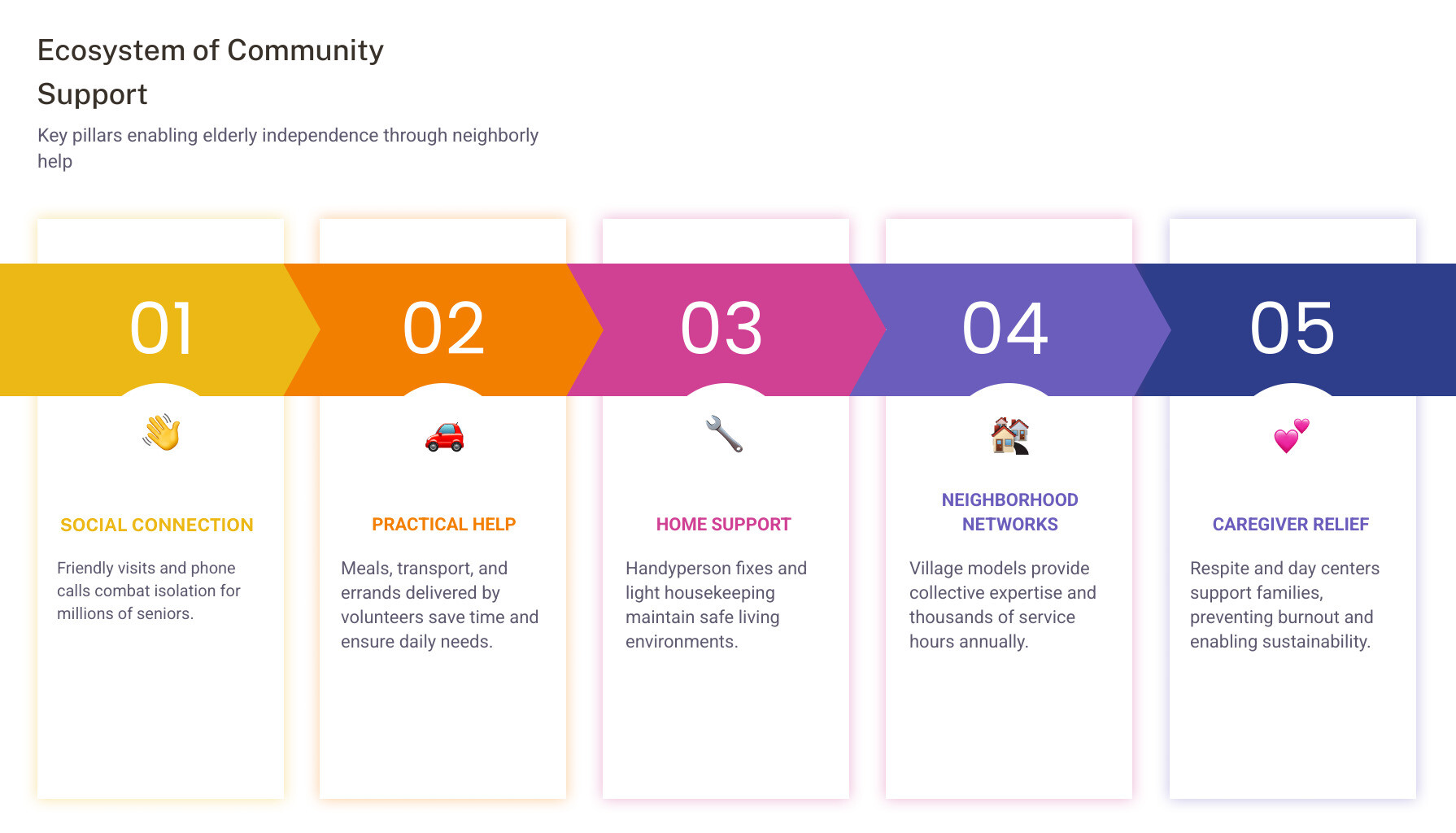
| Social connection | Friendly visiting, telephone reassurance, befriending services |
| Practical help | Meal delivery, transportation, grocery shopping, errands |
| Home support | Handyperson services, light housekeeping, tech assistance |
| Neighborhood networks | Village models, community companions, intergenerational programs |
| Caregiver relief | Respite care, adult day centers, support groups |
| Financial assistance | Medicare, Medicaid, sliding-scale fees, donation-based programs |
Most of these services are low-cost or free. Many are run by volunteers right in your parent's neighborhood.
The challenge isn't that support doesn't exist. It's that finding, coordinating, and trusting the right combination of help — especially from afar — can feel overwhelming.
Millions of older adults want to stay in the homes they love. And the research backs them up: community-based support helps seniors maintain independence, stay socially connected, and avoid unnecessary hospitalizations. Programs like village networks have fulfilled tens of thousands of service requests, driven hundreds of thousands of volunteer miles, and provided countless hours of companionship — all through neighbors helping neighbors.
But navigating that patchwork of programs, eligibility rules, and funding options takes time and energy that most families don't have to spare.
This guide breaks it all down — so you can find the right community support for your loved one, understand what it costs, and feel confident they're not facing this chapter alone.

Quick community help for elderly definitions:
When we talk about community help for elderly residents, we aren't just talking about medical care. In fact, most of the support that allows a senior to thrive at home is non-medical. It’s about the "little things" that add up to a high quality of life.
Nutrition is often the first thing to slip when an older adult lives alone. Cooking for one can feel like a chore, and grocery shopping can become physically taxing. Organizations like Meals on Wheels America provide a vital lifeline. They don't just deliver a hot meal; they provide a "wellness check" at the door. For many, the volunteer who delivers the meal might be the only person they see all day.
Giving up the car keys is a major milestone that often leads to isolation. Community programs fill this gap by providing rides to medical appointments, grocery stores, and even social events. In 2023 alone, volunteers for neighborhood networks across the country drove over 43,000 miles to ensure their neighbors didn't miss a beat. Whether it's picking up a prescription or a weekly trip to the library, these services keep life moving.
A leaky faucet or a hard-to-reach lightbulb shouldn't be the reason someone has to move into a facility. Many community organizations offer handyperson services. These volunteers help with small tasks like installing a window A/C unit, weeding a garden, or setting up a new computer. These elder care support services focus on safety and comfort, ensuring the home remains a sanctuary rather than a source of stress.
It’s helpful to understand the difference between volunteer-led efforts and professional coordination. While volunteers are the heart of the community, professional coordination ensures nothing falls through the cracks.
| Feature | Volunteer-Led Assistance | Professional Lifestyle Coordination (Burnie's Way) |
|---|---|---|
| Cost | Typically free or donation-based | Service-based fee |
| Consistency | Depends on volunteer availability | Scheduled, reliable support routines |
| Scope | Specific tasks (e.g., a ride, a meal) | Comprehensive daily life management |
| Vetting | Standard background checks | Rigorous screening and 50 years of expertise |
| Flexibility | Limited to program hours | Tailored to the member’s specific lifestyle |
Social isolation is more than just a feeling of loneliness; it is a significant health risk. For older adults, having little to no contact with others can lead to cognitive decline, depression, and even heart disease. Community help for elderly adults must prioritize connection as much as practical tasks.
Friendly visiting programs match volunteers with seniors for regular social calls. This might involve playing a board game, sharing a cup of tea, or simply chatting about the news. The goal is to build a genuine friendship. These "befriending" services are particularly effective for homebound seniors who may have outlived their local social circle.
Sometimes, a quick check-in is all it takes to brighten a day and ensure safety. Telephone reassurance programs involve volunteers making scheduled calls to seniors. Since 2020, some organizations have provided over 14,000 hours of telephone reassurance. Just 10 minutes on the phone can significantly reduce feelings of isolation.
Bridging the gap between generations benefits everyone. We’ve seen incredible success with programs where teens teach seniors how to use tablets or avoid internet scams, while seniors share stories and life wisdom. Community gardens and "solidarity cafes" also serve as meeting points where people of all ages can interact naturally. These elderly social interaction opportunities are vital for keeping seniors feeling like valued members of society.
Innovative models like intergenerational housing mix different age groups in the same building. Some models even pair Alzheimer’s residents with live-in students. Social facilitators in these environments help coordinate activities, ensuring that residents remain active participants in their own lives rather than passive recipients of care.
The data is clear: volunteer support changes lives.
The "Village" model is one of the most successful innovations in aging in place. A Village is a member-based, volunteer-driven nonprofit that connects neighbors to help one another.
In Virginia, organizations like the Arlington Neighborhood Village demonstrate this impact daily. With hundreds of members ranging in age from 58 to 102, these networks fulfill thousands of service requests annually. They provide a "safety net" that allows seniors to stay in their own homes safely and independently. This type of senior care coordination leverages the collective expertise of the neighborhood — if one neighbor knows how to fix a computer and another has a car, the Village makes sure those resources reach the person who needs them.
Knowing that help exists is one thing; knowing how to get it is another. The process usually begins with an assessment to determine what level of support is needed.
The Eldercare Locator is a public service of the U.S. Administration on Community Living. By calling 800-677-1116, you can find local resources in your specific zip code. They can point you toward everything from meal programs to legal assistance.
Many government-subsidized programs require a "needs assessment." A social worker or coordinator will visit the home to discuss daily challenges. They look at "Activities of Daily Living" (ADLs) like dressing and eating, as well as "Instrumental Activities of Daily Living" (IADLs) like managing finances or grocery shopping.
Funding for community help for elderly adults is a patchwork of public and private sources:
Cost shouldn't be a barrier to dignity. Many community services are designed to be accessible:
We often forget that community help for elderly people also means help for the people who love them. Caregiving is rewarding, but it can also be exhausting.
Respite care provides a temporary break for family caregivers. This can happen in the home or at an adult day center. These centers provide a safe, social environment for seniors during the day, allowing caregivers to work or rest. The ARCH National Respite Locator is an excellent tool for finding these services nearby. You can also explore family caregiver grants that may help cover these costs.
Technology is playing an increasingly large role in community support:
The best place to start is the Eldercare Locator (800-677-1116) or your local Area Agency on Aging. In Virginia, you can also look into the "Village to Village Network" to see if there is a neighborhood village active in your community.
Many are! Volunteer-led services like friendly visiting or grocery delivery are often free. Meal programs are usually subsidized or donation-based. However, professional services or specialized day centers may have fees, though some accept Medicaid or offer sliding scales based on income.
A senior center is usually a physical location where people go for activities and meals. A "Village" is a network that brings services to the senior's home. Villages focus on helping members age in place by coordinating volunteers to help with transportation, home repairs, and social connection within their own neighborhood.
At Burnie's Way, we believe that aging should be a journey of connection, not isolation. While community help for elderly adults is vast and sometimes confusing, you don't have to navigate it alone.
We act as a personal concierge and lifestyle coordinator for seniors in Virginia and across the United States. Think of us as your personal assistant and events coordinator, dedicated to helping you or your loved one live confidently at home. We don't provide medical care; instead, we provide the human connection and daily coordination that makes life easier.
With 50 years of experience, we help manage the routines, errands, and social connections that allow our members to thrive. Whether it's coordinating a trusted handyperson, setting up a weekly social outing, or simply being a compassionate companion who ensures everything is running smoothly, we are here to provide peace of mind for the whole family.
If you're looking for a personalized approach to staying independent and active in the home you love, we invite you to explore Our Services. Let us help you coordinate the best community support so you can focus on living life to the fullest.
7 min read
When a Parent Needs Help at Home: Where to Start Local senior care is a broad term — and when you're suddenly trying to figure out how to keep a...
13 min read
Understanding the Role of a Family Caregiver Family caregiver support includes a wide range of resources, programs, and services designed to help...
12 min read
Understanding Long-Term Care: What It Means for You and Your Family Long term care is a range of services and supports designed to help people meet...