7 min read

Rapid Response: Navigating Urgent Care for Seniors

Rapid Response: Navigating Urgent Care for Seniors

Why Emergency Senior Care Matters for Your Family

Emergency senior care

Emergency senior care refers to immediate support services available when an older adult faces an urgent health, safety, or care crisis. These situations demand fast action—whether it's a fall, sudden illness, cognitive confusion, or an unexpected caregiver gap.

Quick Access to Emergency Senior Care:

  1. Call 911 for life-threatening medical emergencies (chest pain, stroke symptoms, severe bleeding)
  2. Contact the Eldercare Locator at 1-800-677-1116 to find local emergency respite and home care services
  3. Activate medical alert systems if your loved one has fallen or needs immediate help
  4. Reach out to home health agencies for urgent in-home support, especially post-hospitalization
  5. Use urgent respite care facilities when a family caregiver becomes suddenly unavailable

Research shows that 1 in 3 seniors over age 65 falls every year, and getting help quickly can prevent serious injuries and complications. Seniors who receive immediate assistance after a fall or health event recover faster and are less likely to be hospitalized.

Yet emergencies aren't always medical. Sometimes a family caregiver becomes ill, a hospital discharge happens with little notice, or an older adult living alone faces a sudden inability to manage daily tasks. These "social emergencies" can be just as urgent—and just as overwhelming for families trying to figure out what to do next.

The good news: emergency senior care options exist to bridge these gaps. From 24/7 standby caregivers and short-term in-home support to medical alert systems and rapid response teams, help is available when you need it most. Understanding your options before a crisis hits makes all the difference.

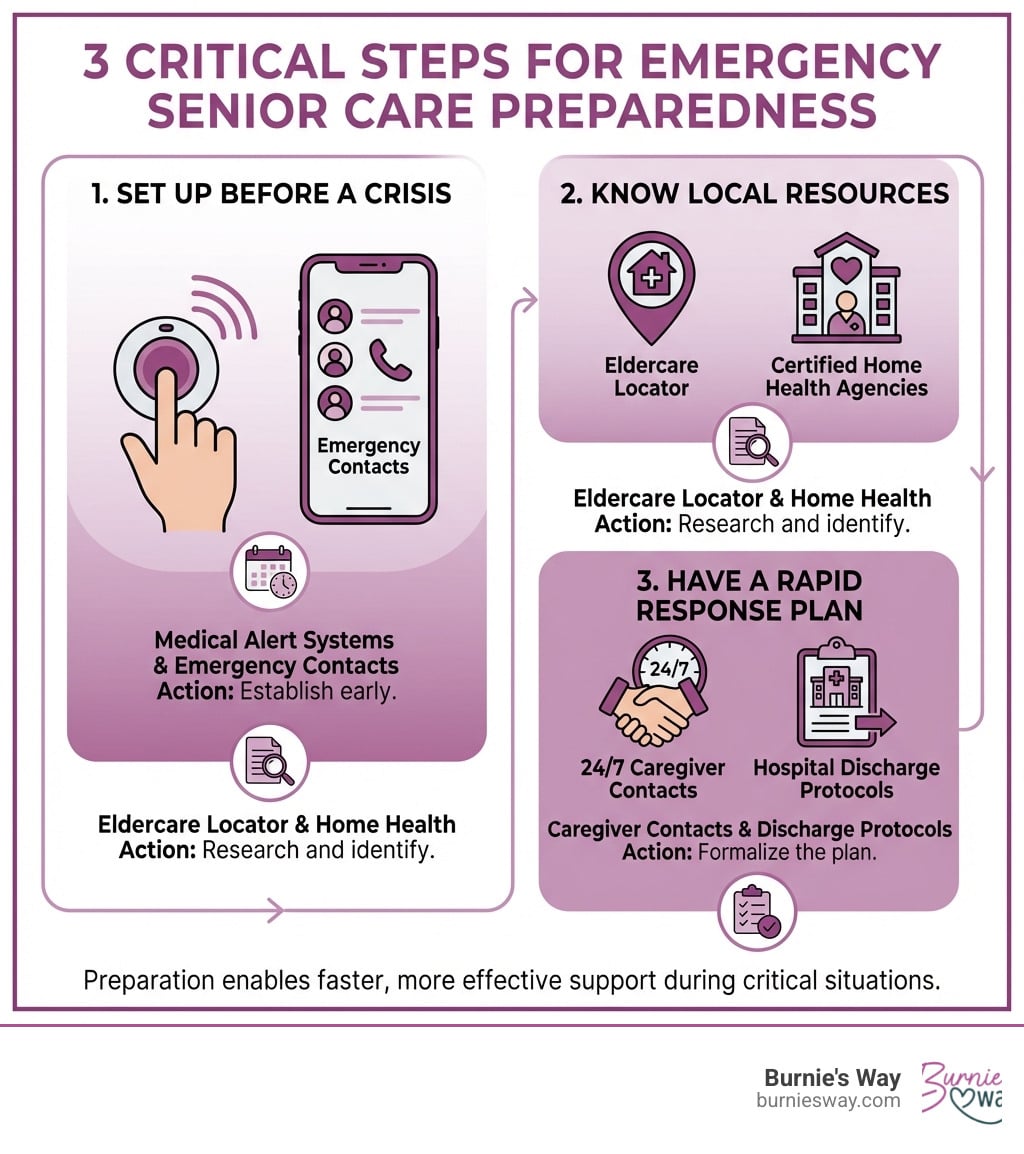
Infographic showing three critical steps for emergency senior care preparedness: 1. Set up medical alert systems and emergency contacts before a crisis, 2. Know your local resources including Eldercare Locator and certified home health agencies, 3. Have a rapid response plan including 24/7 caregiver contacts and hospital discharge protocols - Emergency senior care infographic

Simple guide to Emergency senior care:

Defining Emergency Senior Care and Common Scenarios

When we talk about Emergency senior care, we are looking at a broad spectrum of urgent needs. While we often think of sirens and flashing lights, many emergencies begin quietly at home. Identifying these scenarios early is the first step toward a successful recovery.

Common Scenarios Requiring Rapid Response

  • Falls: This is the leading cause of injury among seniors. A fall can lead to fractures or head injuries, but even a "minor" fall can be dangerous if the senior cannot get up, leading to dehydration or pressure sores.
  • Sudden Illness: Infections like UTIs (Urinary Tract Infections) can cause sudden, extreme confusion in older adults, often mistaken for dementia. Other acute issues include pneumonia or cardiovascular events.
  • Cognitive Crisis: A sudden "flare-up" of disorientation or wandering in a senior with Alzheimer’s or dementia can create an immediate safety risk.
  • Dehydration and Malnutrition: These can happen surprisingly fast, especially during heatwaves or if a senior has been ill, leading to fainting or organ stress.

Scientific research indicates that the speed of the response is a primary factor in long-term outcomes. For more detailed insights on how to handle these moments, you can explore our resources on Emergency Elderly Care Help.

Identifying a Medical vs. Social Emergency

It helps to categorize the crisis so you know who to call first.

Medical Emergencies involve acute injury or physiological distress. If a loved one is experiencing chest pain, difficulty breathing, or sudden numbness, this is a medical emergency. These require ALS (Advanced Life Support) ambulances and ER visits.

Social Emergencies, on the other hand, are logistical crises. These include:

  • Caregiver Unavailability: If the primary family caregiver is suddenly hospitalized or falls ill, leaving the senior without support.
  • Post-Hospitalization Gaps: A senior is discharged from the hospital on a Friday afternoon, but the family hasn't set up help yet, and the senior is too frail to be alone.
  • Safety Risks at Home: A landlord might notice a senior's home has become unsanitary or unsafe, creating an urgent need for intervention to prevent eviction or injury.

In these social emergencies, the goal is to find rapid-response personal support to bridge the gap and keep the senior safe in their own environment.

Types of Urgent Support and Rapid Response Services

A senior wearing a medical alert system button around their neck - Emergency senior care

Navigating Emergency senior care means knowing which "lever" to pull when things go wrong. There are several layers of support designed to react quickly.

Professional Emergency Senior Care Options

  • 24/7 Standby Support: Some agencies offer "shift services" where caregivers work in 8-hour increments. This ensures someone is always awake and alert to assist with toileting, prevent wandering, or respond to a 2 AM fall.
  • Short-Term In-Home Assistance: Programs like the Emergency Short Term In-Home Support (often funded by local departments of aging) provide a limited number of visits—sometimes just four—to stabilize a senior after a hospital stay.
  • Advanced Life Support (ALS) and Critical Care Transport: For medical transfers, specialized ambulances are equipped with 12-lead cardiac monitors, ventilators, and IV pumps. These are essential for moving a senior between facilities when their condition is unstable.
  • Urgent Respite Facilities: These are residential care homes or assisted living communities that accept "emergency admissions" for a few days or weeks while the primary caregiver recovers.

For those looking for long-term safety, finding Reliable Home Care is essential to prevent these emergencies from happening in the first place.

Professional Resources for Coordination

If you are unsure where to start, you can use this online tool to find and compare Medicare-certified home health agencies. These agencies provide nursing care, physical therapy, and medication management which are often critical after an emergency event.

Technology and Monitoring Systems

Technology has changed the "rapid" in rapid response.

  • Medical Alert Systems: These are the classic "I've fallen and I can't get up" buttons. They are lifelines for seniors living alone.
  • Fall Detection: Modern wearables can detect the specific motion of a fall and call for help automatically, even if the senior is unconscious.
  • GPS Tracking: For those with cognitive impairments, GPS shoes or watches can alert family members if the senior leaves a "safe zone."
  • Remote Health Monitoring: Devices that track blood pressure, heart rate, or oxygen levels can alert a central monitoring station to a brewing medical crisis before it becomes a 911 call.

Let’s talk about the "elephant in the room": the cost. Emergency senior care can be expensive because it requires immediate staffing and resources. However, there are ways to offset these costs if you know where to look.

Medicare and Medicaid Coverage

It is a common misconception that Medicare covers all senior care. Here is the breakdown:

  • Medicare Part B: May cover limited, short-term home health services if a doctor certifies they are medically necessary (like wound care or physical therapy after a stroke). It does not typically cover 24/7 personal support or long-term respite.
  • Medicaid: Benefits vary significantly by state. In Virginia, programs like the Department for Aging and Rehabilitative Services (DARS) offer waivers that may pay for emergency in-home support for those who meet financial and functional eligibility.
Service Type Medicare Coverage Medicaid Coverage
Emergency ER Visit Covered (after deductible) Covered
Short-term Home Health Covered (if medically necessary) Varies by state/waiver
24/7 Personal Support Generally Not Covered May be covered via waivers
Urgent Respite Care Not Covered Varies by state

Financial Resources and Assistance

If insurance doesn't cover the full cost, consider these alternatives:

  • Veterans Benefits: The VA offers "Aid and Attendance" benefits which can be used to pay for personal support at home.
  • Long-Term Care Insurance: If your loved one has a private policy, check for "emergency" or "respite" clauses.
  • Community-Funded Programs: Some non-profits and local governments provide low-cost or free meal deliveries and companion visits.
  • Out-of-Pocket: Many families pay hourly rates for rapid-response caregivers. These rates are usually higher than standard scheduled care because of the "on-call" nature of the service.

For more guidance on managing these logistical hurdles, check out The Caregiver’s Handbook.

How to Choose Reliable Emergency Support Providers

When you are in the middle of a crisis, it’s tempting to hire the first person who answers the phone. Take a breath. Choosing the wrong provider can actually make an emergency worse.

Researching Emergency Senior Care Agencies

You want a provider that is not just fast, but also licensed and vetted.

  1. Check the Better Business Bureau: It’s always a good idea to check for any complaints filed against a company with state and local agencies.
  2. Verify Licensing: In Virginia, home care agencies must be licensed by the Department of Health.
  3. Read Reviews: Look for specific mentions of "emergency," "last minute," or "rapid response" in their online reviews to see how they handle pressure.

Finding In-Home Elderly Help requires a balance of speed and scrutiny.

Essential Questions for Providers

When you call a potential agency, ask these four questions:

  1. "How quickly can you have someone at the house?" (Some can do 4 hours, others need 48).
  2. "What are your emergency protocols?" (What do they do if the senior falls while the caregiver is there?)
  3. "Do you perform background checks on all staff?" (This is non-negotiable).
  4. "How often will you communicate with the family?" (In a crisis, you need updates every few hours, not every few days).

Immediate Steps and Resources for Families

If you are facing an emergency right now, here is your checklist of resources to call.

Local and National Resources

  • Eldercare Locator (1-800-677-1116): This is a public service of the Administration for Community Living that connects you to local services for older adults. They can help you find everything from emergency housing to transportation. You can also visit eldercare.acl.gov.
  • Meals on Wheels America: If the emergency involves a lack of food or nutrition, contact Meals on Wheels America to find a local delivery service.
  • Geriatric Care Managers: Also known as Aging Life Care Professionals, these experts act as "private contractors" for families. They can swoop in during a crisis, coordinate medical care, and manage the logistics that a stressed family member might miss. You can find one through the Aging Life Care Association.

For more localized information, see our guide on Senior Care at Home City.

Support for the Family Caregiver

We know that when a senior has an emergency, the caregiver is often in a crisis of their own. The emotional toll is heavy.

  • Respite Care: Don't wait until you burn out. Use the ARCH National Respite Locator to find a place for your loved one to stay for a few days so you can recover.
  • Emotional Resources: Joining a support group (online or in-person) can provide a space to vent and learn from others who have survived similar "911 moments."
  • 988 Suicide & Crisis Lifeline: If the stress becomes too much to bear, call or text 988 for immediate emotional support.

Frequently Asked Questions about Emergency Senior Care

What constitutes an emergency in senior care?

An emergency is any situation where a senior’s health, safety, or basic needs are at immediate risk. This includes medical events (strokes, falls), cognitive crises (severe confusion, wandering), or social crises (sudden loss of a caregiver, unsafe living conditions).

Does Medicare cover emergency respite care?

Generally, no. Medicare does not cover "custodial care" or respite care unless it is part of hospice care. However, some Medicare Advantage plans may offer limited respite benefits. Always check your specific policy.

How can I find local emergency resources quickly?

The fastest way is to call the Eldercare Locator at 1-800-677-1116. If it is a medical emergency, always dial 911 first. For non-medical help, contacting a local aging life care manager or a reputable home care agency with 24/7 dispatch is your best bet.

Conclusion

Navigating Emergency senior care is one of the most stressful experiences a family can face, but you don't have to do it alone. By understanding the difference between medical and social emergencies and knowing which resources to call, you can move from panic to a plan.

At Burnie's Way, we believe that every senior deserves to live with dignity and independence, even when life throws a curveball. We aren't a medical provider or a caregiving agency; rather, we are your personal concierge and lifestyle coordinators. With over 50 years of experience, we help families manage the complex logistics of daily life—from coordinating trusted services to ensuring your loved one stays connected and confident at home.

Think of us as your virtual companion and personal assistant. We provide the "peace of mind" infrastructure that helps prevent emergencies before they start and coordinates the support you need when they do. Explore Our Services to see how we can help you and your family navigate the journey of aging with heart and expertise.

Contact us today to learn more about how we can support your family's independence.

Beyond the Basics: A Comprehensive Guide to Eldercare Services

12 min read

Beyond the Basics: A Comprehensive Guide to Eldercare Services

Why Understanding Eldercare Services Matters Now More Than Ever Eldercare services help older adults live safely and independently at home by...

Read More
From Confusion to Clarity: Crafting Personalized Senior Care Plans

8 min read

From Confusion to Clarity: Crafting Personalized Senior Care Plans

Why Senior Care Planning Matters Now More Than Ever Senior care planning is the process of preparing for an aging loved one's future needs—from...

Read More
Finding Trusted Senior Care That Actually Works

8 min read

Finding Trusted Senior Care That Actually Works

When a Parent Needs Help: Making Sense of Elder Care Solutions Elder care solutions cover a wide range of support options — from help around the...

Read More