7 min read
Your Go-To Guide: Practical Ways to Help Look After Elderly Parents
When a Parent Needs Help: What You Should Know First Help looking after elderly parents is something millions of families navigate every year —...

8 min read
Sydney Giffen
:
Updated on April 16, 2026
Guardianship for seniors is a legal process where a court appoints someone to make personal, medical, or financial decisions for an older adult who can no longer make those decisions safely on their own.
It's a serious step — and one that affects your loved one's fundamental rights. Here's a quick overview of what it involves:
If you're caring for an aging parent, you may have noticed the signs: missed medications, unpaid bills, confusion about daily life, or vulnerability to financial exploitation. It's frightening. And it often raises an urgent question — what legal protections are actually available?
Guardianship is one answer. But it comes at a cost. Once a court grants guardianship, your loved one loses many of their legal rights and their ability to make independent choices. That's why understanding the full picture — including alternatives — matters so much before taking this step.
This guide walks you through everything you need to know, from the types of guardianship and how to file a petition, to less restrictive options that may protect your loved one without removing their independence.

Handy Guardianship for seniors terms:
When we talk about guardianship for seniors, we are entering a legal territory that is both protective and restrictive. At its core, guardianship is a relationship established by a court between a person who needs help (the ward) and a person or entity named to provide that help (the guardian).
Think of it as a legal safety net. When a senior loses the ability to think clearly or make informed decisions—perhaps due to a stroke or advanced memory loss—the law steps in to ensure they aren't left vulnerable. However, because this process involves a judge "stripping" an individual of certain rights (like the right to choose where to live or how to spend their money), the court doesn't hand out these powers lightly.
The guardian takes on what is known as a fiduciary duty. This is a fancy legal term that basically means the guardian must act in the senior's absolute best interest. They aren't just "in charge"; they are legally bound to be the senior's most loyal advocate.
Not all guardianships look the same. Depending on the needs of your loved one, a court might grant different levels of authority. According to Guardianship and Conservatorship resources, the roles are often split between personal care and financial management.
For a deeper dive into how these roles are defined across different regions, you can review the Texas Guide to Adult Guardianship for a comparative perspective on these legal definitions.
We often hear from families who are at their wit's end. They see a parent wandering, forgetting to eat, or—heartbreakingly—sending thousands of dollars to a "lottery" scammer.
Guardianship becomes necessary when there is clear evidence of mental incapacity. This isn't just "forgetfulness"; it is a functional inability to manage the essential requirements for health, safety, or financial management. Common triggers include:
In some jurisdictions, like New York, Article 81 of the Mental Hygiene Law provides a framework that emphasizes tailoring the guardianship to the specific needs of the person. It’s a good reminder that the goal is always protection, not control.
If you’ve determined that guardianship is the only way to keep your loved one safe, you’ll need to prepare for a formal legal journey. This isn't something you can handle with a simple form at the DMV; it requires the Supreme Court (or a specialized probate court) to intervene.
The process begins with petitioning. You (the petitioner) file a document explaining why your loved one (the respondent) needs a guardian. The court then appoints a "court evaluator" or a "guardian ad litem." This person acts as the eyes and ears of the judge. They will visit your loved one, talk to family members, and review medical records to see if a guardian is truly needed.
The standard of proof is high: clear and convincing evidence. The judge needs to be certain that the senior is incapacitated and that no other, less restrictive options will work. Part of this process also involves vetting you. Courts will often require Criminal and Credit Background Checks for Guardians to ensure the person stepping into the role is trustworthy.
| Feature | Emergency Guardianship | Permanent Guardianship |
|---|---|---|
| Trigger | Immediate danger to health or finances | Long-term inability to manage affairs |
| Duration | Temporary (usually 60-90 days) | Ongoing until modified or death |
| Process | Expedited (can happen in days) | Thorough (can take months) |
| Evidence | Proof of imminent risk | Clear and convincing evidence of incapacity |
Navigating the court system can feel like trying to solve a Rubik's Cube in the dark. We always recommend seeking expert legal counsel to ensure the paperwork is flawless. Here is the general flow:
For more help on how to organize your family's approach before hitting the courtroom, check out our guide on Elder Care Planning.
Sometimes, you don't have months to wait for a court date. If Dad is in a health crisis and refusing a life-saving surgery because he doesn't understand he's ill, or if a "new friend" is currently at the bank trying to drain his life savings, you can file for emergency guardianship.
This is an expedited process designed for immediate danger. It grants authority for a very limited duration to stabilize the situation. For more on the emotional and legal weight of these moments, see this related article on claiming guardianship.
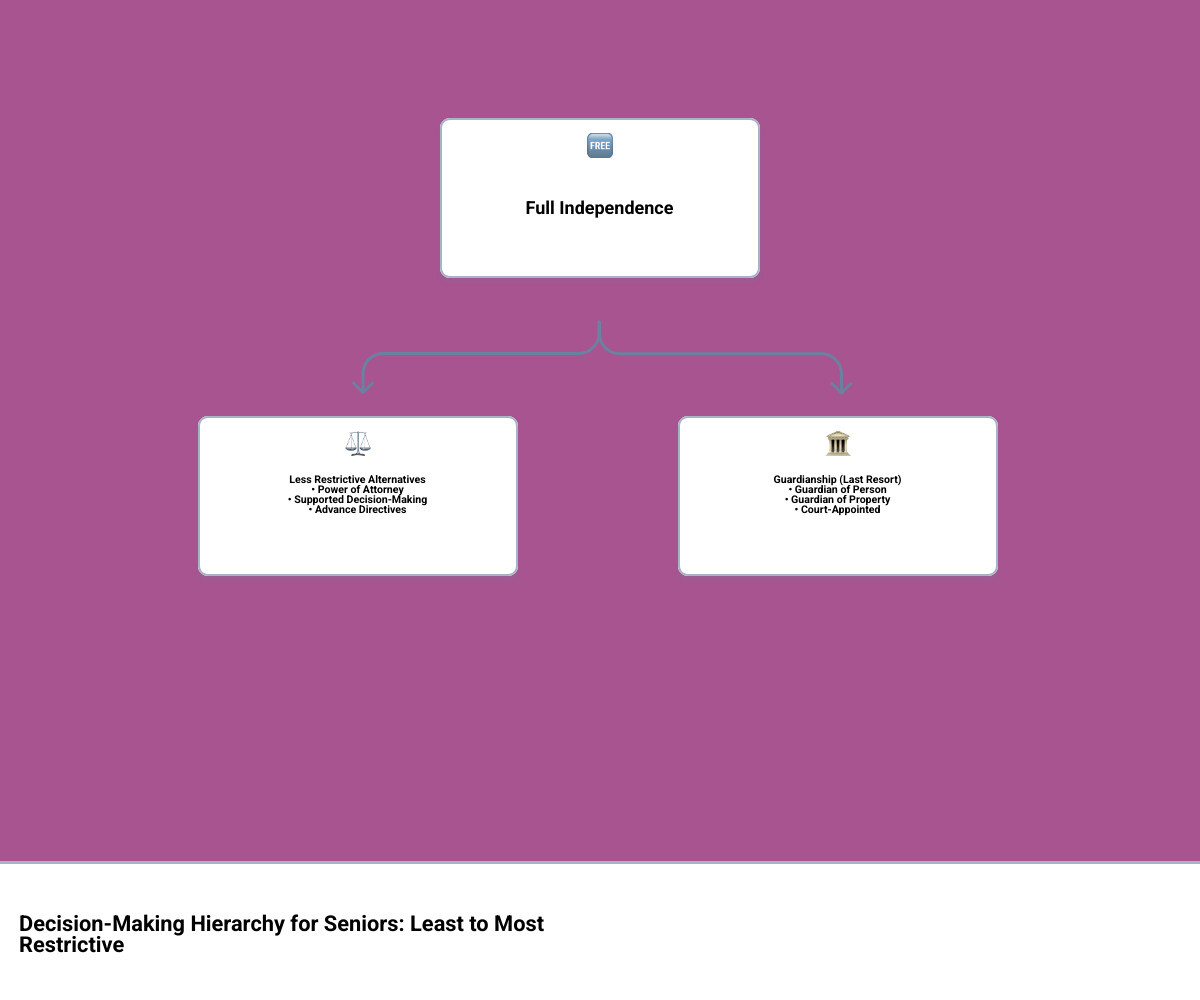
At Burnie's Way, we believe in the power of independence. Guardianship is a powerful tool, but it’s also a heavy one. Because it removes a person's autonomy, courts are legally required to look for "least restrictive means" first.
If we can keep Mom safe using a mix of technology, family support, and simple legal documents, that’s almost always better than a full court-ordered guardianship. It preserves her dignity and her sense of self-determination.
Before the "G-word" (guardianship) is ever uttered, families should look into Supported Decision-Making (SDM). This is a model where the senior keeps their legal rights but signs an agreement for a "support team" to help them understand choices. It’s like having a group of advisors rather than a boss.
Other critical tools include:
Planning these things early is the best gift you can give your future self. Take a look at our resources on End of Life Planning to get started.
Money is often the first place we see things slip. But you don't always need a conservatorship to help.
At Burnie's Way, our role is to provide the lifestyle coordination that keeps these systems running smoothly. Whether it’s through our Custom Care Plans or our more Comprehensive Care Plans, we help seniors stay independent so that legal interventions remain a distant "plan B."
Being appointed a guardian is a bit like becoming a parent to your parent. It is a profound responsibility. You are tasked with overseeing their personal needs—everything from making sure their home is clean to giving consent for medical procedures.
However, you aren't a dictator. The court will keep a close eye on you. Most guardians are required to file annual reports. These reports detail where the senior is living, how their health is, and exactly how every penny of their money was spent.
The irony of guardianship is that while it’s meant to protect against abuse, an unscrupulous guardian can become the abuser. This is why protections exist. If you suspect a guardian is overstepping or exploiting a senior, Adult Protective Services (APS) is the first line of defense.
Courts also use:
Guardianship doesn't have to be a life sentence. If a senior's condition improves—perhaps they recover from a temporary illness or a successful medication adjustment—they can petition the court for a restoration of rights.
The court will review the case, and if the capacity is found to be restored, the guardianship can be ended or modified to be less restrictive. This is a vital protection for the senior's civil liberties. For more on navigating these complex family dynamics, see our article on when an elderly person refuses care.
We’ll be honest: guardianship is not cheap. You’re looking at attorney fees (for you and often for the senior), court filing fees, and evaluator fees. Total costs can range from $3,000 to over $10,000 depending on how much the family disagrees.
Usually, the ward's assets pay for the proceeding if the guardianship is granted. If the court finds the petition was frivolous, the person who filed it might have to foot the bill.
Courts generally prefer family members—spouses, adult children, or siblings. However, if the family is fighting like cats and dogs, the judge might appoint a "professional guardian" or a "public guardian."
In some states, programs like the Adult Guardianship Program (AGP) serve as a last resort for seniors who have no one else to turn to. To be eligible, you generally must be at least 18 years old, have a clean criminal record, and be mentally capable of handling the task.
This is the most common point of confusion. Here is the breakdown:
Always try for a Power of Attorney first! It’s cheaper, private, and keeps the senior in the driver's seat of their own life.
Navigating guardianship for seniors can feel overwhelming, but remember: the goal is always to protect the dignity and safety of the person you love. It should be treated as a last resort, used only when the "village" of support can no longer keep them safe.
At Burnie's Way, we specialize in building that village. We aren't a medical provider, but we are experts in lifestyle coordination and personal support. Think of us as your virtual companion and personal assistant, helping your loved one live confidently at home while giving you the peace of mind that everything is under control.
By coordinating trusted services and routines, we often help families delay or even avoid the need for restrictive legal measures like guardianship. We believe that with the right support, every senior can continue to live a life full of heart and independence.
Ready to see how we can help? Explore Our Services and let's start planning a safer, happier future for your loved one today.
7 min read
When a Parent Needs Help: What You Should Know First Help looking after elderly parents is something millions of families navigate every year —...
12 min read
Why Understanding Eldercare Services Matters Now More Than Ever Eldercare services help older adults live safely and independently at home by...
7 min read
When a Parent Needs Help at Home: Where to Start Local senior care is a broad term — and when you're suddenly trying to figure out how to keep a...