

 Sydney Giffen
When Time is of the Essence: Navigating Emergency Support for Seniors
 Sydney Giffen : Jan 30, 2026 6:11:36 PM
When Every Second Counts: Understanding Emergency Elderly Care Help

Long term senior care covers a wide range of services that help older adults with daily tasks they can no longer do safely on their own.
If you're trying to understand your options quickly, here's a plain-language overview:
The main types of long term senior care:
Key facts to know:
If you're an adult child trying to figure out how to keep your aging parent safe and supported, you already know how quickly things can get complicated. One day everything seems manageable. Then a fall, a diagnosis, or a quiet conversation reveals just how much has changed.
The good news? You don't have to figure this out alone — and understanding the landscape of long term senior care is the best first step.
This guide walks you through everything: the types of care available, how to pay for it, what rights seniors have, and how to find quality help in your area.
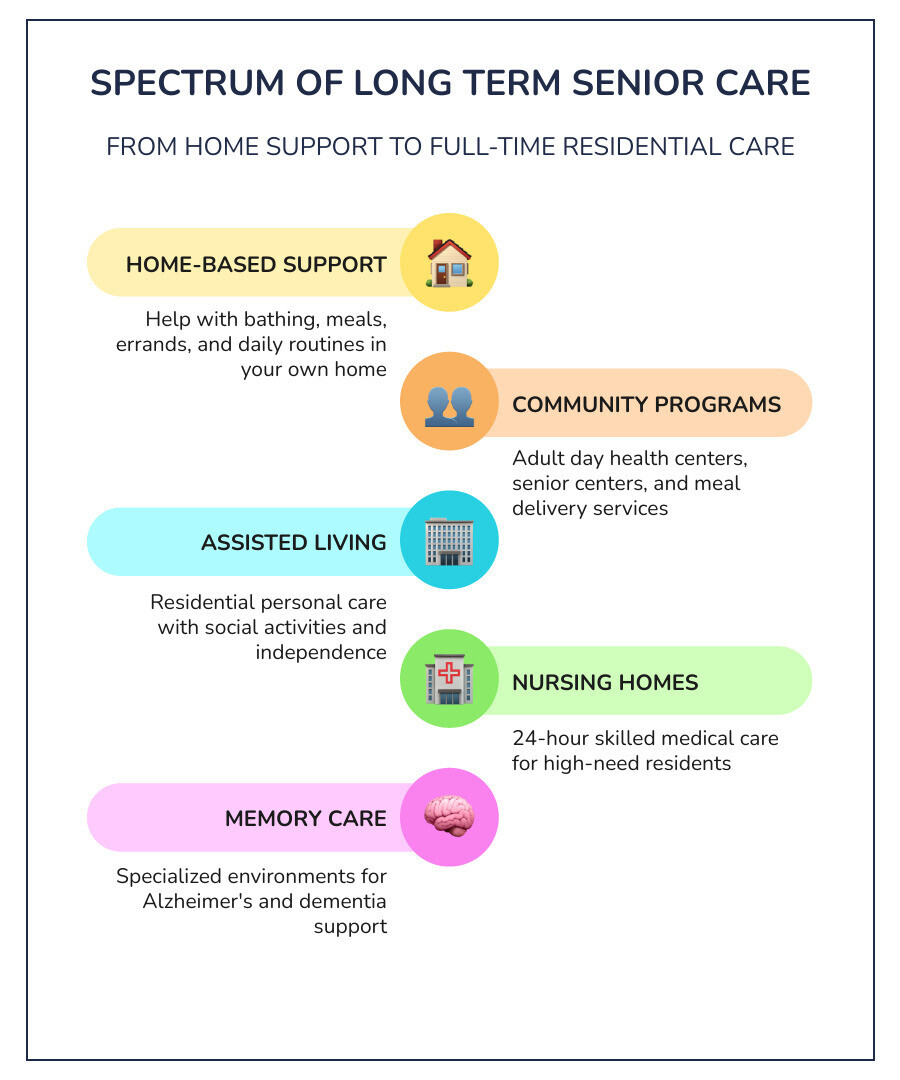
Long term senior care terminology:
When we talk about long term senior care, we aren't just talking about doctors and medicine. In fact, most of what people need as they age is "custodial care." This refers to help with Activities of Daily Living (ADLs). These are the basic tasks we often take for granted: bathing, dressing, using the bathroom, moving from a bed to a chair, and eating.

Who typically needs this support? While every situation is unique, research from What Is Long-Term Care? | National Institute on Aging shows that several factors increase the likelihood of needing help:
It is important to remember that needing help doesn't mean life stops being joyful. It just means the "logistics" of life need a little more coordination. For more insights into these dynamics, check out More info about long term care.
The world of long term senior care isn't an "all or nothing" choice between living alone and moving to a nursing home. There is a broad spectrum of support designed to meet people exactly where they are.
Navigating these choices is part of what we call life management. You can find More info about senior life management to help you understand how to piece these services together.
Sometimes, staying at home is no longer the safest or most comfortable option. When that happens, families look toward residential facilities. These vary significantly in the level of medical care and independence they offer.
| Facility Type | Resident Capacity | Typical Services | Payment Method |
|---|---|---|---|
| Board and Care Homes | 20 or fewer | Personal care, meals, 24-hour staff; usually no nursing. | Private pay; some Medicaid. |
| Assisted Living | 25 to 100+ | Help with ADLs, social activities, meals, medication management. | Mostly private pay; some insurance. |
| Nursing Homes | Varies | 24-hour skilled nursing care, rehab, medical supervision. | Medicaid, private pay; Medicare (short-term only). |
| CCRCs | Large Campuses | Independent living, assisted living, and nursing care in one place. | Entrance fees + monthly fees. |
For a deeper dive into these settings, the Long-Term Care Facilities | National Institute on Aging is an excellent resource. You can also find More info about continuous care services to see how these transitions work in practice.
Let’s talk about the elephant in the room: the cost. Long term senior care is expensive, and many families are shocked to find out that their standard health insurance doesn't cover it.
The national averages are a helpful starting point, but costs in Virginia may vary. On average, basic services in assisted living cost about $70,800 per year. Nursing homes are even steeper, with a semi-private room averaging $111,324 and a private room reaching $127,750 per year.
Because these costs are so high, early planning is essential. You can find More info about elder care planning to help you start the conversation before a crisis hits.
A common misconception is that Medicare will pick up the tab. We want to be very clear: Medicare does not pay for long term custodial care.
Since government programs have so many "ifs" and "buts," many families rely on private pay or specialized insurance.
Long Term Care Insurance (LTCI) is a policy you buy (ideally when you're younger and healthier) to cover these future costs. These policies are highly unique, so you have to read the fine print. Key terms to look for include:
For those looking for a more personalized approach to coordinating these resources, More info about custom care plans can provide a roadmap.
For seniors living with Alzheimer's, dementia, or other cognitive impairments, standard long term senior care might not be enough. These individuals often need "Memory Care" or Special Care Units (SCUs).
Quality memory care focuses on person-centered plans. This might include:
We believe that even when a senior needs intensive support, their individuality should still be celebrated. You can find More info about comprehensive care plans that emphasize this holistic approach.
No matter where a senior receives care, they have fundamental rights. These include the right to be treated with dignity, the right to privacy, and the right to participate in their own care planning.
If you ever have concerns about the quality of care in a facility, there are resources to help:
Deciding to move a loved one from home to a residential facility is one of the hardest decisions a family will ever make. Often, the "right time" is signaled by safety risks—like a senior wandering or leaving the stove on—or by significant caregiver burnout.
If the caregiver's own health is suffering, or if the senior needs 24-hour supervision that a family can no longer provide, it may be time to transition. For those who aren't quite ready for a permanent move, More info about long term respite can offer temporary relief.
Don't just rely on a glossy brochure. When evaluating long term senior care options, we recommend a "boots on the ground" approach:
Resources like the Eldercare Locator (1-800-677-1116) and your local Area Agency on Aging (AAA) can also provide a list of vetted services in your specific part of Virginia.
No. Medicare is designed for medical recovery, not daily living assistance. It may cover a short stay in a skilled nursing facility after a hospital visit, but it will not pay for long-term help with bathing, dressing, or meals.
It’s usually time when safety becomes a constant worry. If your loved one is frequently falling, forgetting to take vital medications, or if the primary caregiver is experiencing physical or emotional exhaustion, a residential setting often provides a higher quality of life for everyone involved.
The best place to start is the Eldercare Locator, a public service of the Administration for Community Living. You can call them at 1-800-677-1116 or visit their website to find support services tailored to your zip code.
Navigating long term senior care can feel like learning a new language while trying to put out a fire. But remember, the ultimate goal is simple: helping your loved one live with as much dignity, connection, and comfort as possible.
At Burnie's Way, we believe that "care" is about more than just checking boxes on a medical form. We see ourselves as a virtual companion and a personal concierge for aging adults. Our mission is to provide the lifestyle coordination and personal support that allows seniors to stay independent and confident in their own homes for as long as possible.
Whether it’s coordinating trusted routines, helping with errands, or simply providing a compassionate voice to ensure everything is okay, we are here to give families peace of mind. You don't have to manage the complexities of aging alone.
Ready to see how a personalized approach to support can change your family's experience? Explore our personal support services and let us help you navigate the journey ahead with heart and competence.

Sydney Giffen : Jan 30, 2026 6:11:36 PM
When Every Second Counts: Understanding Emergency Elderly Care Help

Sydney Giffen : Mar 2, 2026 12:00:00 AM
Why Understanding Home Support Options Matters What are the home care services for the elderly person? Home care services for seniors fall into four...

Sydney Giffen : Mar 18, 2026 12:00:00 AM
Why Emergency Senior Care Matters for Your Family Emergency senior care refers to immediate support services available when an older adult faces an...