

Understanding What You'll Really Pay for In-Home Support
The cost of senior home care depends on three main factors: where you live, how many hours of help you need each week, and what type of support your loved one requires. Here's what families typically pay:
National Median Costs (2024):
- Hourly Rate: $30-$33/hour for non-medical support
- 7 hours/week: ~$1,000/month
- 15 hours/week: ~$2,145/month
- 30 hours/week: ~$4,290/month
- 44 hours/week: ~$6,292/month
- 24/7 support: ~$18,000+/month
After her 90-year-old mother fell and injured herself, one daughter hired someone to help around the house for a few hours each day. Six months later, when her father began experiencing memory lapses, she knew they needed more support. This is a story many families share.
Understanding what in-home support actually costs can feel overwhelming. You're juggling your own responsibilities while trying to figure out how to keep your parent safe, comfortable, and independent at home. The numbers vary widely depending on your location, the level of help needed, and whether you work with an agency or hire privately.
This guide breaks down the real costs of in-home support for seniors—from companion services to more intensive personal assistance. We'll look at what drives these costs, how they compare to facility-based options like assisted living, and the various ways families pay for support.
Important note: Burnie's Way provides personal support and lifestyle coordination to help seniors live independently at home. We are not a caregiving or healthcare provider. When we discuss "in-home care" in this guide, we're providing educational information about the broader landscape of support options available to families.
Whether you're just starting to explore options or actively planning a budget, you'll find practical information to help you make confident decisions about supporting your loved one at home.
Understanding the Types of In-Home Support for Seniors
When we talk about supporting aging adults at home, it's important to understand that "in-home care" isn't a one-size-fits-all solution. It encompasses a spectrum of services, from light assistance to more intensive support, each with its own associated costs. For many families, the goal is to help their loved ones maintain independence and comfort in their familiar surroundings. Our services at Burnie's Way focus on personal support and lifestyle coordination, empowering elders to live safely and independently. We help connect families with the right solutions for their unique situations. You can find more information about the various ways we assist aging adults by visiting More info about our services.

Companion and Homemaker Services
These are often the entry point for families seeking support for an aging loved one. Companion and homemaker services focus on non-medical assistance that helps seniors manage daily life and prevent isolation. These can include:
- Companionship and Social Engagement: Professional support persons can spend hours chatting with older adults, helping them stay connected to their community and providing a crucial antidote to loneliness. Research from the National Institute on Aging highlights that staying socially active is crucial for an older adult's health and well-being, making it a major bonus of home support services.
- Meal Preparation: Ensuring nutritious meals are prepared and available.
- Light Housekeeping: Keeping the home tidy and safe.
- Transportation: Assisting with appointments, errands, or social outings.
- Errand Running: Picking up groceries, prescriptions, or other necessities.
Because these services are generally non-medical and less hands-on, they typically come with lower hourly rates compared to services requiring more specialized skills. They are ideal for seniors who are largely independent but could benefit from an extra pair of hands and some friendly company.
Personal and Lifestyle Support at Home
As needs evolve, seniors may require more direct assistance with daily routines. This is where personal and lifestyle support comes in. These services help individuals with activities they might find challenging due to age or mobility issues, while still prioritizing their autonomy. Our approach at Burnie's Way involves personal assistance that helps with:
- Daily Routines: Support with morning and evening routines, helping to ensure a smooth and comfortable start and end to the day.
- Help with Organization, Scheduling, and Mobility around the Home: This can involve keeping living spaces functional, managing appointments, or offering a steadying hand when moving between rooms.
- Coordination of Trusted Third-Party Services for Specialized Needs: While we don't provide medical care, we help coordinate access to trusted third-party providers for specialized needs, such as physical therapy, skilled nursing, or complex medical equipment. We act as a central point of contact, easing the burden on families.
- Support for Maintaining Independence and Comfort: Our goal is to empower seniors to live the way they want, with support in key areas of daily life. This helps them maintain control over their lives and continue enjoying their home environment.
For more details on how we can personalize this type of assistance, explore our Private Elder Support Services. This level of support requires a higher degree of trust and hands-on involvement, which can influence the cost of senior home care.
Key Factors That Determine the Cost of Senior Home Care
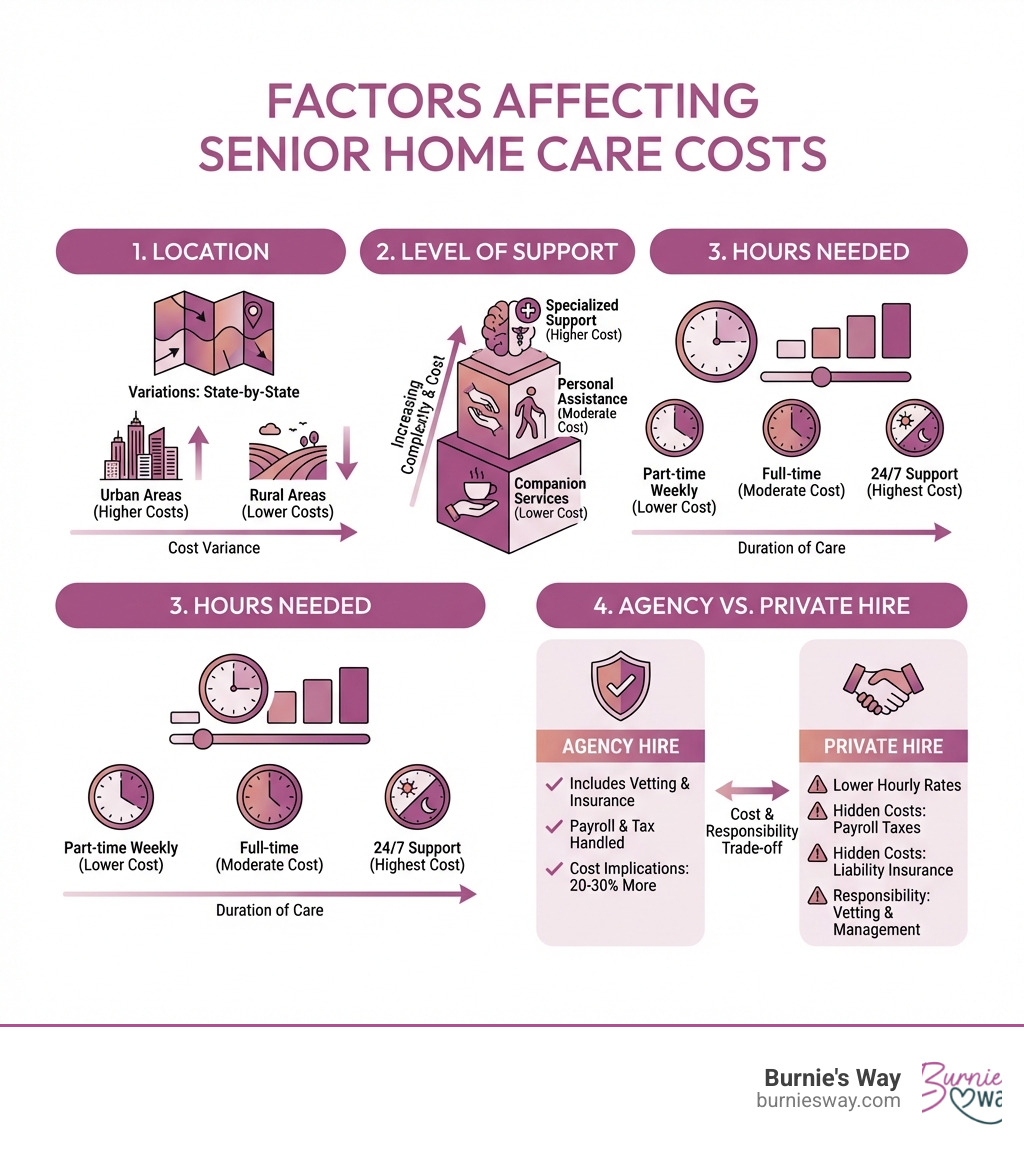
Understanding the average cost of senior home care is just the beginning. Several critical factors can significantly influence the final price tag. These aren't just minor adjustments; they can lead to substantial differences in your monthly expenses. When we help families plan, we emphasize looking at the full picture to avoid surprises.

How Location and Level of Support Impact the Cost of Senior Home Care
Where your loved one lives plays a huge role in how much home support costs. Just like housing prices, care costs vary dramatically by state, city, and even within different neighborhoods.
- State-by-State Cost Differences: The national median cost for home health aide services in the U.S. is around $33 per hour, but this is merely an average. Some states, like Mississippi, might have median hourly rates as low as $24, while states such as Minnesota and South Dakota could see rates climb to $43 per hour. These variations are often tied to local cost of living, demand for support services, and state regulations. Data from sources like the Genworth Cost of Care survey can help you get a more precise estimate for your specific area.
- Urban vs. Rural Price Variations: Within states, urban areas typically have higher hourly rates than rural areas due to increased demand and higher operating costs for agencies.
- Cost Difference Between Homemaker and More Specialized Support: As mentioned earlier, the type of support directly impacts the cost. In 2023, the national median cost for homemaker services (focused on "hands-off" tasks like cooking and cleaning) was $30 per hour, while home health aide services (providing "hands-on" assistance with activities like bathing and dressing) averaged $33 per hour. This $3 difference per hour can add up significantly over a month.
- Higher Costs for Specialized Memory or Dementia Support: When a senior requires specialized support for conditions like Alzheimer's or dementia, the cost of senior home care can increase. This is because these situations often demand caregivers with specific training, more intensive supervision, and a higher level of patience and expertise, which commands a higher hourly rate.
Agency vs. Private Hire: A Cost and Responsibility Breakdown
Another major factor influencing the cost of senior home care is how you choose to hire your support professional. You generally have two options: going through an agency or hiring privately. Each path has its own financial implications and responsibilities.
Agency Benefits and Costs: Hiring through an agency, like those we coordinate with for comprehensive daily life management, typically comes with a higher hourly rate – often 20% to 30% more than hiring privately. However, this increased cost covers significant advantages:
- Vetting and Background Checks: Agencies handle thorough screenings, ensuring professionals are qualified and trustworthy.
- Insurance and Bonding: Agencies carry liability insurance and workers' compensation, protecting both the client and the support professional.
- Backup Support: If your regular support person is sick or unavailable, the agency provides a replacement, ensuring continuity of service.
- Payroll and Taxes: Agencies manage all payroll, taxes, and administrative burdens, relieving families of complex employer responsibilities.
- Supervision and Training: Many agencies provide ongoing training and supervision for their staff. When we help our clients coordinate services, we often work with reputable agencies to ensure Reliable Home Support.
Private Hire Costs and Hidden Responsibilities: Hiring a support professional privately, perhaps through a referral or an online platform, might seem more affordable on an hourly basis. However, this route comes with potential hidden costs and significant responsibilities:
- Lower Hourly Rate: You might pay a lower hourly rate directly to the individual.
- Hidden Costs: You effectively become an employer. This means you are responsible for:
- Payroll Taxes: Withholding and paying federal and state taxes.
- Liability Insurance: If the support professional is injured in your home, you could be held liable.
- Background Checks: Conducting your own thorough background checks, which can be time-consuming and costly.
- Finding Backup: If your private hire is sick or on vacation, finding a temporary replacement falls squarely on your shoulders. The emotional labor and administrative burden of managing a private hire can be substantial. For many, the peace of mind and convenience offered by an agency justifies the higher hourly rate. Learn more about the advantages of Hiring through a home support agency.
Average Costs: From Hourly Rates to 24/7 Support
To truly understand the cost of senior home care, it's helpful to look at national averages and how these translate into monthly expenses based on the level of support needed. These figures provide a baseline for planning, but actual costs will vary by location and specific needs.
What is the Average Hourly and Monthly Cost of Senior Home Support?
The hourly rate is the fundamental building block for calculating the cost of senior home care. According to the Genworth Cost of Care Survey, which is a leading source for long-term care costs:
- The national median cost for homemaker services in 2023 was $30 per hour. Homemaker services typically include assistance with "hands-off" tasks like cooking, cleaning, and general companionship.
- The national median cost for home health aide services in 2023 was $33 per hour. Home health aides provide "hands-on" assistance with activities of daily living (ADLs) such as bathing, eating, and getting dressed. The Genworth Cost of Care Survey 2023 data indicates that these costs saw year-over-year increases, driven by factors like inflation and worker shortages.
To give you a clearer picture of potential monthly expenses, let's look at examples based on the number of hours of support per week:
- Care for 7 hours a week: Approximately $1,000 per month. This could be a few hours, a couple of days a week, for companionship, meal prep, or light errands.
- Care for 15 hours a week: Approximately $2,145 per month. This might involve daily check-ins, assistance with a few ADLs, or more extensive homemaker services.
- Care for 30 hours a week: Approximately $4,290 per month. This level of support is often chosen when a family caregiver works full-time and needs assistance during weekdays.
- Care for 44 hours a week: Approximately $6,292 per month. This is essentially full-time weekday support, suitable for seniors needing consistent help throughout the day.
These figures illustrate how quickly costs can escalate with increased hours. For more insights into how to integrate these services into daily life, read our article on Senior Support at Home.
Comparing 24/7 In-Home Support vs. Facility-Based Options
When an older adult requires round-the-clock support, families often face a critical decision: 24/7 in-home support or a move to a facility like assisted living or a nursing home. The cost of senior home care for 24/7 coverage is substantial, but so are the benefits of staying in one's own home.
- 24/7 In-Home Support: Based on the national median hourly rate of $27 (as per some recent data points), 24-hour support can cost approximately $4,536 per week, or over $18,000 per month. Some sources indicate this can easily reach $28,000 per month, particularly if skilled nursing is required. While expensive, 24/7 in-home support offers one-on-one attention, personalized routines, and the comfort of familiar surroundings.
- Assisted Living Communities: These facilities provide personal care and health services for those needing assistance with activities of daily living, but not 24/7 medical supervision. The national median cost for a private one-bedroom unit in an assisted living community was around $4,500 per month ($54,000 per year) in 2021. Additional costs can include move-in fees and extra services.
- Nursing Homes: Offering the highest level of medical care and supervision, nursing homes are for individuals with significant health needs. The national median cost of a semi-private room at a nursing home was $7,908 per month ($94,896 per year), and a private room cost $9,034 per month ($108,408 per year) in 2021.
Here's a quick comparison of national median monthly costs:
| Care Option | National Median Monthly Cost |
|---|---|
| In-Home Support (44 hours/week) | ~$6,292 |
| Assisted Living (Private 1-bedroom) | ~$4,500 |
| Nursing Home (Semi-Private Room) | ~$7,908 |
Source: Genworth Cost of Care Survey and other industry data, adjusted for 2024 estimates.
You can find a comprehensive Costs of Support overview from the Administration for Community Living. The trade-offs are significant:
- Pros of 24/7 In-Home Support: One-on-one personalized assistance, maintaining independence and routine in a familiar environment, family involvement in daily decisions.
- Cons of 24/7 In-Home Support: Higher cost of senior home care for extensive hours, requires diligent management (if privately hired), potential for isolation if social engagement isn't actively coordinated.
- Pros of Facility-Based Options: Built-in social community, all-inclusive services (meals, activities), 24/7 supervision, no need to manage individual support professionals.
- Cons of Facility-Based Options: Loss of independence and familiar surroundings, less personalized attention, potential for higher overall cost than part-time home support.
The decision often comes down to balancing the desire for aging in place with financial realities and the level of medical or personal attention required. For more detailed comparisons, the Genworth Cost of Care Survey offers valuable insights.
How to Pay for In-Home Support and Plan Your Budget
Once you understand the potential cost of senior home care, the next logical step is figuring out how to pay for it. This can be one of the most challenging aspects for families, requiring careful financial planning and exploration of various funding sources.
Exploring Payment Options: From Private Pay to Government Aid
Many families use a combination of resources to cover the cost of senior home care.
- Personal Savings and Assets: For most, personal savings, investments, and retirement income are the primary payment methods. Adult children may also contribute financially depending on their parent's situation. For those who own their homes, a reverse mortgage can be an option, converting home equity into cash for care expenses, though it's crucial to understand that the entire balance must be repaid when the home is sold or the owner moves out.
- Long-Term Care Insurance: This type of insurance is designed specifically to cover long-term support services, including in-home assistance. It can be an effective way to help pay for home support, but read the fine print. Policies vary widely, and not all cover in-home services. We encourage you to research Long-term care insurance options carefully.
- Medicare Limitations for Non-Medical Support: Medicare generally does not cover non-medical, long-term in-home support. It will help pay for some skilled nursing or therapy in the home if it's medically necessary and prescribed by a doctor, but it won't cover personal assistance or companionship. However, some Medicare Advantage plans (offered by private insurers) may provide coverage for certain in-home services, so it's worth checking specific plans.
- Medicaid Home and Community-Based Services (HCBS) Waivers: Medicaid may cover some home support services, but eligibility and requirements vary significantly by state. These programs are often designed to help low-income individuals receive support in their homes rather than in institutions. To learn more about what's available in your state, you should contact your state’s Medicaid office.
- Veterans (VA) Benefits: If your loved one is a veteran with a VA healthcare plan, long-term home support may be part of their benefits. Eligibility and covered services differ by program (e.g., Aid and Attendance pension, Housebound pension). A VA social worker can help steer these options. Explore more about VA long-term support benefits.
- Tax Deductions: While there isn't a specific deduction for non-medical in-home support, unreimbursed medical expenses (including those for personal assistance with activities of daily living) exceeding 7.5% of adjusted gross income can be itemized and deducted. It's best to consult a tax professional for guidance.
Creating a Budget and Planning for Future Needs
Creating a realistic budget is essential for managing the cost of senior home care without financial strain. This process should be comprehensive and forward-looking.
- Assessing Current Finances: Start by gathering all financial information: income (social security, pensions, investments), savings, assets, and current expenses. Understand what resources are immediately available.
- Listing All Potential Expenses: Include not just the hourly rate for support, but also potential hidden costs like overtime, supplies, agency fees (if applicable), and any increased utility or home maintenance costs. Don't forget living expenses like food, utilities, and taxes.
- Having Open Family Conversations: This is perhaps the most crucial step. Financial discussions can be emotional, but having honest conversations with loved ones about care expectations and finances before an urgent need arises can lessen tension. Experts recommend these discussions to align expectations and avoid disagreements. For advice on facilitating these conversations, the Family Caregiver Alliance offers valuable resources.
- Factoring in Cost Inflation: The cost of senior home care has been rising. Homemaker services increased by 10% and home health aide services by 7.14% year-over-year in 2023. Plan for costs to potentially increase by 2-5% annually.
- The Importance of Early Planning: The earlier you start planning, the more options you'll have. Setting aside money specifically for later years, even before retirement, can make a significant difference. Working with a financial advisor can help maximize savings and create a sustainable plan. This proactive approach helps families feel more prepared and confident in their choices for Home Support Solutions.
Evaluating Value Beyond the Hourly Rate
While the cost of senior home care is a major consideration, look beyond the hourly rate and consider the overall value proposition. The true benefits often extend far beyond the financial numbers, impacting the senior's quality of life and the family's peace of mind.
The Hidden Value: Independence, Safety, and Peace of Mind
Choosing in-home support is an investment in several intangible, yet invaluable, aspects of an aging adult's life:
- Independence at Home: For many seniors, staying in their own home is paramount. It means maintaining familiar routines, cherished memories, and a sense of control over their environment. This ability to age in place significantly contributes to emotional well-being and overall happiness.
- One-on-One Personalized Support: Unlike facility settings, in-home support provides undivided attention. This allows for truly personalized assistance custom to the individual's preferences, pace, and specific needs, fostering a deeper connection with their support professional.
- Safety and Security: Professional support can significantly improve safety at home. Support professionals can help prevent falls by ensuring safe movement from one place to another. This is crucial, as in 2019, 3 million adults aged 65 and older had a serious fall resulting in an emergency room visit. The CDC fall statistics highlight the dangers of falls for older adults, with hospital costs averaging $2,607 per day. Preventing even one serious fall can offset a significant portion of home support costs.
- Reduced Risk of Hospital Readmissions: Consistent support at home can help manage chronic conditions, ensure medication adherence, and provide a watchful eye for changes in health, potentially reducing emergency room visits and hospital readmissions.
- Peace of Mind for the Entire Family: Knowing that a trusted professional is providing support and companionship offers immense relief to family members, especially those living far away or juggling their own busy lives. This peace of mind is an invaluable benefit. We believe in empowering elders to live safely and independently, which is why we focus on Elderly In-Home Support that brings these benefits to the forefront.
The Opportunity Cost for Family Members
The decision to seek professional in-home support isn't just about the financial outlay for the senior; it's also about the opportunity cost for family members who might otherwise be providing unpaid support.
- Providing Relief for Family Members: Bringing in professional support allows family members to step back from the demands of daily support tasks. This can be a lifeline, preventing burnout and allowing them to focus on their own health, relationships, and work.
- More Time to Focus on Personal Health and Work: According to a 2019 study, unpaid family supporters lose out on about $67 billion in earnings annually due to missed work. The financial and personal toll of being a primary support person can be substantial. Investing in professional support can free up family members to pursue their careers, maintain their own well-being, and enjoy quality time with their loved one without the stress of constant responsibility.
- Reducing Emotional Stress and Burnout: The emotional strain of supporting an aging parent can be immense. Professional support can alleviate this burden, allowing family relationships to return to a more natural dynamic, focused on love and connection rather than tasks and worries.
Conclusion
Navigating the cost of senior home care can feel like a complex puzzle, but understanding the pieces makes the picture clearer. We've seen that the cost is highly variable, influenced significantly by geographic location, the level of personal assistance needed, and the number of hours required. Whether you choose an agency or a private hire also plays a crucial role, balancing hourly rates against the responsibilities you're willing to undertake.
The goal is to find a solution that not only fits your budget but, more importantly, supports your loved one's independence, improves their quality of life, and provides peace of mind for the entire family. While 24/7 in-home support can be more expensive than facility-based options, the benefits of aging in place—familiar surroundings, personalized attention, and continued autonomy—are often priceless.
Understanding your options, having open family conversations, and planning financially are the crucial first steps toward making informed decisions. For families exploring how to manage daily life and maintain independence at home, Burnie's Way offers personalized support and coordination, acting as a trusted partner to ensure everything's okay. To learn more about how we can help and to explore custom solutions, please visit See our pricing for personalized support.