
When Your Parent's Pill Bottles Become a Puzzle
Medication management services are professional, pharmacist-led programs that review all of a person's medications — prescriptions, over-the-counter drugs, vitamins, and supplements — to make sure they're safe, effective, and actually being taken correctly.
Here's a quick summary of what they involve:
- Who provides them: Licensed clinical pharmacists, sometimes working alongside doctors and other providers
- What happens: A thorough review of every medication your loved one takes, checking for dangerous interactions, unnecessary doses, and adherence problems
- Who benefits most: Older adults managing multiple chronic conditions or taking five or more medications at once
- How to access them: Through a primary care referral, a Medicare Part D plan, or a health plan invitation
- Cost: Often covered by Medicare Part D or private insurance at no extra charge
Now, here's why this matters so much right now.
Nearly half of all U.S. adults with chronic conditions struggle to take their medications as prescribed. And for older adults, the risk compounds fast — between 30% and 60% of people aged 65 and older are managing five or more medications at the same time.
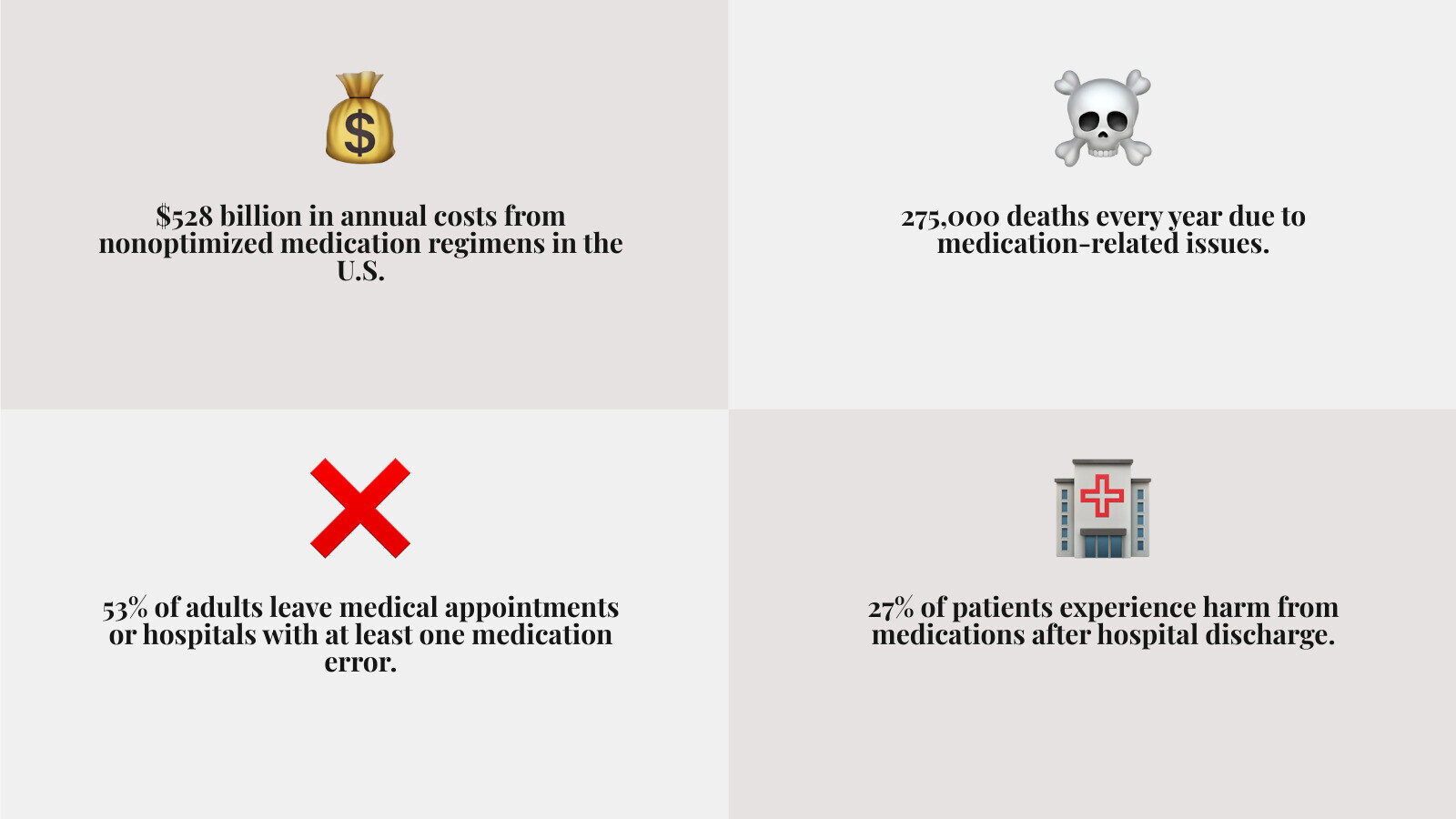
The consequences aren't abstract. Nonoptimized medication regimens contribute to an estimated $528 billion in annual costs and more than 275,000 deaths every year in the United States alone. According to patient safety data, 53% of adults leave a medical appointment or hospital visit with at least one medication error — and 27% experience some form of harm from a medication after being discharged from a hospital.
If you're an adult child trying to make sure your aging parent is safe at home, the medication question is often one of the most overwhelming pieces of the puzzle. Multiple doctors. Multiple pharmacies. Pills that look the same but aren't. Instructions that conflict. Side effects that get mistaken for new symptoms.
That's exactly the gap that medication management services are designed to close.
Understanding Medication Management Services
When we talk about medication management services (MMS), we aren't just talking about a pillbox or a reminder app. We are looking at a high-level, patient-centered collaborative approach to healthcare. It is a spectrum of services provided by pharmacists to ensure that every pill, liquid, or supplement going into a patient's body is doing exactly what it is supposed to do—and nothing it shouldn't.
At its heart, this service is about expert oversight. While a doctor is an expert in diagnosis and treatment plans, a clinical pharmacist is an expert in the "chemistry" of those plans. They look at the whole picture to ensure medication appropriateness. This is especially vital in Elderly Care Planning, where the complexity of care increases every year.
Defining the Goal of Medication Management Services
The primary goal of medication management services is to optimize therapeutic outcomes. In plain English? It means making sure the medicine actually works while keeping the patient safe.
We focus on four key pillars:
- Safety: Identifying potential drug-drug or drug-food interactions that could cause harm.
- Effectiveness: Ensuring the dosage is correct and that the medication is achieving the desired health goal (like lowering blood pressure or stabilizing mood).
- Adherence: Helping patients find ways to actually take the medicine as prescribed, which is a struggle for roughly half of all adults with chronic conditions.
- Cost-Efficiency: Identifying lower-cost alternatives or removing unnecessary medications that no longer serve a purpose.
By achieving these goals, Comprehensive Medication Management For Adults can lead to staggering improvements. For example, at M Health Fairview, this approach led to a 55% improvement in uncontrolled conditions like diabetes and hypertension.
MMS vs. MTM vs. CMM: What is the Difference?
If you feel like you're drowning in alphabet soup, you aren't alone. Even in April 2026, these terms are often used interchangeably, but they have distinct meanings in the clinical world.
| Term | Full Name | Focus |
|---|---|---|
| MMS | Medication Management Services | An umbrella term for all pharmacist-led services focusing on medication safety and health outcomes. |
| MTM | Medication Therapy Management | A specific program often required by Medicare Part D for eligible members. It includes a Comprehensive Medication Review (CMR). |
| CMM | Comprehensive Medication Management | A more clinical, integrated process where the pharmacist has full access to medical records and works closely with the physician to adjust regimens. |
While MTM is often a benefit provided by your insurance, CMM is frequently part of a primary care or specialty clinic's standard of care. Both are forms of medication management services that aim to prevent "pharmacy roulette"—that dangerous game of hoping the combination of pills doesn't cause a crisis.
The High Stakes of Polypharmacy and Medication Errors
The term "polypharmacy" sounds fancy, but it just means taking a lot of medications—specifically, five or more at once. Globally, 30% to 60% of adults over 65 are affected by this. In Virginia, where many of our families reside, we see this daily. A senior might see a cardiologist for their heart, an endocrinologist for diabetes, and a GP for everything else. If those doctors aren't talking to each other, the patient ends up with a "medication pile-up."

This isn't just a matter of convenience. It’s a matter of life and death. Nonoptimized regimens lead to 275,000 deaths annually in the U.S. Furthermore, 20% of patients are readmitted to the hospital within a short window due to an adverse reaction to a medication. This is why Senior Safety Solutions must always include a professional review of the medicine cabinet.
Who Benefits Most from Medication Management Services?
While anyone taking a prescription can benefit, these services are a lifeline for specific groups:
- Seniors (65+): As we age, our bodies process drugs differently. What was safe at 40 might be toxic at 80.
- Those with Chronic Conditions: Managing diabetes, heart disease, or COPD requires precision.
- Transitions of Care: Patients recently discharged from the hospital are at the highest risk. Remember: 27% of patients experience harm from a medication following discharge.
- Multiple Prescribers: If your parent sees three or more specialists, they need a "medication quarterback" to coordinate the play.
Addressing Side Effects and Drug Interactions
One of the most exciting developments in 2026 is the use of pharmacogenomics—testing how your specific genes affect your response to drugs. Research shows that pharmacogenomic-guided prescribing has reduced hospitalizations by 39% within 60 days.
Clinical pharmacists use this data, along with symptom diaries, to identify if a "new symptom" is actually a side effect. For instance, a patient might complain of a metallic taste in their coffee; a pharmacist can quickly identify which drug interaction is causing that, rather than the doctor prescribing another pill to treat the taste issue. This prevents the "prescribing cascade," where one drug's side effects lead to a second, third, and fourth prescription.
What to Expect During a Consultation
A medication management services consultation is much more than a quick chat at the pharmacy counter. It is a dedicated 10-to-30-minute deep dive into your health. We often recommend that families use a Daily Life Management Tips Guide to prepare for these meetings, as the more information you provide, the better the outcome.
The Comprehensive Medication Review (CMR) Process
When you sit down (or hop on a video call) for a CMR, the pharmacist will:
- Gather the Goods: You should bring every single bottle—prescriptions, OTC meds like aspirin, vitamins, herbal supplements (like St. John’s wort, which can interact dangerously with antidepressants), and even infusions.
- Review History: They will look at your medical history and current symptoms.
- Check for "Problems": They look for duplicate therapies (two drugs doing the same thing) or medications that are no longer needed.
- Create a Plan: You will leave with a Personal Medication List (a "source of truth" for all your doctors) and a To-Do List for you and your healthcare team.
Virtual vs. In-Person Medication Management Services
In today’s world, virtual options have become incredibly popular. They allow seniors to receive expert advice from the comfort of home, which is a huge win for Senior Care Coordination.
However, there are differences:
- Virtual: Great for routine reviews, addressing adherence issues, and education. It’s convenient and reduces the stress of travel.
- In-Person: Necessary if a physical exam is needed or if the pharmacist needs to demonstrate how to use a complex device, like a new insulin pump or certain inhalers.
In some regions, there are specific regulations. For instance, virtual-only services may be limited to non-controlled substances. If a patient needs management for controlled pain medications, an in-person referral is usually required.

Navigating Access, Insurance, and Costs
One of the biggest hurdles families face is simply knowing that these services exist and how to pay for them. The good news? For many, the cost is $0.
How to Enroll in Medication Management Services
There are three main ways to get started:
- Medicare Part D: If you have a Medicare drug plan and meet certain criteria (usually having multiple chronic diseases and high drug costs), you are often automatically enrolled in an MTM program. You’ll receive an invitation in the mail or a phone call.
- Primary Care Referral: You can ask your doctor for a referral to a clinical pharmacist. This is becoming a standard part of Senior Care Planning Guide 2026.
- Health Plan Outreach: Many private insurers now offer virtual pharmacy clinics to their members at no extra cost because they know it prevents expensive hospitalizations.
When Virtual Options Are Not Appropriate
Virtual medication management services are a marvel, but they aren't for everyone. They may not be appropriate if:
- Controlled Substances are Involved: Medications with a high potential for misuse often require in-person monitoring.
- Cognitive Impairment is Severe: If a senior has advanced dementia and no caregiver is available to assist with the video call, an in-person visit or a different support model is needed.
- Technological Barriers: If there is no reliable internet or the patient is uncomfortable with the tech, the stress of the call might outweigh the benefits.
Frequently Asked Questions about Medication Management
Do I need to fill my prescriptions at a specific pharmacy to use these services?
No! This is a common misconception. Most medication management services, especially those through Mayo Clinic or independent clinical pharmacists, are available regardless of where you fill your prescriptions. They are there to review the regimen, not just sell the pills.
Can a family member or caregiver attend the consultation with me?
Absolutely. In fact, it is highly encouraged. Caregivers often have insights into a senior's daily routine or side effects that the patient might forget to mention. Having a second pair of ears helps ensure the "To-Do List" actually gets done.
Are these services covered by Medicare?
Yes, under Medicare Part D, Medication Therapy Management (MTM) is a covered benefit for those who qualify. Qualification is usually based on having at least three chronic conditions and reaching a certain threshold in annual drug costs (around $1,276 in 2026).
Conclusion
At Burnie's Way, we believe that staying independent at home starts with staying safe. You can have the best exercise routine and the healthiest diet, but if your medications are working against you, your independence is at risk.
While we are not doctors or pharmacists, we are your partners in lifestyle coordination and personal support. We help families navigate these complex systems, ensuring that routines are built, appointments are kept, and that "medication pile-up" never happens.
Think of us as your personal concierge for aging gracefully. We coordinate the experts so you can focus on the connection. If you're feeling overwhelmed by the pharmacy roulette, don't wait for a hospital visit to be the wake-up call. Explore More info about our services and let us help you bring order to the chaos, providing the peace of mind you and your family deserve.