

Finding the Right Virginia Senior Care: A Quick Overview
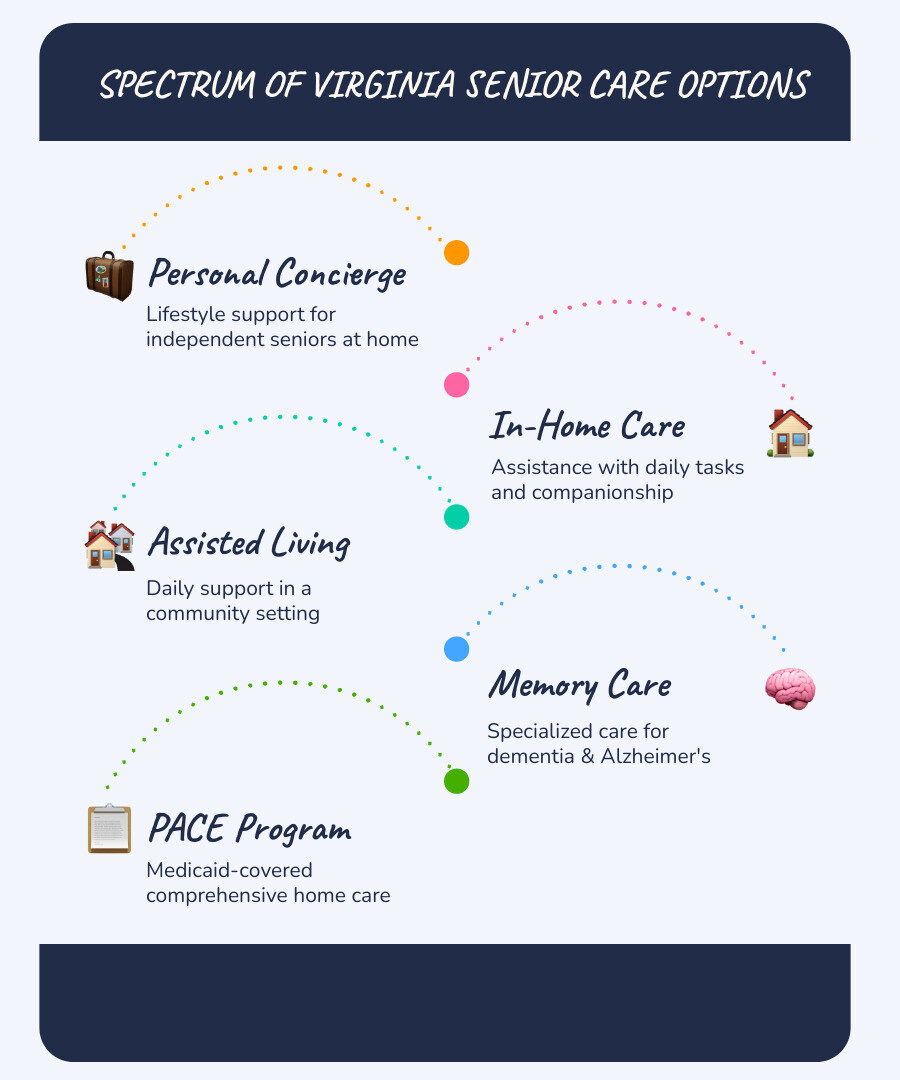
Virginia senior care covers a wide spectrum of options — from personal support at home to specialized memory care communities. Here's a quick look at the five main types:
| Care Type | Best For | Setting |
|---|---|---|
| Personal concierge & lifestyle support | Independent seniors who want help staying organized and connected | At home |
| In-home care | Seniors needing help with daily tasks or companionship | At home |
| Assisted living | Seniors who need daily support but want community life | Residential facility |
| Memory care | Seniors living with Alzheimer's, dementia, or Parkinson's | Specialized facility |
| PACE program | Seniors eligible for Medicaid who want to stay home | Community center + home |
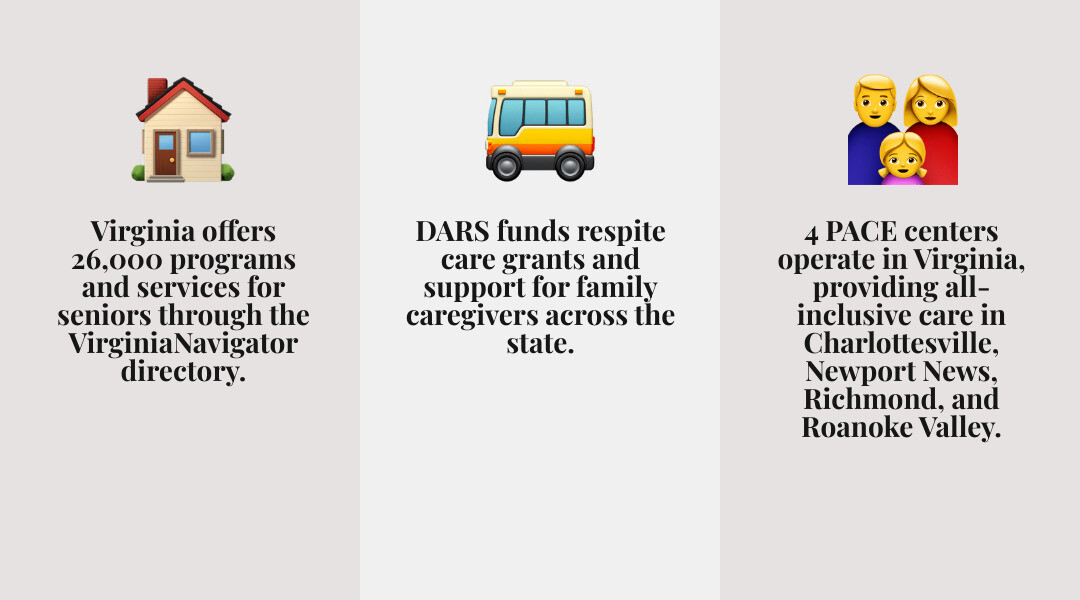
Choosing the right option is rarely simple. Virginia has over 26,000 programs and services for older adults listed through VirginiaNavigator alone. That's a lot to sort through — especially when you're already stretched thin trying to keep a parent safe, happy, and independent.
Most families start this search after a scare. A fall. A missed medication. A phone call where mom didn't quite sound like herself.
The good news: Virginia has strong public resources, a network of local Area Agencies on Aging (AAAs), and a growing range of private support options. Whether your parent wants to stay home or is ready for a community setting, there's a path forward.
This guide breaks down the five best options — side by side — so you can make a confident, informed decision.
Navigating the Landscape of Virginia Senior Care
When we start looking into virginia senior care, it often feels like entering a different country where everyone speaks a different language. You’ll hear acronyms like DARS, AAA, and ALF. Don’t worry; we’re here to translate.
In Virginia, the "front door" to aging services is usually the Aging Services - DARS (Department for Aging and Rehabilitative Services). They work alongside 25 local Area Agencies on Aging (AAAs) to provide everything from home-delivered meals to transportation and Medicare counseling.

For many of us, the goal is to keep our loved ones in the communities they love for as long as possible. This requires proactive Elderly Care Planning. Whether that means finding a community center in Richmond or a local support group in Virginia Beach, the Commonwealth has a robust infrastructure designed to support independent living.
Understanding In-Home Care and Personal Support in Virginia Senior Care
Many seniors in Virginia want to "age in place." This is where the distinction between medical care and lifestyle support becomes vital.
- Personal Concierge and Lifestyle Support: This is what we specialize in at Burnie's Way. Think of us as a virtual companion and personal assistant. We don't provide medical care or help with physical bathing; instead, we help with the "business of life." We coordinate appointments, help with technology, and provide the social connection that keeps the mind sharp. It’s about In-Home Elderly Help that focuses on confidence and independence.
- Non-Medical In-Home Care: These services typically involve "Activities of Daily Living" (ADLs). This includes help with dressing, grooming, and light housekeeping. Many families look for these Home Care Solutions when a loved one can no longer safely manage the physical demands of a house but doesn't need a nurse.
By combining these two — having a lifestyle concierge to manage the schedule and a home care aide for physical tasks — many Virginia seniors can avoid moving to a facility entirely.
Comparing Community-Based Virginia Senior Care Facilities
Sometimes, staying at home isn't the best fit. Maybe the house has too many stairs, or the social isolation is becoming too much. In these cases, Virginia offers several residential options.
- Independent Living: These are often apartment-style communities for active seniors. You get your own place, but you don't have to worry about mowing the lawn or fixing a leaky faucet.
- Assisted Living Facilities (ALFs): These are regulated by the Assisted Living Facilities (ALF) - Virginia Department of Social .... They provide housing, meals, and 24-hour supervision. It’s a step up in support from independent living and is a common choice for Long-Term Care in Virginia.
- Residential Care: Smaller, more "home-like" settings (often called adult care residences) can provide a more intimate environment than a large facility.
Specialized Support for Chronic Conditions and Memory Care
As of April 2026, we are seeing a significant increase in the need for specialized care for conditions like Alzheimer’s and Parkinson’s. Standard assisted living isn't always enough for a senior who is prone to wandering or needs intensive cognitive stimulation.

Virginia has specific licensing requirements for memory care units. These environments are designed with "secured" entries and exits to keep residents safe while allowing them the freedom to move within a protected space. If you are navigating this, our Dementia Elderly Care Complete Guide can help you understand the nuances of cognitive support.
| Feature | Standard Assisted Living | Specialized Memory Care |
|---|---|---|
| Staff Training | General senior care training | Specialized dementia/Alzheimer's training |
| Environment | Open, apartment-style | Secured, easy-to-navigate, "looped" hallways |
| Activities | Social outings, movies, fitness | Cognitive therapy, sensory activities, "reminiscence" therapy |
| Safety | Standard emergency pull-cords | 24/7 monitoring, delayed-exit doors |
For those who want to stay home while managing these conditions, Memory Care for Elderly can be provided through a combination of specialized home care agencies and high-touch lifestyle coordination to ensure medications and routines are strictly followed.
State Resources and Financial Assistance Programs
Let's talk about the elephant in the room: the cost. Virginia senior care is an investment. Whether you're looking at private pay or government assistance, you need a clear financial roadmap.
The Cost of Senior Home Care varies wildly depending on whether you are in Northern Virginia (where prices are higher) or the more rural parts of the Shenandoah Valley.
To help manage these costs, you can explore:
- Medicaid Waivers: Virginia offers "Commonwealth Coordinated Care Plus" (CCC Plus), which can help pay for home and community-based services for those who meet medical and financial eligibility.
- VA Benefits: For our veterans, the VA Community Care Network can be a lifesaver, providing credentialed in-home support.
- Long-Term Care Insurance: If your loved one had the foresight to get a policy years ago, now is the time to dust it off.
- Unclaimed Property: Did you know the Virginia Treasury's Unclaimed Property Division returns millions to citizens every year? It’s always worth a check to see if there are dormant accounts that could help fund care.
You can use the Find Virginia Nursing Homes and Assisted Living Communities tool to compare facilities and see which ones accept specific insurance types.
Frequently Asked Questions about Senior Care in Virginia
What is the PACE program in Virginia?
PACE stands for the Program of All-inclusive Care for the Elderly. It is a fantastic option for seniors who are 55 or older, live in a PACE service area, and are certified by the state as needing a "nursing home level of care" but want to remain at home.
InnovAge currently operates four PACE centers in Virginia:
- Charlottesville
- Newport News
- Richmond
- Roanoke Valley
These centers provide medical care, physical therapy, and social activities. They even handle transportation to and from the center. It’s an "all-in-one" model that integrates medical and social services to prevent nursing home placement.
How do I find my local Area Agency on Aging?
The AAAs are your best local resource. They are non-profits or local government entities that receive federal and state funding to help seniors. To find yours, you can visit the DARS website or use the VirginiaNavigator directory, which includes 26,000 programs and services across the state. They act as the "front door" to services like Meals on Wheels and local transportation.
What resources are available for family caregivers in Virginia?
We know that caregiving is a rewarding but exhausting mission. Virginia offers several "respite" programs designed to give family caregivers a break. DARS provides specific grants for this purpose.
Additionally, we recommend checking out our Family Caregiver Support Guide for tips on managing the emotional toll. There are also "Senior Employment Programs" for low-income older adults looking to stay active in the workforce, which can provide a sense of purpose and extra income.
Conclusion
Navigating virginia senior care doesn't have to be a solo journey. Whether you choose the all-inclusive model of a PACE program, the community of an assisted living facility, or the comfort of staying at home with specialized support, Virginia has the resources to help.
At Burnie's Way, we believe that independence is a precious thing. We don't provide medical "care," but we do provide the heart and the helping hand that makes staying at home possible. As a personal concierge and virtual companion, we coordinate the chaos of daily life so you can go back to being a son or daughter, and your loved one can go back to enjoying their life in the Commonwealth.
With over 50 years of collective experience, our personalized approach ensures that no senior in Virginia has to feel alone or overwhelmed. We are your partners in lifestyle coordination, helping you live the way you want, with the support you need.
Explore Our Services today to see how we can help your family find the perfect balance of independence and support.