
The Essential Caregiver Skills Checklist: Are You Ready for the Job?
What a Caregiver Skills Checklist Actually Covers (And Why It Matters)
A caregiver skills checklist is a structured tool that helps you verify whether a caregiver — professional or family — has the core competencies needed to provide safe, effective, and compassionate care. Here are the essential skill domains it should cover:
- Activities of Daily Living (ADLs) — bathing, dressing, toileting, feeding, mobility
- Physical safety skills — transfer techniques, gait belt use, fall prevention, body mechanics
- Health monitoring — vital signs, medication administration, wound care, infection control
- Communication and soft skills — active listening, patience, emotional presence, de-escalation
- Cognitive and dementia care — stage-specific support, validation techniques, behavioral management
- Safety awareness — home hazard recognition, emergency preparedness, abuse reporting
- Documentation and compliance — care plans, progress notes, HIPAA, agency policy adherence
- Cultural competency — respecting personal, cultural, and linguistic preferences
If you're trying to choose, evaluate, or become a better caregiver for an aging parent, getting clarity on these skill domains is the right starting point.
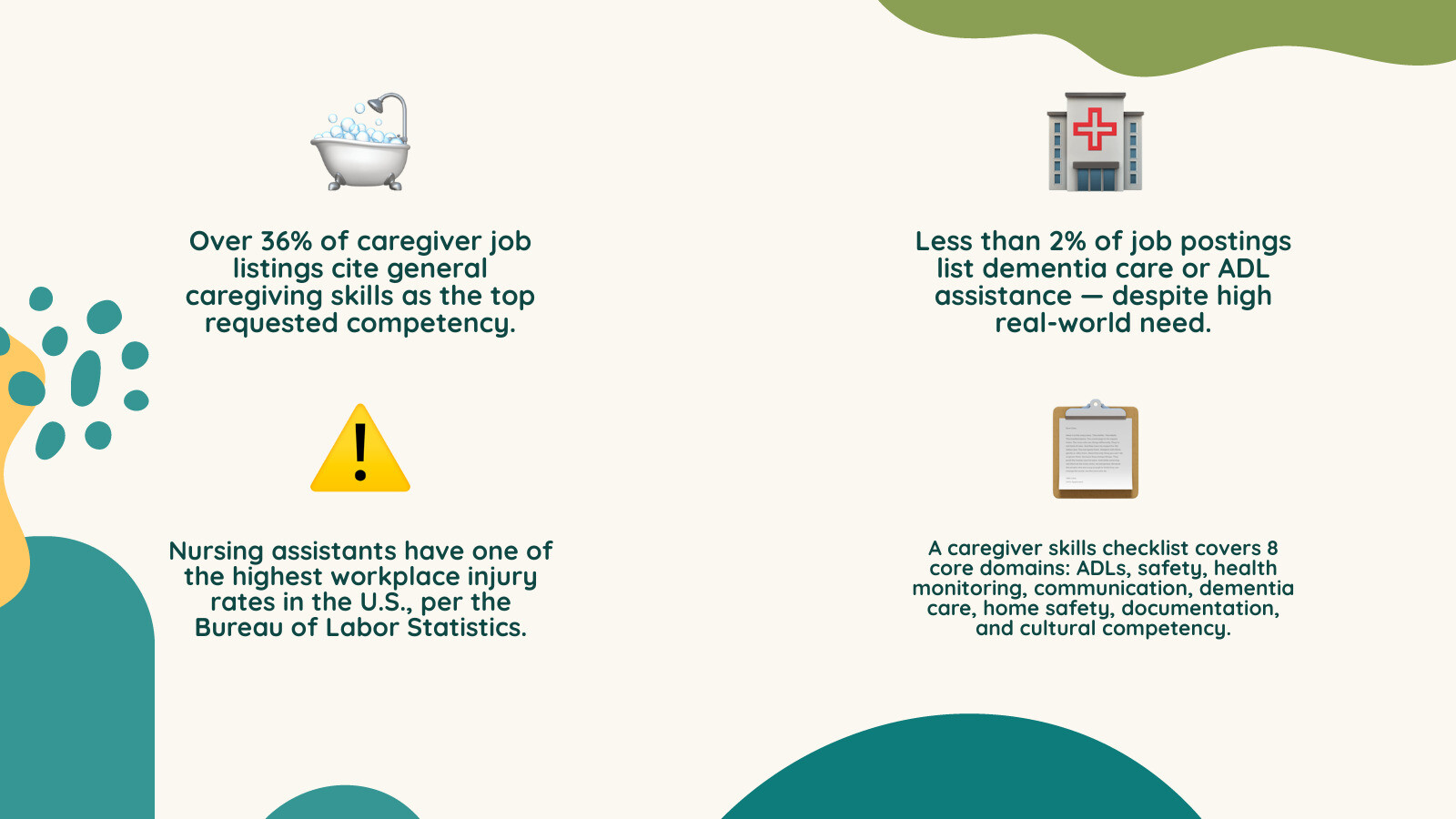
Caregiving is one of the most demanding jobs there is — and one of the most under-evaluated. According to data from Indeed job postings, general "caregiving" skills appear in over 36% of caregiver job listings, making it the single most requested competency. Yet specialized skills like dementia care and ADL assistance appear in fewer than 2% of postings — a gap that often leaves families uncertain about what to actually look for or ask about.
The stakes are real. The Bureau of Labor Statistics identifies nursing assistants and orderlies as having some of the highest workplace injury and illness rates of any occupation in the U.S. And for families coordinating care for a parent at home, a caregiver without the right skills isn't just ineffective — they can be a safety risk.
I'm Sydney Giffen, and in this guide I'll walk you through every major domain of a caregiver skills checklist — from hard clinical skills to soft interpersonal competencies — so you can evaluate care with confidence.
Caregiver skills checklist basics:
Core Domains of a Comprehensive Caregiver Skills Checklist
When evaluating or designing a comprehensive caregiver skills checklist, dividing competencies into operational domains ensures no critical safety or emotional need is overlooked. Whether you are managing home care in Henrico, setting up care for a relative in Midlothian, or conducting a professional audit, a complete checklist addresses the whole individual — balancing physical capabilities with interpersonal strengths.
Understanding the baseline Best Qualities and Skills Needed to Be a Caregiver (Complete Guide) helps establish what makes direct care both safe and dignified. The foundational domain centers around assistance with Activities of Daily Living (ADLs). A complete Caregiver ADL Checklist Complete Guide assesses proficiency in personal hygiene, dressing, toileting, and nutrition. Caregivers providing Personal Care for Elderly at Home must balance technical execution with personal respect, recognizing that receiving help with bathing or grooming can challenge an older adult’s sense of independence.
Equally critical is physical safety and environmental awareness. Proper body mechanics protect both the care recipient and the care provider from severe musculoskeletal injury. Beyond physical execution, caregivers must evaluate the physical space for hazards like poor lighting, cluttered pathways, or slippery surfaces. At Burnie's Way, while we do not provide hands-on direct caregiving, we work directly with families across the Richmond area — from Short Pump to Bon Air — to conduct free in-home senior safety assessments and install structural aging-in-place modifications. Ensuring that physical home environments support safe care delivery is essential for any caregiving strategy.
The Hard Skills Component in the Caregiver Skills Checklist
Hard skills represent the technical, measurable capabilities required to maintain physical health and prevent clinical complications. A robust caregiver skills checklist explicitly measures proficiency in execution, proper equipment operation, and clinical observation.

Key technical competencies include:
- Transfer Techniques and Equipment: Proper usage of gait belts, mechanical lifts (such as Hoyer or Kelly lifts), and slide boards. Caregivers must know how to assist with sit-to-stand movements, reposition bedridden individuals every two to three hours to avoid pressure injuries, and handle weight-bearing transitions safely.
- Vital Signs and Physical Observation: Accurate measurement and recording of blood pressure, heart rate, respiration rate, temperature, and pulse oximetry. Caregivers must recognize subtle physical changes — such as sudden localized swelling or unexplained lethargy — that signal medical issues.
- Wound Care and Infection Control: Applying sterile technique during basic dressing changes, recognizing signs of wound infection (redness, heat, discharge), maintaining hand hygiene, and implementing Standard Precautions with personal protective equipment (PPE).
- Medication Administration: Following the "five rights" of medication management (right patient, right medication, right dose, right route, right time), logging entries accurately, and observing potential side effects or drug interactions. For detailed strategies, review our guide on Medication Management Services.
- Fall Risk Mitigation: Conducting routine checks of client footwear, ensuring mobility devices are properly fitted, and applying targeted techniques from our Fall Prevention Home Tips Guide.
Soft Skills and Communication Competencies
While technical skills ensure physical safety, soft skills build trust, emotional security, and effective cooperation. A caregiver who excels at mechanical transfers but lacks patience or active listening skills may struggle when a resident or family member experiences fear or distress.
Core interpersonal competencies include:
- Active Listening and Therapeutic Communication: Giving full attention during conversations, verifying understanding without interrupting, and using clear, age-appropriate language. Caregivers must adapt their tone, slow their speech cadence, and maintain reassuring eye level contact rather than standing over a seated individual.
- Patience and Emotional Presence: Maintaining composure during repetitive questions, delayed physical responses, or resistive behaviors. Approaching care as a collaborative interaction rather than a task to rush preserves dignity.
- Cultural Competency and Personal Identity Preservation: Respecting diverse cultural traditions, dietary customs, religious observations, and personal preferences. According to the Administration for Community Living’s 2023 Profile of Older Americans, older Black, Hispanic, and Asian American populations are growing significantly. Matching cultural preferences and honoring life stories fosters authentic rapport.
- De-escalation and Behavioral Calm: Recognizing early triggers of frustration and using quiet vocal tones, non-threatening posture, and soft touch to reduce environmental tension. For deeper strategies on building emotional connections, consult our Companionship for Seniors Guide.
Specialized Dementia and Cognitive Care Competencies
Caregiving for individuals with cognitive decline requires specialized competencies that go far beyond standard physical care. Dementia, Alzheimer’s disease, and other neurocognitive conditions alter perception, language, and logic. Standard communication strategies — such as correcting facts or attempting logical persuasion — often increase distress rather than resolve it.
Research on dementia staff training reveals a stark reality: only 20% of traditional attendance-based training is successfully applied in practice. This highlights the vital need for a practical, competency-based caregiver skills checklist that measures observed behaviors rather than classroom attendance.
Behavioral and psychological symptoms of dementia (BPSD) — including agitation, resistance to care, repetitive questioning, and wandering — affect up to 90% of individuals living with cognitive loss. Effective cognitive care requires caregivers to view behavior as a primary form of communication. When a care recipient resists a bath or attempts to leave a setting, they are often expressing an unmet need, such as pain, coldness, fear, or sensory overload.
Essential dementia care skills include:
- The 10–20 Second Processing Pause: Allowing adequate time for cognitive processing after speaking before repeating or rephrasing statements. Rushing a response creates cognitive overload.
- Validation and Redirection: Meeting the individual in their perceived reality rather than enforcing reality orientation. For instance, if an older adult in a Chesterfield home expresses distress about needing to pick up her young children, a skilled caregiver validates her loving feelings ("You care so much about taking care of your family") before smoothly redirecting her to a meaningful activity.
- Non-Pharmacological De-escalation: Adjusting environmental variables — such as dimming overhead lights, muting television noise, or introducing soothing music — before resorting to medical interventions.
- Cognitive Engagement: Incorporating structured daily tasks that match the person's functional capacity, utilizing techniques detailed in our guides on Cognitive Stimulation Activities, Dementia Care at Home, and Memory Care for Elderly.
General Caregiving vs. Stage-Specific Dementia Care
Care requirements shift dramatically as cognitive conditions progress. A functional caregiver skills checklist distinguishes between general personal care and stage-specific dementia competencies:

- Early-Stage Support: Caregivers assist with executive function challenges — such as organizing schedules, managing complex household tasks, or remembering appointments — while supporting maximum independence.
- Mid-Stage Care: Caregivers manage behavioral changes, spatial disorientation, and sensory processing deficits. Strategic cueing, simple two-step options (e.g., holding up two shirts rather than opening a full closet), and routine validation become primary tools.
- Advanced-Stage Competencies: As verbal ability declines, caregivers rely on non-verbal observation tools like the Pain Assessment in Advanced Dementia (PAINAD) scale. Caregivers monitor breathing, vocalizations, facial expressions, and body language to detect discomfort or urinary tract infections early.
Integrating these specialized strategies into individualized plans ensures that identity and personal history are preserved at every stage, as highlighted in our examples for Caregiver Care Plan Examples for Elderly.
How to Use a Caregiver Skills Checklist for Self-Assessment and Training
A caregiver skills checklist serves as a vital diagnostic tool for professional growth, pre-employment evaluation, and personal safety awareness. Rather than treating a checklist as a static test, care workers and family members can use it as an ongoing self-assessment tool to pinpoint strengths, target training needs, and establish clear operational boundaries.
When utilizing a self-assessment, honesty is essential. Tools like the Self-Assessment for Caregivers explicitly instruct individuals not to mark a task if they are currently unable or unwilling to perform it. Distinguishing between willingness and capability is a crucial step in maintaining personal safety and delivery quality. A caregiver may be willing to perform a high-lift bed transfer, but without mastery of mechanical equipment or adequate physical strength, attempting the task puts both parties at risk of physical injury.
For professionals, checking competency standards against regional credentialing handbooks — such as the Skills - Virginia Nurse Aide - Handbook — ensures alignment with official state testing standards, including hand hygiene, privacy protection, and bed-to-wheelchair transfer protocols.
Performing a Self-Assessment with the Caregiver Skills Checklist
Executing a thorough self-assessment allows caregivers to conduct a structured skill gap analysis and take proactive steps toward professional development:
- Evaluate Physical and Technical Execution: Rate your ability to perform heavy transfers, operate specialized equipment, and handle personal hygiene duties safely.
- Assess Soft Skills and Stress Handling: Reflect on how you respond to agitation, repetitive questioning, or tight daily schedules.
- Identify Skill Gaps: Pinpoint specific areas needing formal instruction — such as advanced wound care, medication administration log formats, or dementia de-escalation techniques.
- Prioritize Self-Care and Mental Wellness: Evaluate emotional fatigue and stress levels. Caregiving demands high emotional presence; ignoring burnout reduces care quality and increases turnover.
- Commit to Continuous Skill Upgrading: Seek formal certifications (CNA, CPR, First Aid, Certified Dementia Practitioner) and regular continuing education.
Reviewing practical guides like our Caregiver Self-Care Checklist Guide 2026 and actionable strategies for Caregiver Stress Relief helps maintain physical stamina and long-term emotional resilience.
Adapting the Skills Checklist Across Care Settings and Agencies
Caregiving competencies do not exist in a vacuum — they must adapt to the operational context of the care environment. What works in a private home setting in Mechanicsville may require different operational reporting than care delivered in a residential memory care facility in Short Pump.
Professional home care agencies utilize checklists to streamline hiring and maintain strict regulatory compliance. Under federal standards like CMS 42 CFR §483, care facilities and licensed agencies are held accountable for individualized care planning, restraint avoidance, dignity preservation, and documented staff competencies. State regulatory surveys frequently cite deficiencies rooted in inadequate staff skills or improper dementia management.
Furthermore, given that Bureau of Labor Statistics data ranks direct care workers among the highest for occupational injuries, agencies that enforce mandatory skill verifications — particularly around Safe Patient Handling and Mobility (SPHM) — reduce workers' compensation claims and safeguard staff health.
When evaluating care recipient needs, agencies and families often use intake tools like the Assessment Checklist to Determine the Needs of a Care Receiver. Cross-referencing care receiver needs with caregiver skill self-assessments ensures safe client matching. For families exploring residential transitions, our Assisted Living Checklist and general Senior Safety Checklist provide additional clarity on environmental and care standards.
Frequently Asked Questions About Caregiver Skills Checklists
What is the main difference between general caregiving skills and dementia care competencies?
General caregiving skills focus primarily on physical assistance with Activities of Daily Living (ADLs), such as bathing, dressing, meal preparation, medication monitoring, and mobility transfers. In contrast, dementia care competencies focus on specialized cognitive and behavioral communication strategies. These include using validation therapy instead of reality correction, applying a 10–20 second processing pause during speech, identifying non-verbal cues of pain using tools like the PAINAD scale, and applying non-pharmacological de-escalation methods for behavioral symptoms (BPSD).
Which core certifications should be included on a caregiver skills checklist?
A comprehensive checklist should verify foundational clinical and emergency response credentials, including:
- Certified Nursing Assistant (CNA) or Home Health Aide (HHA) state credentials
- Basic Life Support (BLS) or CPR certification
- Standard First Aid certification
- Certified Dementia Practitioner (CDP) or specialized dementia training credentials
- Medication Administration Training (MAT) where state regulations apply
How does a skills checklist help prevent caregiver stress and burnout?
A skills checklist prevents burnout by clearly defining operational boundaries, physical capabilities, and skill limits before care begins. By identifying gaps early — such as a lack of training in heavy mechanical lifts or behavioral management — caregivers can request appropriate equipment, assistance, or specialized training rather than taking on unsafe tasks. Establishing clear skill boundaries reduces physical injuries, lowers emotional fatigue, and builds confidence in care delivery.
Conclusion
A comprehensive caregiver skills checklist is more than a list of duties — it is an essential foundation for safety, care quality, and peace of mind. Whether you are a professional care worker assessing your technical competencies or a family member coordinating care for a loved one in Richmond, Henrico, or Chesterfield, getting clear on core skills ensures that daily care is delivered with safety, efficiency, and deep respect.
However, even the most skilled caregiver cannot prevent accidents if the physical home environment presents built-in fall hazards. Inadequate bathroom grab bars, steep stairs, narrow doorways, and poor lighting create constant safety risks for aging adults and physical strain for caregivers.
At Burnie's Way, we believe true home safety requires aligning hands-on care competency with a secure physical environment. While we are not a home care agency, we partner with families throughout the greater Richmond area — including Glen Allen, Innsbrook, Midlothian, and Bon Air — to assess and modify homes for safe, independent living.
Our team provides free, comprehensive In-Home Senior Safety Assessments to identify structural hazards before fall incidents occur. From professional grab bar installations and curbless shower conversions to stair lifts, ramps, slip-resistant flooring, and widened doorways, we build aging-in-place modifications tailored to your family's needs.
Ready to make your home or your loved one's living space safe and accessible? Explore Burnie's Way specialized senior home services today to book your free in-home safety assessment and take the first step toward lasting safety and independence.