12 min read
Beyond the Basics: A Comprehensive Guide to Eldercare Services
Why Understanding Eldercare Services Matters Now More Than Ever Eldercare services help older adults live safely and independently at home by...

Assistance caring for elderly parents comes in many forms — from financial aid and home modifications to professional support services and caregiver respite. Whether you're noticing warning signs in your parent's daily life or feeling overwhelmed by the demands of caregiving, understanding your options is the first step toward creating a sustainable support system.
Financial & Legal:
Home-Based Support:
Caregiver Resources:
Long-Term Options:
"There are only four kinds of people in the world — those who have been caregivers, those who are currently caregivers, those who will be caregivers, and those who will need caregivers." — Rosalynn Carter
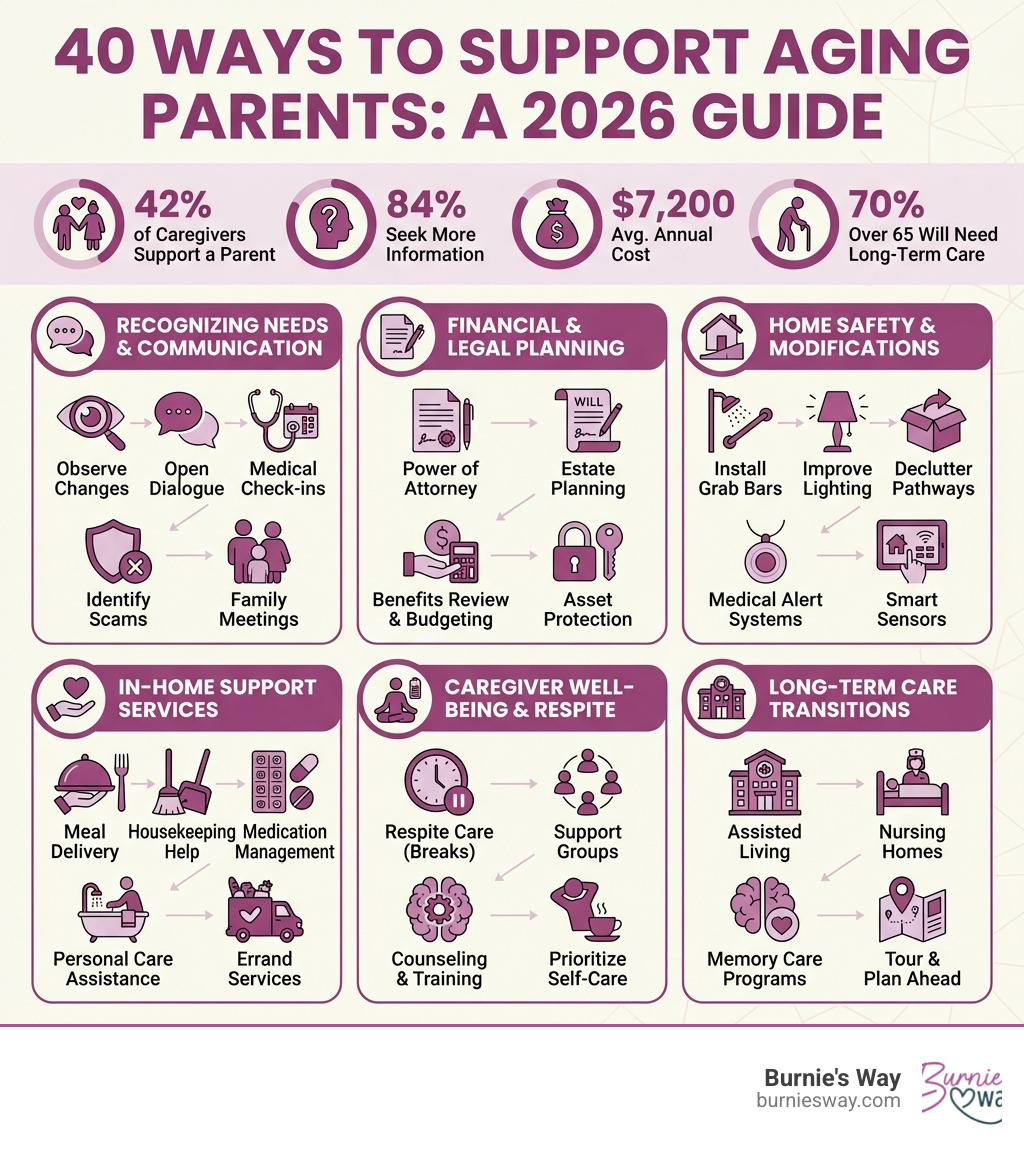
This truth hits home for millions of families. Today, about 1 in 4 Americans are caregivers, with 42% specifically caring for a parent. The reality? Most spend an average of 24 hours each week providing support, often while juggling jobs and other responsibilities. And 84% of those caregivers say they want more information on how to do it well.
The financial burden is real too. Caregivers spend an average of $7,200 per year out of pocket, and 39% have had to stop working entirely to provide needed support.
But here's the good news: you don't have to figure this out alone. A wealth of resources exists — from government programs and nonprofit organizations to professional support services and community networks. The challenge isn't that help doesn't exist. It's knowing where to find it and how to access it when you need it most.
This guide walks you through 40 concrete ways to support your aging parents, covering everything from recognizing early warning signs to managing the emotional complexities of role reversal. We'll explore financial assistance programs many families don't know exist, home modifications that prevent falls and maintain independence, and strategies for protecting your own well-being while providing compassionate support.

Assistance caring for elderly parents terms to know:

Knowing when to step in is one of the hardest parts of the journey. Often, our parents want to maintain their independence—and we want that for them, too. However, waiting for a crisis like a fall or a medical emergency can limit your options.
Geriatricians often suggest looking at "Instrumental Activities of Daily Living" (IADLs). These are the skills needed to live independently in a community, such as managing finances, handling transportation, shopping, and keeping up with home maintenance. When these start to slip, it’s a signal that assistance caring for elderly parents is becoming necessary.
At Burnie’s Way, we believe in senior life management that prioritizes dignity. We don't provide clinical care, but we act as a personal concierge to help coordinate the logistics of daily life so these "slips" don't turn into disasters.
Keep an eye out for subtle changes. Is the mail piling up? Are there scorched pots in the kitchen?
Recognizing these signs early allows for better elderly care planning, ensuring your parents stay safe while remaining in the home they love.
Talking about help can feel like a role reversal that neither side is ready for. The key is to start slow. Instead of saying, "You can't drive anymore," try asking, "How is the driving going for you lately?"
Use "I" statements to express your concerns without sounding like you are blaming them. For example, "I feel worried when I see the stairs are getting difficult for you." If the conversation stalls, involving a neutral third party—like a doctor, a faith leader, or a professional specializing in senior care coordination—can help keep things objective and calm.
The administrative side of aging is complex. Without the right paperwork, you might find yourself locked out of important medical or financial decisions. Essential documents include a Durable Power of Attorney (for finances), a Healthcare Proxy, and a HIPAA release form. These legal tools are the backbone of effective elderly care planning.
Many families are surprised to learn about "found money" available through various programs. While the cost of senior home care can be high, these resources can offset out-of-pocket expenses:
If your parent has a life insurance policy, it might be a source of immediate funding.
To find more local resources, the Eldercare Locator is an invaluable public service. You can also use the BenefitsCheckUp tool from the National Council on Aging to see what state or federal programs your parents qualify for. This is a vital part of comprehensive elder care support.
Most seniors—about 77%—want to stay in their own homes as they age. To make this possible, the environment must be safe. Simple elderly home modifications can prevent the falls that often lead to a loss of independence.
Start with these high-impact changes:
You don't have to do everything yourself. Bringing in targeted help can make a world of difference:
These types of daily life assistance allow your parent to focus on enjoying their day rather than struggling with chores. If you need more hands-on help, exploring in-home elderly help can provide the extra layer of safety needed to stay at home.
Technology can act as a "virtual assistant" for both you and your parent. Here are some top-rated apps to help with senior care coordination:
You cannot pour from an empty cup. Caregiving is physically and emotionally demanding, and burnout is a real risk. Statistics show that 84% of caregivers want more information on managing stress. Prioritizing your own health is not selfish—it is a requirement for providing good elder care support.
Respite care provides a temporary break for the primary caregiver. It can last a few hours or a few weeks.
Exploring elderly inhome care options for respite can give you the peace of mind to step away and recharge.
Don't be a hero. If friends or siblings ask how they can help, give them a specific task. "Can you handle Dad's grocery shopping on Tuesdays?" is much more effective than "I'm fine, thanks."
Resources like the Family Caregiver Alliance provide wonderful support groups and educational materials. Building a network of reliable home care and family support ensures that the care is sustainable for the long haul.
Sometimes, despite our best efforts, a parent's needs exceed what can be safely managed at home. This is especially true when dealing with advanced dementia, where memory care for elderly becomes a necessity for their safety.
When vetting a facility, don't just look at the lobby. Visit during a mealtime to check the food quality and observe how staff interact with residents. Ask about staff-to-resident ratios and what their safety standards are for emergencies.
| Feature | Home Support | Assisted Living |
|---|---|---|
| Independence | High | Moderate |
| Social Interaction | Requires effort | Built-in |
| Cost | Variable | Fixed monthly |
| Safety | Modified for home | Professional 24/7 |
Every family is different, which is why custom care plans are so important when making these transitions.
The move to a facility often brings up feelings of guilt for the child and loss for the parent. Acknowledge these feelings. Focus on the benefits—better safety, more social opportunities, and a return to being a "daughter" or "son" rather than a "manager."
Professional senior life management can help with the logistics of downsizing and moving, making the physical transition less of a burden so you can focus on the emotional support your parent needs.
Warning signs include wandering, leaving the stove on, frequent falls, or an inability to manage basic hygiene. If they can no longer be left alone safely for even an hour, it may be time to consider 24/7 support or a facility.
Most people use a combination of personal savings, long-term care insurance, and eventually Medicaid once assets are depleted. Veterans should always check for Aid and Attendance benefits, and those with life insurance should look into settlements.
Communication with your employer is key. Check if your company offers an Employee Assistance Program (EAP) or if you are eligible for the Family and Medical Leave Act (FMLA). Use technology to coordinate tasks and don't hesitate to hire personal support for errands and daily logistics.
Providing assistance caring for elderly parents is a journey of love, but it doesn't have to be a journey of exhaustion. By recognizing the signs early, tapping into financial resources, and modifying the home environment, you can help your parents live with the dignity they deserve.
At Burnie’s Way, we understand that you want the best for your loved ones. We aren't a medical provider, but we are your personal concierge and lifestyle coordinator. Think of us as a virtual companion and personal assistant who helps manage the "everything else" of daily life. From coordinating trusted services to ensuring routines stay on track, we give families in Virginia and across the U.S. the peace of mind that everything is okay.
Let us help your loved one stay independent and connected. Explore more info about our services today and see how we can support your family's unique journey.
12 min read
Why Understanding Eldercare Services Matters Now More Than Ever Eldercare services help older adults live safely and independently at home by...
7 min read
Why Emergency Senior Care Matters for Your Family Emergency senior care refers to immediate support services available when an older adult faces an...
8 min read
Why Senior Care Planning Matters Now More Than Ever Senior care planning is the process of preparing for an aging loved one's future needs—from...